



ABSTRACT:
OBJECTIVE: We systematically analyzed the age of substance use initiation across continents,
examined temporal trends, and tested demographic moderators.
METHODS: Following the Preferred Reporting Items for Systematic Reviews and Meta-Analyses guidelines,
we searched PubMed, ISI Web of Science, PsycArticles, and Scopus in April 2024 without
restrictions on study design or sampling method. We estimated pooled mean ages through
random-effects meta-analyses with multilevel modeling and explored heterogeneity through
meta-regressions.
RESULTS: A total of 304 studies comprising 771 samples were included. The estimated global
age of first use was 16.1 years for alcohol (standard error [SE] = 0.2), 16.1 years
for nicotine (SE = 0.2), 16.5 years for cannabis (SE = 0.2), and 17.2 years for inhalants
(SE = 0.6). Hallucinogens (18.4, SE = 0.5), amphetamines (20.5, SE = 0.4), sedatives
(20.7, SE = 0.5), cocaine (20.8, SE = 0.3), and opioids (21.2, SE = 0.3) had significantly
later onsets (p < 0.001). Age of first use increased significantly in recent decades,
particularly for alcohol (+0.06, p = 0.013) and stimulants (+0.12, p = 0.002). Geographically,
initiation occurred earlier in South America (-2.2 years, p = 0.004) and later in
Asia (+2.1 years, p < 0.001). Demographic characteristics such as sex (p = 0.007),
the sample's mean age (p < 0.001), and risk level for problematic substance use (p
= 0.002) were also significantly associated with heterogeneity estimates.
CONCLUSIONS: Although the age of first substance use has increased in recent decades, earlier initiation
has been consistent in South America. These findings highlight persistent geographic
and demographic disparities that are relevant for prevention policies.
REGISTRATION NUMBER: PROSPERO CRD42024596884.
Keywords: Substance use; geography; age of onset; drug-seeking behavior; review.
FIGURES
| Note: How to cite this article: Monteiro IT, Simon AC, Schmitt BV, Dallarosa GT, Viola TW. Global patterns in age of substance use initiation: a systematic review and meta-analysis of continental and temporal trends in 58 countries. Braz J Psychiatry. 2026;48:e20254422. Epub 2025 Dec 23. http://doi.org/10.47626/1516-4446-2025-4422 |
| Received: July 09 2025; Accepted: December 09 2025 |
INTRODUCTION
The use of psychoactive substances, such as alcohol, nicotine, cannabis, and other illicit or prescription drugs, is a significant global public health issue. Early initiation of substance use is particularly concerning, as it has been consistently associated with a range of negative long-term outcomes.1,2 These include increased vulnerability to substance use disorders, cognitive deficits, poor academic performance, impaired social functioning, and an elevated risk of psychiatric conditions in later life, such as depression and anxiety.3-5
Understanding epidemiological trends about the point at which individuals first begin using substances may help identify high-risk populations and inform prevention strategies.6 However, the age of substance initiation may vary across different substances, demographic profiles, and geographical regions.7,8 Such variations would likely be influenced by a complex interplay of factors, including the availability and legal regulation of substances, cultural norms regarding drug use, socioeconomic status, public health policies, and social or individual vulnerability.9-11
Although epidemiological surveys conducted across various countries have provided insight into substance use patterns, few studies have comprehensively synthesized these findings to produce global estimates of the age of initiation across multiple substances and geographical regions.12,13 Moreover, the determinants of substance use initiation in youth are dynamic, varying across generations, and it remains uncertain whether recent societal changes have advanced or postponed the global age of first substance use.
To address these gaps, we conducted a systematic review and meta-analysis of the global literature on the age of first substance use. Our aims were to: 1) estimate the pooled mean age of first major psychoactive substance use; 2) assess temporal trends in age of initiation over time; 3) evaluate variations across continents; and 4) investigate the influence of sample and study characteristics, including sex distribution, mean age of the sample, clinical risk level for problematic substance use, and national income classification, on the age of substance initiation through univariate and multivariate meta-regression models. This study contributes to a growing body of research seeking to contextualize global substance use trends among youth, potentially informing broader public health and policy frameworks.
METHODS
The review was conducted in accordance with the Preferred Reporting Items for Systematic Reviews and Meta-Analyses guidelines. The protocol was finalized prior to conducting the systematic review and was registered in PROSPERO (CRD42024596884). The search was performed in April 2024.
Search strategy
No restrictions were placed on the language of publication. The following databases were searched: PubMed, ISI Web of Science, PsycArticles, and Scopus. The search terms used were: ("age of first use" OR "age at initiation" OR "age at onset" OR "age of initiation" OR "age at first use" OR "use onset" OR "consumption onset") AND (alcohol OR tobacco OR nicotine OR cannabis OR marijuana OR smoking OR cocaine OR opioid OR morphine OR heroin OR fentanyl OR amphetamine OR "illicit drugs" OR "drug dependence" OR "substance use disorder" OR addiction OR "substance-related disorders"). The Boolean query, including the search terms and use of quotation marks, was identical across databases. Eligibility was determined by four researchers, initially based on the title and abstract, followed by a full-text review in a second step. The researchers were divided into pairs to select studies independently, and conflicts were resolved through group discussion.
Eligibility criteria
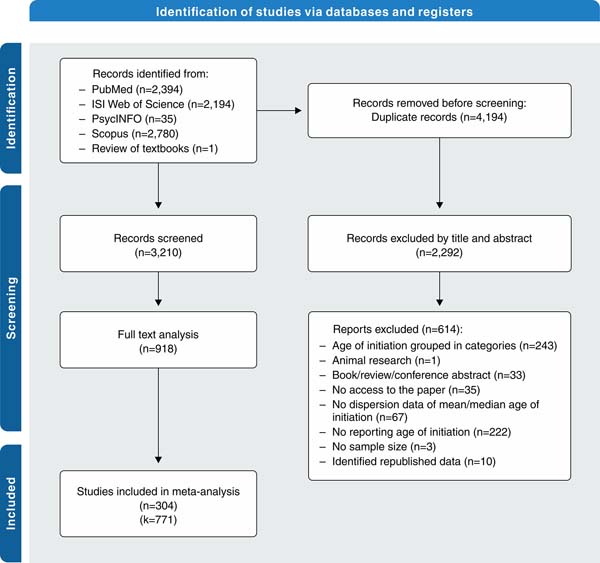
No restrictions were imposed on study design or sampling method. During the title and abstract screening, the following records were excluded: articles or book chapters, conference abstracts or proceedings, experimental studies involving cells, animals, or in vitro models, or studies clearly indicating an absence of data on age of first substance use. In the subsequent full-text analysis, additional exclusion criteria included studies that did not report the age of initiation, those reporting the age of initiation only as grouped categories (e.g., percentages by age groups), studies lacking dispersion measures (e.g., SD) for mean or median ages, missing sample size information, animal studies, and republished data. Some studies included the percentage of individuals who reported experimentation with a given substance, and therefore, the sample size was adjusted using such values. The study selection process is outlined in Figure 1.
Data extraction
We collected information on the following variables: country of publication or data collection, year of publication or data collection, sample characteristics, sample size, sample age, percentage of male participants, substance description and percentage of use, age of onset (mean or median), and dispersion estimates. The included studies could contribute multiple data entries when presenting samples or stratified information that could influence age estimates of first substance use.
Four main criteria were established to allow this multiplicity of entries. 1) Stratification by clinical, psychiatric, or sample-type characteristics, i.e., studies presenting differentiated samples (such as individuals with and without psychiatric disorders or individuals with and without clinical problems related to substance use). Studies including both community samples and clinical samples (e.g., patients from specialized mental health or substance use services) also contributed distinct entries, since these characteristics could influence the estimated age of first use. 2) Stratification by sex: studies providing disaggregated data for men and women contributed distinct entries for each gender, considering potential sex differences in estimates of the age of first substance use. 3) Stratification by geographical location: when a study included data from multiple countries, each country was treated as a separate entry, reflecting possible variations arising from geographical and cultural contexts. 4) Temporal stratification: for studies reporting data from multiple years, age of first use estimates were included only for the earliest and most recent years. If two entries were = 2 years apart, only the entry with the larger sample size was included. This strategy aimed to reduce the overrepresentation of data entries from a single study with a time-series analysis while still capturing meaningful temporal variations.
Multiple entries from the same study based on ethnic data were not considered, given the infrequent stratification of data on age of first substance use by ethnicity. Likewise, multiple entries based on genetic variants were excluded, as investigating genetic factors related to age at first substance use was beyond the scope of this study. When studies involved groups that did not fit the four above-described criteria, the selected group always had the largest available sample size.
Moreover, to prevent double counting between studies, we screened for overlapping cohorts/samples by cross-checking author groups, study sites and recruitment periods, cohort names/registry identifiers (when available), sample sizes, and sample descriptions. When overlap was identified, we retained a single study based on the following hierarchy: 1) the largest sample size; 2) the most complete data for the outcomes/covariates included in the meta-analysis.
Outcome
Mean (SD) values of the age of first substance use were extracted from each study when explicitly available. When these measures were not reported directly, they were estimated as follows: 1) median values were considered equivalent to means; 2) standard error (SE) was converted to SD by multiplying the reported SE by the square root of the sample size; 3) IQR was converted to SD by dividing the IQR by 1.35, assuming an approximate normal distribution; and 4) when studies reported 95% CI rather than SD, these intervals were first converted to SE by dividing their range by 3.92, because a 95% CI typically spans 1.96 SE above and below the mean (1.96 × 2 = 3.92). The resulting SE was then converted to an SD by multiplying by the square root of the sample size. Data provided only in graphics were extracted using Get Data 2.26.0.20.
Potential moderators
Potential moderators were divided into categorical and numerical variables. Categorical moderators included continent, income level, and sample risk level for problematic substance use. Continents were categorized as North America, South America, Europe, Africa, Oceania, and Asia. Country income level was considered high or middle/low according to World Bank classification. The sample risk level for problematic substance use was classified into three groups: low (samples of community-dwelling individuals without clinical problems or substance-related issues), moderate (samples including individuals engaging in recreational substance use, diagnosed with psychiatric disorders other than substance use disorders, or experiencing clinical conditions such as HIV), and high (samples including individuals diagnosed with substance use disorders). Numerical moderators included the year of data collection (when not explicitly reported, the year of publication was used), the percentage of male participants, and the mean age of participants.
To assess risk of bias in the included studies, we assessed only domains relevant to our outcome. Thus, five binary (low- vs. high/unclear-risk) domains were applied to every included study: 1) representative sampling frame - use of a random or probability-based design aimed at the general community (low risk) vs. any convenience or clinical frame (high/unclear); 2) precise exposure assessment - explicit reporting of the proportion of participants who had ever used the focal substance and a clear definition of "ever use" (low) vs. absent or ambiguous information (high/unclear); 3) age-data reporting - providing a mean (or median) sample age (low) vs. nonreporting (high/unclear); 4) sex-data reporting - providing the percentage of male participants (low) vs. nonreporting (high/unclear); and 5) temporal context reporting - reporting the calendar year(s) in which data were collected (low) vs. nonreporting, i.e. publication year only (high/unclear). Each domain was scored 1 (low risk) or 0 (high/unclear), resulting in total scores from 0 to 5.
Data analysis
Given that some studies could contribute to more than one sample, the assumption of independence between outcomes was violated. Therefore, to take possible between- and within-study differences into consideration, a multilevel approach to meta-analysis was used to accommodate the presence of non-independent mean estimates in the overall sample, with a 2-level hierarchical data structure in which samples within studies were nested with samples between studies. Additionally, for studies reporting the percentage of individuals who used with a given substance, the sample sizes were adjusted accordingly.
We first generated an overall pooled-raw mean estimated age of first substance use through multilevel meta-analytic models with the restricted maximum likelihood estimator. Study-level weights were assigned using the inverse-variance method, incorporating both the sampling variance (SE) of each study and the estimated between-study variance (t2 ). Individualized datasets were then produced for the following substances: nicotine, alcohol, cannabis, stimulants (cocaine and amphetamines), opioids, and non-specific drugs (inhalants, sedatives, hallucinogens, or, when studies generalized illicit drug consumption). We performed meta-regression analyses to assess the moderating effects of geographical, temporal, and study-characteristic variables on mean estimated age of first substance use, using both univariate and multivariate models. Heterogeneity was evaluated usingQ statistics. In the multivariate model, only variables with significant contributions to heterogeneity in univariate analysis were retained.
The proportional reduction in total heterogeneity variance-accounted-for (VAF) was computed for each meta-regression model as a pseudo R2measure. These estimates were derived from simpler, non-multilevel (i.e., single-level) models, which provide an approximate indication of the explanatory power of the moderators. Parameter estimates were reported with 95% CIs. All analyses were conducted in R 2.10.0 using themetaforpackage 0.5-7.
RESULTS
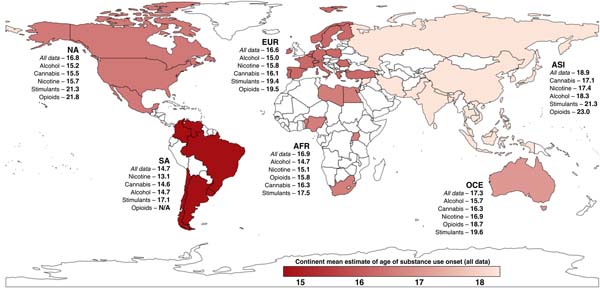
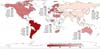
The search yielded 3,210 studies that potentially reported estimated age of first substance use. After the eligibility criteria were applied, 304 studies comprising 771 samples were included in the analysis (reference list, Supplementary Material S1). This analysis incorporated data from 58 countries: 18 from Europe (31%), four from North America (6.8%), 23 from Asia (39.6%), six from Africa (10.3%), six from South America (10.3%), and one from Oceania (1.7%). In terms of continental contribution, North America accounted for nearly half (48%) of the samples used in the analysis (Figure 2), followed by Europe (20%), Asia (17%), South America (7%), Oceania (5%), and Africa (3%). The risk of bias assessment for the included studies is presented in Supplementary Table S1 (available as a spreadsheet file for download), with a mean score of 3.6 out of 5.
Of the 771 samples, 26.5% reported age at first use of nicotine (k = 205), followed by alcohol (23.6%, k = 182), cannabis (19.3%, k = 149), stimulants (12.7%, k = 98, amphetamines/cocaine), opioids (6.9%, k = 53), sedatives (2.2%, k = 17), inhalants (1.8%, k = 14), and hallucinogens (1.6%, k = 13). Five percent (k = 40) of the samples did not specify a particular substance and were categorized as "non-specific drugs."
Comparisons between substances
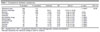
A meta-analysis was initially conducted with substance type included as a moderator of heterogeneity. This model was significant (Q = 446.89, p < 0.0001) and accounted for approximately 25% of the variance in age of initiation estimates (Table 1). Alcohol was considered the reference substance, with a global estimated age at first use of 16.07 years (SE = 0.25), followed by nicotine (16.09, SE = 0.23), cannabis (16.45, SE = 0.24), and inhalants (17.20, SE = 0.61), none of which differed significantly from alcohol. In contrast, the age of first use for hallucinogens (18.44, SE = 0.59), amphetamines (20.53, SE = 0.40), sedatives (20.72, SE = 0.52), cocaine (20.83, SE = 0.33), and opioids (21.23, SE = 0.37) was significantly (all p-values < 0.001) later than alcohol.
| N (studies) | K (samples) | Estimate | SE | 95%CI | p-value | VAF (%) | |
|---|---|---|---|---|---|---|---|
| Substance type | 304 | 771 | < 0.0001 | 24.89 | |||
| Alcohol (intercept) | 127 | 182 | 16.07 | 0.25 | 15.57 to 16.56 | - | |
| Nicotine | 133 | 205 | +0.02 | 0.23 | -0.43 to 0.48 | 0.921 | |
| Cannabis | 113 | 149 | +0.38 | 0.24 | -0.09 to 0.85 | 0.110 | |
| Inhalants | 12 | 14 | +1.13 | 0.61 | -0.06 to 2.34 | 0.064 | |
| Non-specific drugs | 33 | 40 | +1.72 | 0.41 | 0.92 to 2.53 | < 0.0001 | |
| Hallucinogen | 10 | 13 | +2.37 | 0.59 | 1.22 to 3.53 | < 0.0001 | |
| Amphetamines | 35 | 44 | +4.46 | 0.40 | 3.66 to 5.26 | < 0.0001 | |
| Sedatives | 13 | 17 | +4.65 | 0.52 | 3.63 to 5.67 | < 0.0001 | |
| Cocaine | 42 | 54 | +4.76 | 0.33 | 4.10 to 5.42 | < 0.0001 | |
| Opioids | 42 | 53 | +5.16 | 0.37 | 4.44 to 5.89 | < 0.0001 |
SE = standard error; VAF = proportional reduction in total heterogeneity variance-accounted-for.
Intercept represents the reference category used for analysis.
Effect of year of data collection/publication
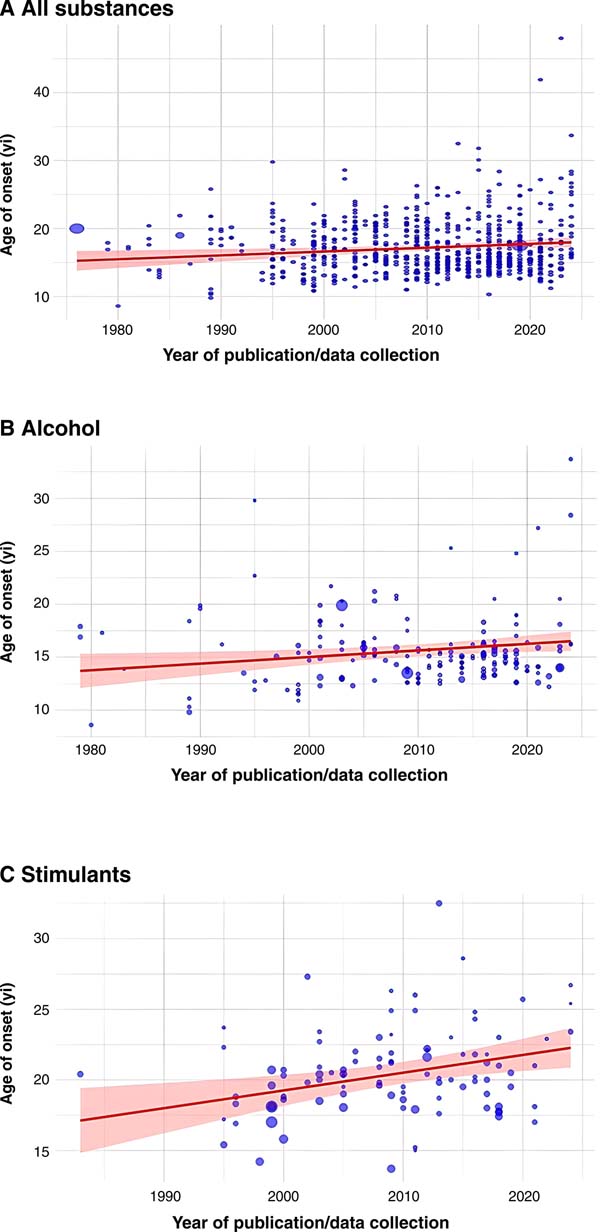
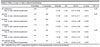
A series of univariate meta-regressions was conducted, including year of data collection/publication as a moderator of heterogeneity. An initial model incorporating all samples, regardless of substance type, yielded a significant result (Q = 7.52, p = 0.006) (Table 2), indicating increased estimated age of first substance use over time (+0.05, SE = 0.02) (Figure 3A).
| N (studies) | K (samples) | Estimate | SE | 95%CI | p-value | VAF (%) | |
|---|---|---|---|---|---|---|---|
| All substances | 304 | 771 | 0.26 | ||||
| Year of data collection/publication | +0.05 | 0.02 | 0.01 to 0.09 | 0.007 | |||
| Alcohol | 127 | 182 | 0.29 | ||||
| Year of data collection/publication | +0.06 | 0.02 | 0.01 to 0.11 | 0.013 | |||
| Nicotine | 133 | 205 | - | ||||
| Year of data collection/publication | +0.03 | 0.03 | -0.02 to 0.09 | 0.358 | |||
| Cannabis | 113 | 149 | - | ||||
| Year of data collection/publication | +0.002 | 0.02 | -0.03 to 0.04 | 0.920 | |||
| Stimulants | 60 | 98 | 4.88 | ||||
| Year of data collection/publication | +0.12 | 0.04 | 0.04 to 0.20 | 0.002 | |||
| Opioids | 42 | 53 | - | ||||
| Year of data collection/publication | +0.08 | 0.06 | -0.03 to 0.21 | 0.168 | |||
| Non-specific drugs | 52 | 84 | - | ||||
| Year of data collection/publication | +0.06 | 0.04 | -0.03 to 0.15 | 0.205 |
SE = standard error; VAF = proportional reduction in total heterogeneity variance-accounted-for.
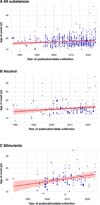
Subsequent models were stratified by substance group. Cocaine and amphetamines were combined into a single "stimulants" category, while sedatives, inhalants, and hallucinogens, due to their low representation, were grouped into the "non-specific drugs" category. Significant effects of year of data collection/publication were observed for alcohol (Q = 6.06, p = 0.013, +0.06, SE = 0.02) (Figure 3B) and stimulants (Q = 9.15, p = 0.002, +0.12, SE = 0.04) (Figure 3C), both showing a trend toward later initiation in more recent years. No significant effects were found for nicotine, cannabis, opioids, or non-specific drugs.
Continent comparisons
An initial model including continent as a potential moderator of heterogeneity, incorporating all samples regardless of substance type, yielded a significant result (Q = 36.05, p < 0.001) (Table 3). Using North America as the reference category, the age of first substance use was later in Asia (+2.13 years, SE = 0.47, p < 0.001) and earlier in South America (-2.18, SE = 0.75, p = 0.004). These estimates are shown in Figure 2. In a secondary analysis including all substance types, we compared 16 countries with at least 10 available samples (Q = 68.78, p < 0.001) (Table 4) to identify potential country-level differences. Using the United States as the reference, we found significant differences for Argentina (-2.65 years old, SE = 1.23, p = 0.031), China (+4.51, SE = 0.93, p < 0.001), and India (+2.00, SE = 0.71, p = 0.005).
| N (studies) | K (samples) | Estimate | SE | 95%CI | p-value | VAF (%) | |
|---|---|---|---|---|---|---|---|
| All substances | |||||||
| Continent | 303 | 770 | < 0.001 | 6.83 | |||
| North America (intercept) | 138 | 367 | 16.8540 | 0.2910 | 16.2836 to 17.4244 | - | |
| South America | 19 | 57 | -2.1840 | 0.7582 | -3.6702 to -0.6979 | 0.0040 | |
| Europe | 70 | 150 | -0.2596 | 0.5057 | -1.2508 to 0.7316 | 0.6077 | |
| Africa | 9 | 21 | 0.0481 | 0.9908 | -1.8938 to 1.9900 | 0.9613 | |
| Oceania | 15 | 41 | 0.5574 | 0.9435 | -1.2919 to 2.4066 | 0.5547 | |
| Asia | 66 | 134 | 2.1350 | 0.4713 | 1.2114 to 3.0587 | < 0.001 | |
| Nicotine | |||||||
| Continent | 133 | 205 | < 0.001 | 5.72 | |||
| North America (intercept) | 62 | 81 | 15.7846 | 0.4663 | 14.8706 to 16.6987 | - | |
| South America | 8 | 12 | -2.6235 | 1.2870 | -5.1460 to -0.1010 | 0.0415 | |
| Europe | 29 | 42 | 0.0114 | 0.8200 | -1.5958 to 1.6186 | 0.9889 | |
| Africa | 3 | 4 | 0.7018 | 1.3621 | -1.9679 to 3.3715 | 0.6064 | |
| Oceania | 5 | 8 | 1.2264 | 1.8700 | -2.4388 to 4.8916 | 0.5119 | |
| Asia | 31 | 58 | 1.7509 | 0.6029 | 0.5692 to 2.9325 | 0.0037 | |
| Alcohol | |||||||
| Continent | 127 | 182 | < 0.001 | 19.03 | |||
| North America (intercept) | 67 | 93 | 15.2237 | 0.3275 | 14.5819 to 15.8655 | - | |
| South America | 13 | 18 | -0.5663 | 0.6346 | -1.8101 to 0.6776 | 0.3722 | |
| Europe | 23 | 31 | -0.2273 | 0.5946 | -1.3928 to 0.9381 | 0.7022 | |
| Africa | 7 | 8 | 0.5324 | 0.7342 | -0.9067 to 1.9715 | 0.4684 | |
| Oceania | 6 | 9 | 0.5552 | 1.2297 | -1.8549 to 2.9653 | 0.6516 | |
| Asia | 18 | 23 | 3.1830 | 0.6270 | 1.9541 to 4.4120 | < 0.001 | |
| Cannabis | |||||||
| Continent | 112 | 148 | < 0.001 | 14.57 | |||
| North America (intercept) | 54 | 71 | 15.5318 | 0.2091 | 15.1219 to 15.9416 | - | |
| South America | 12 | 17 | -0.9143 | 0.4881 | -1.8710 to 0.0424 | 0.0610 | |
| Europe | 22 | 31 | 0.6230 | 0.3846 | -0.1309 to 1.3768 | 0.1053 | |
| Africa | 2 | 2 | 0.8799 | 1.1234 | -1.3219 to 3.0817 | 0.4335 | |
| Oceania | 10 | 13 | 1.0448 | 0.5246 | 0.0166 to 2.0730 | 0.0464 | |
| Asia | 12 | 14 | 1.6656 | 0.5118 | 0.6624 to 2.6688 | 0.0110 | |
| Opioids | |||||||
| Continent | 42 | 53 | < 0.001 | 10.54 | |||
| North America (intercept) | 20 | 28 | 21.8105 | 0.9884 | 19.8733 to 23.7477 | - | |
| South America | - | - | - | - | - | - | |
| Europe | 9 | 11 | -2.3726 | 1.7634 | -5.8289 to 1.0836 | 0.1785 | |
| Africa | 3 | 3 | -6.0767 | 2.7151 | -11.3982 to -0.7551 | 0.0252 | |
| Oceania | 1 | 2 | -3.1492 | 4.4835 | -11.9366 to 5.6383 | 0.4824 | |
| Asia | 9 | 9 | 1.2558 | 1.7634 | -2.2111 to 4.7226 | 0.4777 | |
| Stimulants | |||||||
| Continent | 60 | 98 | < 0.001 | 12.32 | |||
| North America (intercept) | 28 | 51 | 21.3907 | 0.5495 | 20.3137 to 22.4677 | - | |
| South America | 6 | 7 | -4.2165 | 1.2762 | -6.7178 to -1.7152 | 0.0010 | |
| Europe | 11 | 20 | -1.9871 | 1.0338 | -4.0132 to 0.0391 | 0.0546 | |
| Africa | 1 | 2 | -3.8407 | 2.8435 | -9.4138 to 1.7324 | 0.1768 | |
| Oceania | 4 | 5 | -1.7727 | 1.5901 | -4.8892 to 1.2437 | 0.2649 | |
| Asia | 11 | 13 | -0.0300 | 1.0319 | -2.0525 to 1.9924 | 0.9768 | |
| Non-specific drugs | |||||||
| Continent | 52 | 84 | < 0.001 | 1.95 | |||
| North America (intercept) | 22 | 43 | 18.0291 | 0.6977 | 16.6616 to 19.3967 | - | |
| South America | 2 | 3 | -4.9148 | 2.4124 | -9.6431 to -0.1865 | 0.0416 | |
| Europe | 9 | 15 | -0.6735 | 1.2936 | -3.2088 to 1.8619 | 0.6026 | |
| Africa | 2 | 2 | -1.3687 | 2.5098 | -6.2879 to 3.5504 | 0.5855 | |
| Oceania | 2 | 4 | -0.2513 | 2.3423 | -4.8420 to 4.3394 | 0.9146 | |
| Asia | 15 | 17 | -0.1024 | 1.1186 | -2.2948 to 2.0900 | 0.9271 |
SE = standard error; VAF = proportional reduction in total heterogeneity variance-accounted-for.
Intercept represents the reference category used for analysis.
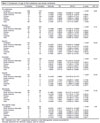
| K = 630; VAF = 8.1% | K (samples) | Estimate | SE | 95%CI | p-value |
|---|---|---|---|---|---|
| United States (reference) | 338 | - | - | - | - |
| Argentina | 16 | -2.6571 | 1.2361 | -5.0798 to -0.2344 | 0.0316 |
| Australia | 41 | 0.562 | 0.921 | -1.243 to 2.3671 | 0.5417 |
| Brazil | 24 | -1.6528 | 1.0571 | -3.7246 to 0.4191 | 0.1179 |
| Canada | 14 | 2.046 | 1.4275 | -0.6694 to 4.7614 | 0.2919 |
| Chile | 13 | -2.2042 | 1.4721 | -5.1101 to 0.6694 | 0.1321 |
| China | 18 | 4.5193 | 0.9339 | 2.6887 to 6.3498 | < .0001 |
| England | 21 | 0.5772 | 1.0845 | -1.5484 to 2.7028 | 0.5946 |
| France | 12 | -0.3318 | 1.407 | -3.0859 to 2.426 | 0.8136 |
| Germany | 11 | -1.7212 | 1.2703 | -4.2109 to 0.7684 | 0.1754 |
| India | 40 | 2.0047 | 0.7171 | 0.5714 to 3.418 | 0.0054 |
| Malaysia | 10 | -0.3368 | 1.3256 | -2.9469 to 2.2736 | 0.7847 |
| Mexico | 13 | 0.7567 | 1.1075 | -1.414 to 2.9273 | 0.4945 |
| Netherlands | 10 | -2.4878 | 1.5004 | -5.4286 to 0.453 | 0.0989 |
| Spain | 29 | -0.293 | 0.9547 | -2.1616 to 1.5756 | 0.7611 |
| Switzerland | 20 | -0.2724 | 2.1436 | -4.4737 to 3.929 | 0.8989 |
SE = standard error; VAF = proportional reduction in total heterogeneity variance-accounted-for.
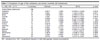
When analysis was restricted to specific substance groups, continent significantly explained heterogeneity for nicotine (Q = 14.69, p = 0.011), alcohol (Q = 29.71, p < 0.001), cannabis (Q = 21.85, p < 0.001), and stimulants (Q = 16.01, p = 0.006), but not for opioids (Q = 8.41, p = 0.077) or non-specific drugs (Q = 4.49, p = 0.480).
Specifically, initiation of nicotine (+1.75 years old, SE = 0.60, p = 0.003), alcohol (+3.18, SE = 0.62, p < 0.001), and cannabis use (+1.66, SE = 0.51, p = 0.011) was later in Asia than North America (Table 3). Cannabis use began significantly later in Oceania (+1.04, SE = 0.52, p = 0.046) than North America. In contrast, nicotine (-2.62, SE = 1.28, p = 0.041) and stimulant use began earlier in South America (-4.21, SE = 1.27, p < 0.001). Although the overall effect of continent was not significant for opioids, a significant difference was detected between North America and Africa, indicating earlier initiation in Africa (-6.07, SE = 2.71, p = 0.025); however, this estimate was based on only three African samples and should be interpreted with caution. Country-level analyses by specific substance were not performed due to the limited number of available studies.
Multivariate meta-regression model
Before conducting a multivariate analysis, a series of univariate meta-regressions was performed using all samples, regardless of substance type, to identify demographical and sample characteristics potentially associated with heterogeneity in estimated age of first use. The percentage of males in the sample was significantly associated with heterogeneity (Q = 4.21, p = 0.040), indicating that samples with a higher proportion of males reported earlier age of first use (-0.006, SE = 0.003). The mean age of the sample was also a highly significant predictor (Q = 142.1, p < 0.001), with older samples reporting a later age of first use (+0.18, SE = 0.015). Sample risk level (low, moderate, high) was significantly associated with heterogeneity (+0.61, SE = 0.20, Q = 9.15, p = 0.002), as was country income level (+0.84, SE = 0.38, Q = 4.76, p = 0.029).
The multivariate model (Table 5) included all of the aforementioned variables, in addition to continent, year of data collection/publication, and substance type. This comprehensive model explained over half of the observed heterogeneity (VAF = 53%, Q = 640.57, p < 0.0001). In this model, a higher proportion of males (-0.006, SE = 0.002, p = 0.007) and a higher risk level (-0.439, SE = 0.175, p = 0.012) were associated with earlier age of first substance use, while higher mean age (0.173, SE = 0.014, p < 0.0001) and later year of data collection/publication (0.062, SE = 0.018, p = 0.0005) were associated with later first use. Among the geographical variables, only South America remained a significant predictor relative to the reference category of North America, indicating an earlier age of initiation (-1.957, SE = 0.764, p = 0.010). The previously significant effect for Asia became marginal (p = 0.070), and no significant effect was observed for country income level.
| K = 605 VAF = 53.8% | Estimate | SE | 95%CI | p-value |
|---|---|---|---|---|
| Methodological and time-related variables | ||||
| Sample risk level | -0.439 | 0.175 | -0.78 to -0.09 | 0.012 |
| Mean age of the sample | 0.173 | 0.014 | 0.14 to 0.20 | < 0.0001 |
| Year of publication/data collection | 0.062 | 0.018 | 0.02 to 0.09 | 0.0005 |
| Percentage of male participants | -0.006 | 0.024 | -0.01 to 0.001 | 0.007 |
| Geographical and economic variables | ||||
| Africa | -1.061 | 0.946 | -2.90 to 0.78 | 0.259 |
| Asia | 1.195 | 0.661 | -0.10 to 2.49 | 0.070 |
| Europe | -0.023 | 0.410 | -0.83 to 0.79 | 0.950 |
| Oceania | 0.237 | 0.820 | -1.37 to 1.85 | 0.772 |
| South America | -1.957 | 0.764 | -3.45 to -0.46 | 0.010 |
| Low-/middle-income countries | 0.769 | 0.614 | -0.43 to 1.97 | 0.210 |
SE = standard error; VAF = proportional reduction in total heterogeneity variance-accounted-for.
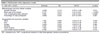
Given the possibility that country income level might be associated with continent, we re-estimated the model, excluding the continent covariate. In this model, low/middle-income countries had a significantly later age of first substance use than high-income countries (+0.73 years; SE = 0.35, p = 0.036). This divergence between multivariate models with and without the continent covariate likely reflects only partially shared variance between continent and income. The continent covariate aggregates regional cultural, policy, and other socioeconomic features that are not reducible to country income level alone.
Sensitivity analyses
Of the 304 included studies, the risk-of-bias score was = 2 in 18 (5.9%). To test the robustness of our findings, we re-estimated the multivariate model after excluding these low-quality studies. This sensitivity analysis removed only three observations (k = 601 vs. 604), and the results remained practically unchanged.
Inspection of the multivariate analysis funnel plot indicated two influential studies that produced rightward asymmetry (Supplementary Figure S1). After removing these studies, the funnel plot became more symmetrical. As a sensitivity analysis, we re-estimated the multivariate meta-regression, excluding the low-quality studies and these influential studies, resulting in 599 individual samples. Most results (Supplementary Table S2) were unchanged relative to the primary analysis (k = 604). One exception was the Asia vs. North America contrast for age of first substance use, which shifted from marginal (p = 0.070) to statistically significant (p = 0.010).
Given that the age of first substance use was consistently earlier in South America than North America, we re-estimated the multivariate model in the sensitivity dataset (k = 599) using South America as the reference continent (Supplementary Table S3). Relative to South America, first substance use occurred later in Asia (+3.125, SE = 0.544, p < 0.0001), Europe (+1.912, SE = 0.642, p = 0.002), Oceania (+2.131, SE = 0.849, p = 0.012), and North America (+1.750, SE = 0.621, p = 0.004). The difference was non-significant in Africa (+0.922, SE = 0.753, p = 0.221).
Finally, given that the sample's risk level (low, moderate, high) was consistently associated with heterogeneity across all previous models, we restricted the analysis to low-risk samples (k = 214), which are characteristic of community-based recruitment, and re-estimated the multivariate model (Supplementary Table S4). Using South America as the reference category, later ages were observed in Europe (+2.303, SE = 1.175, p = 0.049) and Asia (+2.692, SE = 0.909, p = 0.003). In contrast, there was no longer a significant difference with North America (+1.932, SE = 1.110, p = 0.081), Oceania (+1.401, SE = 1.514, p = 0.354), or Africa (+0.887, SE = 1.133, p = 0.430).
DISCUSSION
This systematic review and meta-analysis aimed to estimate the global age of first substance use, investigating temporal trends and assessing the influence of geographic and methodological factors. The study identified significant continental differences, with first substance use occurring later in Asia and earlier in South America. For alcohol, which was used as the reference substance, the estimated global age of first use was 16 years, followed closely by nicotine and cannabis. In contrast, significantly later initiation ages were found for hallucinogens, stimulants, sedatives, and opioids exhibited, ranging from 2 to 5 years after alcohol initiation. Additionally, methodological aspects, including sex, the sample's risk level for problematic substance use, country income level, mean age of the sample, and year of data collection/publication, were associated with heterogeneity in the meta-analyses.
Regarding geographical differences, psychoactive substance use still begins at an earlier age in South America than other parts of the world.15,16 Conversely, in Asia, where traditional values are more predominant, including strict family norms and educational systems that support social control and intolerance to deviant adolescent behaviors, experimentation tends to occur later.17-19 In such contexts, the consumption of illicit substances is culturally less acceptable.20,21 Furthermore, zero-tolerance drug policies in these countries may serve as an additional limiting factor among young people.22 This dissonance reveals regional variations and suggests that advances in prevention and awareness of the risks of early drug use have not reached all global contexts with equal effectiveness. Cultural differences between Asia and South America consistently emerged in the univariate models for nearly all substances. However, in the fully adjusted multivariate model, this only remained significant in South America, while the association weakened to marginal significance in Asia (p = 0.070). Nevertheless, this discussion is still relevant, given the stronger social control and lower cultural acceptance of substance use in Asia, whereas in South America, where there is greater social vulnerability and socioeconomic inequality, more permissive attitudes toward alcohol and other drugs prevail.23 These factors, combined with early exposure to risk environments, may contribute to earlier initiation of drug use in this region. In the country-level analysis, using the United States as the reference, Argentina showed a markedly earlier age of first use, whereas in China and India, it was significantly later. These findings are consistent with the notion that macro-level geographical, cultural, policy, and socioeconomic differences between South America and Asia influence the timing of first substance use. Additionally, in the last multivariate model, including only low-risk samples characterized by community recruitment, the differences between these continents remained, indicating an earlier age of first substance use in South America than Asia. Even in the multivariate model limited to low-risk, community-based samples, differences between continents remained evident, consistently indicating an earlier age of first substance use in South America than Asia.
Compared to previous decades, a global trend toward later experimentation with drugs was found, especially for alcohol and stimulants. This phenomenon may be combined with factors such as increased access to information, stronger public prevention policies, and transformed sociocultural patterns.24-26 In the United States between 2002 and 2020, it was observed that fewer adolescents aged 12 to 17 began using alcohol, marijuana, nicotine, and other drugs.27 This trend toward reduced drug use among young people has been the focus of several studies.28-30 To better understand this phenomenon, some contributing factors have been investigated, including public health policies that promote prevention and encourage healthy behaviors, as well as increased concern for health during adolescence and early adulthood.31 Moreover, increasing Internet use and online interaction has resulted in reduced face-to-face interaction, leading adolescents to spend more time at home and thus reducing exposure to risk situations for psychoactive substance use.32 Another important factor is parental behavior, as adolescents who do not consume alcohol often have parents who also abstain from alcohol, suggesting that the family environment has a protective influence.33,34 Cultural changes, such as the formation of more heterogeneous social bonds and the decreased influence of peer pressure, have also been identified as potential explanations.35,36 However, none of these factors alone can fully explain the phenomenon, highlighting the need for a multifactorial analysis that considers interactions among these different variables.
Our findings corroborate previous literature, highlighting the influence of demographic and contextual factors on the age of first psychoactive substance use.37-39 Sex differences were also identified, indicating that males tended to experiment with substances at an earlier age than females. It was also found that participants from samples at higher risk for problematic substance use, especially those with psychiatric comorbidities, reported earlier experimentation than individuals from community samples. Experimentation occurred earlier in low- and middle-income countries than high-income countries. However, this effect did not remain significant in the multivariate model, suggesting that other variables may have played a role in this outcome.
Our multivariate model estimated ~ 53% of the variability in age at first use of psychoactive substances, leaving almost half of the between-study heterogeneity unexplained. Several data gaps likely contributed to this residual variance. First, many studies failed to report key covariates, such as parental substance-use history, family structure, twin- or adoption-based designs, or self-reported ethnicity. Consequently, we could not determine the influence of these variables in our meta-analysis. Second, because most studies came from North America and Western Europe, while large regions (e.g., South America, Central Africa, or Southeast Asia) were sparsely represented, we collapsed countries into continental blocs. This pragmatic choice precluded deeper country-level comparisons, which might have revealed important patterns within continents. Third, at the eligibility stage, we excluded studies that either reported the age of first substance use only as proportions within broad age brackets (e.g., = 13 years, 14-17 years), or provided a mean age without an accompanying measure of variability (e.g., SD, SE, or CI). However, our meta-analysis was designed to pool mean ages, which required both a point estimate and its dispersion to calculate study weights and overall variance. Fourth, our search strategy crossed age-related with substance-use terms, which may have under-ascertained studies reporting age of initiation only in the main text or tables (and not in titles, abstracts, or keywords). To mitigate this, we retrieved and screened more than 900 full-text articles and manually analyzed data on age of first substance use. Although such an approach cannot fully eliminate retrieval/indexing bias, it likely reduced its impact.
Despite these limitations, our final dataset incorporated 304 peer-reviewed studies published between 1976 and 2024, yielding more than 700 independent samples from 56 countries. These findings are important for understanding delayed first substance use, offering valuable insight into how this trend has evolved over time. However, the underlying reasons for this delay remain unclear. Further research is needed to clarify the social, cultural, and individual factors that contribute to this shift, thereby informing more effective prevention and intervention strategies.
 PDF
 Print
 Send this article by email
 How to cite this article
 Submit a comment
 Mendeley
 Pocket
 Share on Facebook
 Share on Twitter



