



ABSTRACT:
OBJECTIVE: The large body of literature examining the association between parenthood and mortality
in the general population contrasts with a lack of such studies on older adults with
schizophrenia. Identifying potential protective factors of premature death in this
population is important to help guide prevention measures. Here, we examined whether
all-cause and cause-specific mortality rates significantly differ between older parents
and non-parents with schizophrenia during a 5-year follow-up.
METHODS: We used data from a 5-year prospective multicenter sample of older adults with an
ICD-10 diagnosis of schizophrenia (aged 55 years or more) recruited in France. We
performed a forward stepwise logistic regression to examine the association between
parenthood and all-cause mortality, including only independent variables that best
explain outcome.
RESULTS: Of the 323 older adults with schizophrenia, 133 (41.2%) were parents (mean age = 67.0,
SD = 6.1) and 190 were not (mean age = 67.2, SD = 6.6). Following adjustments, parenthood
was significantly associated with lower all-cause mortality compared to patients without
children (21.1% [n=28] vs. 35.8% [n=68]; AOR = 0.50; 95%CI 0.27-0.94; p = 0.032);
the association involved no significant sex differences.
CONCLUSION: Parenthood could be a protective factor against mortality among older patients with
schizophrenia who live in France. Further research is needed to understand the specific
mechanisms underlying this association.
Keywords: Parenthood; children; schizophrenia; mortality; older adults.
FIGURES
| Note: How to cite this article: Rezaei K, Kassm SA, Garcés-González MS, Sánchez-Rico M, Olfson M, Ouazana-Vedrines C, et al. Parenthood and all-cause mortality in older adults with schizophrenia: a multicenter 5-year prospective study. Braz J Psychiatry. 2025;47:e20243731. http://doi.org/10.47626/1516-4446-2024-3731 |
| Received: May 15 2024; Accepted: August 30 2024 |
INTRODUCTION
In the general population, parents consistently have a higher life expectancy than those non-parents, which is mainly related to lower mortality due to cardiovascular disease (CVD) and suicide. Some studies have considered childlessness a proxy of infertility, and hence a risk factor/marker of CVD, in both men and women.1 Additionally, feelings of responsibility and connectedness have been hypothesized to be related to the lower suicide rates of parents than non-parents.2
Parenthood estimates among individuals with psychosis range from 27% to 63%.3 Studies on parenthood in psychotic patients have primarily focused on reproductive patterns and risks to the mother and child in the peripartum period as well as on child safety thereafter.4-6 A sex difference has been consistently found, with significantly higher motherhood rates compared to fatherhood rates and a much higher probability that mothers will live with their underage children than fathers.7-9
The large body of literature on the association between parenthood and mortality in the general population contrasts with a lack of studies among patients with psychotic disorders.10-13 This is particularly unfortunate since the mortality gap in patients with schizophrenia is substantial and persists into later life.14,15 Therefore, identifying protective factors against premature death among older adults with schizophrenia is important to help guide prevention measures and improve treatment for these patients.
In addition to the aforementioned protective mechanisms against mortality found in parents of the general population, a major potential health advantage of parents with psychotic disorders is the caring role that their offspring might assume, especially later in life.16 Additionally, sex differences in fertility rates and living arrangements in this population may affect the mortality rates of people with psychotic disorders. To our knowledge, no study has specifically examined the association between parenthood and mortality rates among older adults with schizophrenia. Understanding these associations could inform targeted interventions and support strategies for these vulnerable patients, ultimately extending their longevity and improving their overall health.
In this report, we used data from the Cohort of individuals with Schizophrenia Aged 55 years or more, a 5-year prospective multicenter study of older people with schizophrenia to examine the association between parenthood and mortality among older adults with schizophrenia. We hypothesized that parenthood would be associated with reduced mortality among older adults with schizophrenia, independent of several confounding factors. These factors include sociodemographic characteristics such as age, education, marital status, urbanicity, institutionalization, and inpatient status; clinical characteristics such as disorder severity, number of medical conditions, body mass index (BMI), current smoking, at-risk drinking, and past-year consultation with a general practitioner; and psychotropic medication use, including antipsychotics, antidepressants, and benzodiazepines. We also evaluated potential effect modification by sex and hypothesized that parenthood would be more protective against mortality in older women than older men with schizophrenia.
METHODS
Selection and description of patients
In this observational epidemiological prospective study, data were drawn from the CSA study, a cohort of 353 patients aged 55 years or older with an ICD-10 diagnosis code for schizophrenia (82.4%) or schizoaffective disorder (17.6%). A more detailed description of the study methods can be found elsewhere.15,17-28 Patients were recruited between February 2010 and June 2013 from French community psychiatric departments covering 63 mutually independent catchment areas.24 Exclusion criteria included limited French proficiency, not being affiliated with the social security system, meeting ICD-10 criteria for any pervasive developmental disorder or major neurocognitive disorder, any neurological disorder affecting the central nervous system, or any serious/life-threatening medical, or surgical condition requiring immediate treatment. All participants were interviewed face-to-face by their treating psychiatrist, who collected the baseline clinical data. The research protocol, including informed consent procedures, was conducted in accordance with Declaration of Helsinki guidelines and received full ethical review and approval from the local research ethics committee, the Advisory Committee on Information Processing in Material Research in the Field of Health, and the National Board on Computerized Information and Freedoms. Written informed consent was obtained from all patients.
Data collection and measurements
Assessment of schizophrenia spectrum
Schizophrenia and schizophrenia ICD-10 subtypes (i.e., paranoid, schizoaffective, residual, hebephrenic, simple, catatonic, post-schizophrenic depression, undifferentiated, unspecified), as well as schizoaffective disorder, were diagnosed face-to-face by the treating psychiatrist according to ICD-10 criteria.
Sociodemographic and clinical characteristics
Parenthood. Parenthood, defined as being a parent vs. remaining childless, was assessed by the treating psychiatrist. It did not require that the children to be alive at the time of the interview.
Sociodemographic characteristics. Sociodemographic characteristics included sex, age, education, marital status, urbanicity (defined as living in an area with more than 1,000 inhabitants per km2), institutionalization (defined as living in a dwelling that offers some formal supervision, including nursing homes, homes for older adults, hospital stays longer than 3 months, chronic-care beds, and psychiatric institutions; temporary admission for convalescence or rehabilitation was not considered as institutionalization), and inpatient status.
Clinical characteristics. Clinical characteristics included the number of general medical conditions, current smoking status (smoker vs. non-smoker), and at-risk alcohol consumption, evaluated using the CAGE questionnaire.29,30 BMI was also measured and categorized into three groups: i) underweight (BMI < 23 kg/m2); ii) overweight (BMI > 30 kg/m2); and iii) normal weight (BMI between 23 and 30 kg/m2). As suggested by a two-stage random-effects meta-analysis31 of the association between BMI and all-cause mortality risk in adults = 65 years of age, we used the specific cutoff points of < 23 and > 30 kg/m2 to define "underweight" and "overweight," respectively, given their significant associations with increased mortality risk in older adults. The investigators also asked whether the participant consulted a general practitioner in the past year.
Disorder severity. The severity of schizophrenia was evaluated using the Brief Psychiatric Rating Scale and the Clinical Global Impression rating scale. The Brief Psychiatric Rating Scale, a well-validated 18-item scale, was used to measure general psychiatric symptoms, including affective, positive, and negative symptoms.32,33 Each symptom is rated from 1 (absent) to 7 (severe). In our study, the internal consistency reliability of the Brief Psychiatric Rating Scale was good, with a Cronbach's alpha of 0.85. The Clinical Global Impression scale is a 7-point scale with a range of responses from 1 (least severe) to 7 (most severe).34 This scale asks clinicians to rate the patient based on their past experiences with other patients with the same diagnosis.
Psychotropic medications. For all patients, psychotropic medications prescribed at the time of the interview, including antipsychotics, antidepressants, and benzodiazepines, were recorded.
Causes of mortality
Deaths were confirmed by a mortality review committee (consisting of authors NH and FL) based on information from the treating psychiatrists, hospital records, death certificates, autopsy reports, obituaries, and interviews with physicians or next of kin. Cause of death was adjudicated as disease-related mortality, including CVD (coronary heart disease, cerebrovascular disease, heart failure, or peripheral vascular disease) and non-CVD diseases (e.g., infection), suicide, or accident. Disease-related mortality comprised both CVD and non-CVD related mortalities.
Statistical analysis
We calculated the frequency and mean (SD) of all baseline characteristics described above in older parents and non-parents with schizophrenia and compared them using standardized mean differences.35
To examine the association between parenthood and all-cause mortality, we performed crude and forward stepwise logistic regression models in the context of a relatively limited sample size and to reduce the risk of multicollinearity. Stepwise regression models iteratively remove weaker variables in the full model, ensuring that only the independent variables that best explain the outcome are included. Using F-tests and t-tests to compare models by their Akaike information criterion, variables are added or deleted until the best possible model, i.e., that which best predicts the outcome, is achieved.36
As a sensitivity analysis, we performed a multivariable logistic regression analysis that simultaneously included all baseline characteristics (i.e., sex, age, education, marital status, urbanicity, institutionalization, inpatient status, at least one consultation with a general practitioner in the last year, number of medical conditions, BMI, current smoker, at-risk drinking, Brief Psychiatric Rating Scale results, Clinical Global Impression results, and the use of antipsychotics, antidepressants, and benzodiazepines).
We performed two additional analyses. First, we reproduced the main analysis while specifically examining each cause of death (i.e., due to CVD or non-CVD, suicide, and accident). Second, we tested whether the main association significantly differed between men and women by including the interaction term parenthood*sex.
For all associations, we examined the fit of the data, checked assumptions and potential collinearity issues, and examined the potential influence of outliers. Statistical significance was evaluated using a two-sided design with alpha risk of 0.05. All analyses were conducted in R 4.3.1 (R Project for Statistical Computing).
RESULTS
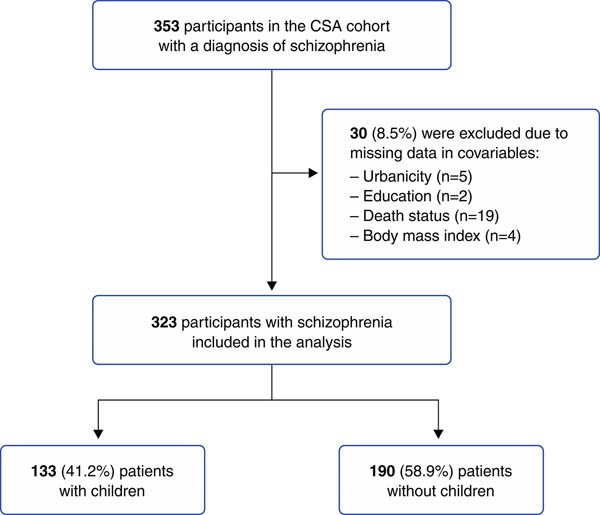
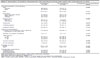
Of the 353 older patients with an ICD-10 diagnosis of schizophrenia, 30 (8.5%) were excluded from the analyses because of missing data. Of the 323 remaining patients, 133 (41.2%) were parents (Figure 1). Of the 133 patients with children, 66.2% were women and 33.8% were men. The differences in baseline characteristics between patients who died and those who survived and between parents and non-parents are shown in Tables 1 and 2, respectively.
| Full sample | Dead | Alive | Crude logistic regression OR (95%CI; p-value) | Multivariable logistic regression┼ AOR (95%CI; p-value) | GVIF | |
|---|---|---|---|---|---|---|
| Sociodemographic characteristics | ||||||
| Sex | ||||||
| Female | 166 (51.4) | 42 (25.3) | 124 (74.7) | Ref. | Ref. | 1.25 |
| Male | 157 (48.6) | 54 (34.4) | 103 (65.6) | 1.55 (0.96-2.50; 0.075) | 1.36 (0.75-2.48; 0.315) | |
| Age | 67.10±6.39 | 70.00±7.29 | 65.90±5.55 | 1.89 (1.48-2.42; < 0.001)* | 1.10 (1.05-1.16; < 0.001)* | 1.26 |
| Education | 1.23 | |||||
| Less than high school | 226 (70.0) | 70 (31.0) | 156 (69.0) | Ref. | Ref. | |
| High school | 45 (13.9) | 14 (31.1) | 31 (68.9) | 1.01 (0.50-2.01; 0.985) | 1.17 (0.52-2.60; 0.705) | |
| College | 52 (16.1) | 12 (23.1) | 40 (76.9) | 0.67 (0.33-1.35; 0.262) | 0.66 (0.29-1.52; 0.327) | |
| Marital status | 1.16 | |||||
| Married | 49 (15.2) | 9 (18.4) | 40 (81.6) | 0.48 (0.22-1.04; 0.063) | 0.62 (0.25-1.50; 0.287) | |
| Unmarried | 274 (84.8) | 87 (31.8) | 187 (68.2) | Ref. | Ref | |
| Urbanicity | 75 (23.2) | 23 (30.7) | 52 (69.3) | 1.06 (0.60 - 1.86; 0.838) | 0.93 (0.46-1.89; 0.842) | 1.31 |
| Institutionalized | 115 (35.6) | 45 (39.1) | 70 (60.9) | 1.98 (1.21-3.23; 0.006)* | 1.35 (0.72-2.52; 0.349) | 1.32 |
| Inpatient status | 74 (22.9) | 31 (41.9) | 43 (58.1) | 2.04 (1.19-3.51; 0.010)* | 1.47 (0.77-2.81; 0.238) | 1.13 |
| Clinical characteristics | ||||||
| At least one consultation with a general practitioner in the past year | 266 (82.4) | 76 (28.6) | 190 (71.4) | 0.74 (0.40-1.36; 0.330) | 0.69 (0.34-1.41; 0.312) | 1.13 |
| Number of medical conditions | 2.14±1.61 | 2.74±1.75 | 1.88±1.48 | 1.69 (1.33-2.16; < 0.001)* | 1.29 (1.09-1.54; 0.004)* | 1.12 |
| BMI (kg/m2) | 1.16 | |||||
| < 23 | 86 (26.6) | 27 (31.4) | 59 (68.6) | 0.83 (0.47-1.46; 0.509) | 0.81 (0.42-1.55; 0.523) | |
| 23-30 | 143 (44.3) | 51 (35.7) | 92 (64.3) | Ref. | Ref. | |
| > 30 | 94 (29.1) | 18 (19.1) | 76 (80.9) | 0.43 (0.23-0.79; 0.007) | 0.48 (0.24-0.99; 0.045) | |
| Current smoker | 91 (28.2) | 28 (30.8) | 63 (69.2) | 1.07 (0.63-1.82; 0.796) | 1.36 (0.71-2.61; 0.359) | 1.24 |
| At-risk drinking | 22 (6.8) | 4 (18.2) | 18 (81.8) | 0.50 (0.17-1.53; 0.228) | 0.77 (0.22-2.73; 0.685) | 1.13 |
| Disorder severity | ||||||
| BPRS | 43.0±14.60 | 44.80±14.10 | 42.30±14.80 | 1.18 (0.93-1.49; 0.173) | 1.00 (0.98-1.03; 0.837) | 1.62 |
| CGI | 4.42±1.23 | 4.64±1.11 | 4.33±1.27 | 1.29 (1.00-1.66; 0.046) | 1.20 (0.90-1.62; 0.219) | 1.60 |
| Psychotropic medications | ||||||
| Antipsychotics | 298 (92.3) | 93 (31.2) | 205 (68.8) | 3.33 (0.97-11.39; 0.056) | 3.35 (0.90-12.40; 0.070) | 1.04 |
| Antidepressants | 71 (22.0) | 23 (32.4) | 48 (67.6) | 1.17 (0.67-2.07; 0.577) | 1.51 (0.76-2.99; 0.244) | 1.15 |
| Benzodiazepines | 96 (29.7) | 30 (31.2) | 66 (68.8) | 1.11 (0.66-1.86; 0.696) | 0.97 (0.53-1.79; 0.922) | 1.14 |
Data presented as n (%) or mean ± SD, unless otherwise specified.
AOR = adjusted odds ratio; BMI = body mass index; BPRS = Brief Psychiatric Rating Scale; CGI = Clinical Global Impressions; GVIF = generalized variance inflation factor.
┼ Adjusted for sex, age, education, marital status, urbanicity, institutionalization, inpatient status, at least one consultation with a general practitioner in the last year, number of medical conditions, BMI, current smoker, at-risk drinking, BPRS results, CGI results, and use of antipsychotics, antidepressants, and benzodiazepines (degrees of freedom = 19).
* Significant two-sided p-value (p < 0.05).
| Parenthood(n=133) | No parenthood(n=190) | Parenthood vs. no parenthood(SMD) | |
|---|---|---|---|
| Sociodemographic characteristics | |||
| Sex | 0.520 | ||
| Female | 88 (66.2) | 78 (41.1) | |
| Male | 45 (33.8) | 112 (58.9) | |
| Age | 67.0±6.1 | 67.2±6.6 | 0.031 |
| Education | 0.172 | ||
| Less than high school | 91 (68.4) | 135 (71.0) | |
| High school | 16 (12.0) | 29 (15.3) | |
| College | 26 (19.5) | 26 (13.7) | |
| Marital status | 0.560 | ||
| Married | 36 (27.1) | 13 (6.8) | |
| Unmarried | 97 (72.9) | 177 (93.2) | |
| Urbanicity | 24 (18.0) | 51 (26.8) | 0.212 |
| Institutionalized | 37 (27.8) | 78 (41.1) | 0.281 |
| Inpatient status | 32 (24.1) | 42 (22.1) | 0.046 |
| Clinical characteristics | |||
| At least one consultation with a general practitioner in the past year | 112 (84.2) | 154 (81.1) | 0.083 |
| Number of medical conditions | 2.2±1.7 | 2.1±1.5 | 0.023 |
| BMI (kg/m2) | 0.155 | ||
| < 23 | 32 (24.1) | 54 (28.4) | |
| 23-30 | 57 (42.9) | 86 (45.3) | |
| > 30 | 44 (33.1) | 50 (26.3) | |
| Current smoker | 26 (19.5) | 65 (34.2) | 0.335 |
| At-risk drinking | 12 (9.0) | 10 (5.3) | 0.146 |
| Disorder severity | |||
| BPRS | 43.3±14.8 | 42.9±14.5 | 0.026 |
| CGI | 4.3±1.2 | 4.5±1.3 | 0.140 |
| Psychotropic medications | |||
| Antipsychotics | 124 (93.2) | 174 (91.6) | 0.062 |
| Antidepressants | 27 (20.3) | 44 (23.2) | 0.069 |
| Benzodiazepines | 39 (29.3) | 57 (30.0) | 0.015 |
Data presented as n (%) or mean ± SD, unless otherwise specified.
Bold type represents statistical significance.
Standardized mean differences (SMD) > 0.10 (in bold) are considered as substantial.
BMI = body mass index; BPRS = Brief Psychiatric Rating Scale; CGI = Clinical Global Impression Scale.
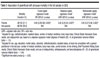
After 5 years of follow-up, all-cause mortality was 21.1% (n=28; 4,800 deaths per 100,000 person-years) among parents and 35.8% (n=68; 8,400 deaths per person-years) among non-parents. Parents had significantly lower rates of all-cause mortality than non-parents in the crude, unadjusted logistic regression model (odds ratio = 0.48; 95%CI 0.29-0.80; p = 0.005), the stepwise regression model (adjusted odds ratio = 0.45; 95%CI 0.25-0.80; p = 0.007), and the fully-adjusted multivariable logistic regression model (AOR = 0.50; 95%CI 0.27-0.94; p = 0.032) (Table 3). The latter analysis achieved a statistical power (1-ß) of 0.52 with a sample size of 323 patients, a mortality rate of 29%, a 21.1% proportion of parents, and an alpha risk of 0.05.
| Mortality | Crude logistic regression model | Stepwise logistic regression model┼ | Multivariable logistic regression model╬ | |
|---|---|---|---|---|
| Events/n (%) | OR (95%CI; p-value) | AOR (95%CI; p-value) | AOR (95%CI; p-value) | |
| Parents | 28/133 (21.1) | 0.48 (0.29-0.80; 0.005)* | 0.45 (0.25-0.8; 0.007)* | 0.50 (0.27-0.94; 0.032)* |
| Non-parents | 68/190 (35.8) | Ref. | Ref. | Ref. |
AOR = adjusted odds ratio; OR = odds ratio.
┼ Adjusted for age, institutionalization, inpatient status, number of medical conditions, body mass index, Clinical Global Impression Scale results, and antipsychotic use, based on a stepwise regression model (degrees of freedom [df] = 9; all generalized variance inflation factor < 1.5).
╬ Adjusted for sex, age, education, marital status, urbanicity, institutionalization, inpatient status, at least one consultation with a general practitioner in the last year, number of medical conditions, body mass index, current smoker, at-risk drinking, Brief Psychiatric Rating Scale results, Clinical Global Impression Scale results, and use of antipsychotics, antidepressants, and benzodiazepines (df = 20; all generalized variance inflation factor < 1.64).
* Significant two-sided p-value (p < 0.05).
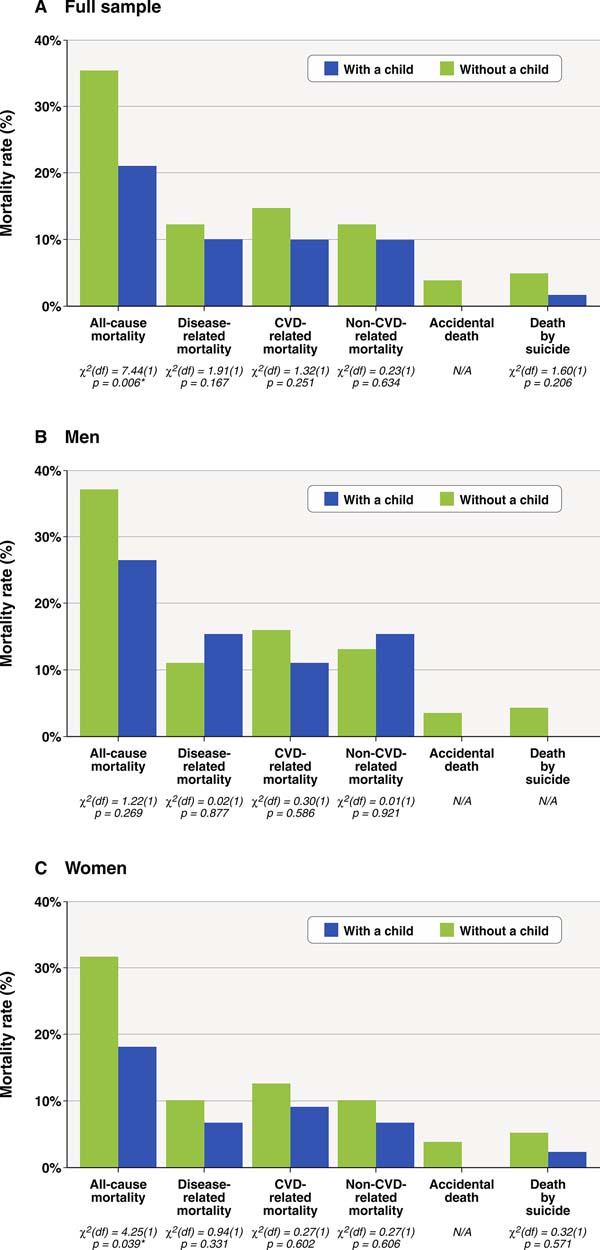
Mortality rates among parents were 11% (n=13; 2,241 per 100,000 person-years) from CVD, 11% (n=13; 1,896.5 per 100,000 person-years) from non-CVD, and 1.9% (n=2; 335 per 100,000 person-years) from suicide; there we no accidental deaths. Among non-parents, the mortality rates were 18.7% (n=28; 3,444 per 100,000 person-years) from CVD, 15.9% (n=23; 2,829 per 100,000 person-years) from non-CVD, 6.9% (n=9; 1,107 per 100,000 person-years) from suicide, and 5.4% (n=7; 861 per 100,000 person-years) from accidents (Supplementary Table S1). There were, however, no significant differences in causes of mortality between parents and non-parents (Figure 2 and Supplementary Table S1).
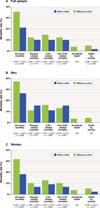
Finally, there were no significant sex differences in the magnitude of the association between parenthood and all-cause mortality (odds ratio = 1.05; 95%CI 0.30-3.70; p = 0.943) or for each cause of death (Supplementary Table S1 and Figure S1).
DISCUSSION
Our study investigated the association between parenthood and mortality among 323 older patients aged 55 years or older with an ICD-10 diagnosis of schizophrenia or schizoaffective disorder. To our knowledge, this is the first study to examine this association in a sample of older patients with schizophrenia. We found that parenthood was significantly associated with lower all-cause mortality, but not specific causes of death, independently of psychotropic medication use and a wide range of sociodemographic and clinical characteristics. This association did not differ significantly between men and women.
The prevalence of parenthood among older participants with schizophrenia in our sample was 41.2%. This estimate is within the range reported by prior research in adults with psychotic disorders (27%-63%).14 It is also interesting that two-thirds of the parents in our sample were mothers, a difference that has also been previously described in the literature.9
Our study suggests that the protective effect of parenthood consistently found in general population samples37 seems to apply to older populations with schizophrenia as well. This is particularly important given the increase in premature mortality among patients with severe psychiatric disorders, especially those with schizophrenia.3 The explanatory mechanisms underlying the protective effect of parenthood on mortality could lie in analyzing the differences in causes of death. However, we found no significant difference in specific causes of death between parents with non-parents, possibly due to insufficient power. However, the preponderance of mothers may provide clues to the mechanisms involved in the protective effect of parenthood on mortality. It has been previously described that mothers with psychotic disorders live with and raise their underage children much more often than fathers with psychotic disorders.38-40 It is therefore more likely that mothers keep in touch with their children, which could play a protective role against suicide and, when their children assume a caregiving role, it could result in better physical and mental healthcare access.
In addition, previous studies41,42 have shown that cultural differences can significantly impact all-cause mortality, maternal mortality, and the effects of child death on parental mortality. However, to our knowledge, only one 2006 systematic review explored how the number of births affects mortality in women.43 They identified 33 cohorts, which they divided into historical (16th to early 20th century, with non-contracepting populations) and contemporary cohorts (late 20th century, with contracepting populations). A survival benefit from high fertility was only evident in historical cohorts and the only contemporary cohort from a less developed country.
Support from children in old age was mentioned as an explanatory hypothesis, which is valid for contemporary populations but counterbalanced by the financial strain of raising children. More recently, a nationwide Swedish study11 found that parents live longer than non-parents and that the protective effect of parenthood is more evident among the unmarried and increases with age, further suggesting social support as an explanation. Therefore, further research on the mechanisms behind the protective role of parenthood in this population is necessary, focusing especially on more refined strategies to optimize their well-being.44 For instance, increased adherence to pharmacological therapy,45 continuity of care,46 and the effect of social and cultural factors on mortality risk could be explanatory mechanisms.
As previously suggested,47 our findings indicate that future interventions should focus on family planning services, care support, and accompanying the offspring of patients with schizophrenia. There is a need for effective social services that provide both material and emotional support to patients with schizophrenia to optimize their parenting, since they are more likely to have restricted social networks and limited social skills. Improved parenting skills can strengthen relationships with children in the long term. A previous study48 has suggested that social support may be especially helpful in cases where children are no longer with their parents.
This study has several limitations. First, measures of association do not necessary imply causal associations. Even if we included a wide range of potential confounders, some potentially influential variables were not available in our data, such as age at the birth of the first child. In addition, selection bias and residual confounding may have led to overestimation of the results.49 Second, since each participant was interviewed by only one psychiatrist and the recruitment took place at multiple centers (n=63), we were unable to assess potential error variance in rating measurements. Third, data on treatment adherence for clinical comorbidities were not available, although adherence might have been greater among patients with children, given that these patients may be more likely to prioritize their health. Fourth, our data did not allow exploration of the influence of parenthood on other health outcomes over time in this population. Fifth, due to the limited number of patients and mortality events in each subgroup, we were unable to explore sex differences for specific causes of death. Sixth, we did not inquire about the current relationship between patients and their offspring, so we could not determine whether and to what extent the patients had contact with them. Seventh, only public-sector psychiatric departments were involved in recruiting, which decreases the generalizability of our findings. Eighth, variations in parenting behaviors and social norms across different cultures may influence how parenthood affects mortality risk. Therefore, further research is needed to elucidate these effects. Finally, despite significant results, our study's relatively low statistical power may have led to overestimation of the magnitude of the association between parenthood and mortality.50
In a multicenter prospective study of 323 older adults with schizophrenia who live in France, we found that parenthood was significantly associated with lower all-cause mortality. Parenthood may be a protective factor against mortality among older adults with schizophrenia, especially women. Understanding these associations could inform targeted interventions and support strategies for patients with schizophrenia who are parents, ultimately improving overall health outcomes in this vulnerable population. Psychosocial support and psychoeducation for caregivers and individuals with schizophrenia, tailored to their parental status, could be particularly important.
ACKNOWLEDGEMENTS
This study was supported by a grant from the French Ministry of Health and Social Affairs (PHRC 2008-N11-01; http://solidarites-sante.gouv.fr/) and the French Psychiatric Congress (http://www.congresfrancaispsychiatrie.org). It was promoted by the University of Reims Champagne-Ardenne (http://www.univ-reims.fr/) and the University Paris-Descartes (https://www.univ-paris5.fr). The funders had no role in study design, data collection and analysis, decision to publish, or preparation of the manuscript.
The authors would like to thank the Clinical Research Unit of Georges Pompidou European Hospital, and in particular Pr Gilles Chatellier, Mr Yvann Frigout, Mrs Juliette Djadi-Prat, and Mrs Pascaline Aucouturier, and the Clinical Research Unit of Robert Debré Hospital, and in particular Mrs Sarah Rubingher, Dr Bérengère Hubsch, Dr Eric Tran, Dr Fabien Gierski, and Mr David Da Rin. We warmly thank all the patients and the investigators who made this study possible.
Disclosure
The authors report no conflicts of interest.
Author contributions
KR: Formal analysis, Writing - original draft.
SAK: Writing - original draft.
MSG-G: Formal analysis.
MS-R: Data curation, Formal analysis, Methodology, Software.
MO: Writing - review & editing.
CO-V: Writing - review & editing.
VS: Writing - review & editing.
MF: Writing - review & editing.
PM: Writing - review & editing.
FL: Conceptualization, Funding acquisition, Project administration, Resources, Writing - review & editing.
NH: Conceptualization, Investigation, Project administration, Supervision, Validation, Writing - review & editing.
All authors have read and approved of the final version to be published.
Handling Editor: Raffael Massuda
 PDF
 Print
 Send this article by email
 How to cite this article
 Submit a comment
 Mendeley
 Pocket
 Share on Facebook
 Share on Twitter



