



ABSTRACT:
OBJECTIVES: To test the association of 45 single nucleotide polymorphisms (SNPs) with transition
to psychiatric disorders in a cohort of individuals at ultrahigh risk (UHR) mental
state for psychosis.
METHODS: Through general population screening, 88 non-help-seeking UHR subjects and 130 healthy
control individuals were genotyped for 45 SNPs related to psychosis. They were followed
for a mean of 2.5 years, and conversion to psychotic and to general psychiatric disorders
was assessed. Genotype frequencies between controls, converters, and non-converters
were analyzed.
RESULTS: There were no differences in sociodemographics between controls and UHR. Also, UHR
converters and non-converters had no differences in their baseline symptoms scores.
The dopamine receptor D2 gene (DRD2) SNP rs6277 was significantly more common among UHR who transitioned to psychosis
(p < 0.001) and to UHR who transitioned to any psychiatric disorders (p = 0.001) when
compared to UHR who did not transition. The rs6277 T allele was related to psychiatric
morbidity in a dose-response fashion, being significantly more frequent in UHR converters
than UHR non-converters and control subjects (p = 0.003).
CONCLUSION: Our findings suggest that rs6277 could potentially constitute a genetic marker of
transition to psychiatric disorders in subjects with at-risk mental states, warranting
further investigation in larger samples.
Keywords: Dopamine; schizophrenia; clinical high risk; flip-flop; attenuated psychosis.
FIGURES
| Received: November 26 2022; Accepted: March 13 2023 |
INTRODUCTION
To identify early stages of schizophrenia spectrum disorders, the ultrahigh risk (UHR) for psychosis criteria were developed. They comprise three syndromes: attenuated psychosis syndrome (APS), brief intermittent psychotic symptom (BIPS), and genetic risk (first-degree relative with psychotic disorder or participant with schizotypal personality) and deterioration (functional decline) (GRD) syndromes.1 Currently, the UHR concept is one of the best studied preventive paradigms in psychiatry.2 Still, some major issues remain to be addressed.
First, at-risk samples are usually highly heterogeneous and non-epidemiological, composed of help-seeking individuals with a wide range of symptoms.3 This generates selection bias, leaving most at-risk individuals out of preventive initiatives,4 as people with subclinical psychosis tend to significantly delay seeking treatment.5 Second, this leads to varying transition-to-psychosis rates across studies; recently, a downward trend in such rates was observed. Therefore, the high proportion of false-positive UHR designation became a concern regarding stigma.6,7 Third, it is common for these subclinical states to develop into persistent mood, anxiety, personality, and/or substance use disorders, suggesting a heterotypic course for UHR.8 Accordingly, many argue that these subclinical psychotic states are a general unspecific proxy for mental distress.8,9 This suggests a need to both increase population-based UHR studies and investigate potential biomarkers that could accurately predict progression to a psychiatric disorder.10
Genetic biomarkers have been found to have an effect across all the psychosis continuum - from at-risk states to chronic schizophrenia - and may thus constitute potential candidates to improve UHR outcome prediction.10 Some candidate genes were extensively studied in schizophrenia for their effects in neurotransmitter networks implicated in disease pathophysiology (glutamatergic and dopaminergic pathways).11 However, far less research is available for UHR.12,13 Besides, no such study has been conducted in UHR individuals recruited from the general population. As such, our aim is to investigate possible genetic biomarkers for transition in a population-based UHR cohort.
METHODS
Sample
This study is part of the Subclinical Symptoms and Prodromal Psychosis (SSAPP) project. Briefly, a household survey was conducted in the general population of São Paulo, Brazil, to recruit a probabilistic sample of 2,500 subjects aged 18-30 years. Further details are published elsewhere.14 The exclusion criteria were presence of any psychiatric diagnosis according to the Structured Clinical Interview for DSM-5 Diagnosis (SCID-5), mental retardation, severe neurological disease or head injury, and substance use disorder. All subjects were drug-naive. UHR status was determined with the Structured Interview for Psychosis-Risk Syndromes (SIPS), Portuguese version.15,16 SIPS four symptom domains (positive, negative, disorganization, and general) and functioning through the Global Assessment of Functioning (GAF). The UHR sample was followed for a mean period of 30 months (~ yearly visits). The primary outcome was defined as development of any psychotic symptom (any SIPS P item = 6), according to the SIPS guidelines.16 A secondary outcome was transition to any psychiatric disorder according to the SCID-5. The present study assesses 88 UHR and 130 control subjects.
DNA sampling and single nucleotide polymorphism (SNP) selection
DNA was extracted from peripheral blood samples through the salting-out method and genotyped for 60 SNPs with Taqman® Genotyping OpenArray, Custom Format 64 QuantStudio 12K. After extraction, DNA samples were stored at -20 °C for no more than 3 years. They were defrosted for dilution and refrigerated shortly thereafter. Open-array experiments were conducted within no more than 20 hours after dilution; in the meantime, diluted DNA samples were stored at 4 °C.
The plate format allowed us to select a total of 60 SNPs. We selected 20 candidate SNPs from eight genes based on the disrupted dopaminergic and glutamatergic transmission hypothesis of schizophrenia: catechol-O-methyl-transferase (COMT), D-amino acid oxidase (DAO), D-amino acid oxidase activator (DAOA), disrupted in schizophrenia 1 (DISC1), dystrobrevin binding protein 1 (DTNBP1), neuregulin 1 (NRG1), dopamine receptor D2 (DRD2), and dopamine receptor D1 (DRD1).12,17-24 The remaining 40 SNPs were selected among the most associated polymorphisms from the genome-wide association study (GWAS) conducted with the International Schizophrenia Consortium (ISC) case-control sample.25 The exclusion criterion for SNPs was unavailability among pre-designed TaqMan probes and primers. A summary of investigated SNPs can be found in Table S2, available as online-only supplementary material.
Genotyping and quality assessment
All 60 SNPs were determined with pre-designed, commercially available TaqMan probes and primers. The reactions were run in an Applied Biosystems QuantStudio 12K Flex Real-Time PCR System. We analyzed data using the Thermo Fischer ConnectT genotyping app, which clusterizes the samples in heterozygous and homozygous type 1 and type 2, based on fluorescence. Six SNPs were not adequately clusterized and were excluded from this study. The quality of the experiments was assessed through Hardy-Weinberg equilibrium (HWE) for each SNP, and nine SNPs that were not in HWE were also excluded. Thus, 45 SNPs were successfully genotyped. HWE and minor allele frequency for each of these can be found in Table S2, available as online-only supplementary material.
Statistical analysis
Normality was tested with the Kolmogorov-Smirnov and Shapiro-Wilk methods. Between-group differences were analyzed with chi-square statistics (categorical variables) and one-way analysis of variance (ANOVA) or the Mann-Whitney U test (continuous variables) for parametric and non-parametric distributions, respectively. Bonferroni post-hoc analysis was used if applicable. The relationship between SNPs and sample groups was analyzed with chi-square statistics. To correct for possible type I error, p-values were adjusted for multiple comparisons using the simpleM procedure, which is recommended for SNP association studies.26 Accordingly, we used the obtained meff for the Bonferroni multiple-comparisons p correction. IBM SPSS Statistics version 25.0 and R statistics version 4.2.2 for OS were used for analysis.
Availability of data and materials
The datasets of SNPs analyzed during the current study are available in the National Center for Biotechnology Information (NCBI) dbSNP repository at <https://www.ncbi.nlm.nih.gov/snp>. Clinical and genetic datasets from the study sample are available from the corresponding author on reasonable request.
Ethics statement
The present study was approved by the National Research Ethics Commission (Comissão Nacional de Ética em Pesquisa [CONEP] #53536816.0.0000.0065) and was performed in accordance with the relevant guidelines and regulations, including the Declaration of Helsinki. Informed consent was obtained from all participants.
RESULTS
At the end of follow-up, four subjects had developed a psychotic disorder (schizophrenia = 3, brief psychotic episode = 1; 4.5%), and 12, a psychiatric disorder (depressive and anxiety disorders; 13.6%), for an overall transition rate of 18.2%.
There were no significant between-group differences in sociodemographics. Almost all SIPS and GAF scores significantly differed between UHR and controls - but did not differ between UHR converters and non-converters on post-hoc analysis (Table 1).
| UHR converters | UHR non-converters | Controls | ||
|---|---|---|---|---|
| Variables | (n=16) | (n=72) | (n=130) | p-value┼ |
| Sex, female | 9 (56.3) | 49 (68.1) | 74 (56.9) | 0.281 |
| Socioeconomic class C, middle income | 10 (62.5) | 39 (55.7) | 73 (57.0) | 0.565 |
| Age, mean (SD) | 25.3 (4.2) | 24.6 (4.0) | 25.2 (4.3) | 0.602 |
| Education, mean (SD) | 10.5 (2.6) | 10.9 (1.9) | 11.0 (2.1) | 0.670 |
| SIPS, mean (SD) | ||||
| P1 - Unusual thought content/delusional ideas | 2.4 (1.7) | 2.1 (1.5) | 0.6 (0.8) | < 0.001 |
| P2 - Suspiciousness/persecutory ideas | 2.9 (1.4) | 2.3 (1.4) | 0.7 (0.9) | < 0.001 |
| P3 - Grandiosity | 0.4 (0.8) | 0.4 (0.8) | 0.3 (0.7) | 0.572 |
| P4 - Perceptual abnormalities/hallucinations | 3.5 (1.3) | 2.9 (1.8) | 0.6 (0.9) | < 0.001 |
| P5 - Disorganized communication | 0.7 (1.1) | 0.5 (1.0) | 0.2 (0.6) | 0.027 |
| N1 - Social anhedonia | 0.9 (1.1) | 1.3 (1.6) | 0.2 (0.7) | < 0.001 |
| N2 - Avolition | 1.2 (1.5) | 0.9 (1.4) | 0.2 (0.6) | < 0.001 |
| N3 - Expression of emotion | 0.8 (1.0) | 0.5 (0.9) | 0.1 (0.4) | < 0.001 |
| N4 - Experience of emotions and self | 0.9 (1.0) | 0.7 (1.0) | 0.2 (0.7) | < 0.001 |
| N5 - Ideational richness | 0.8 (0.8) | 1.5 (1.6) | 0.6 (1.1) | < 0.001╬ |
| N6 - Occupational functioning | 0.8 (1.4) | 0.6 (1.1) | 0.2 (0.6) | 0.004 |
| D1 - Odd behavior and appearance | 0.1 (0.3) | 0.4 (0.8) | 0.1 (0.5) | 0.029╬ |
| D2 - Bizarre thinking | 0.4 (0.9) | 0.3 (0.7) | 0.0 (0.2) | 0.016 |
| D3 - Trouble with focus and attention | 1.6 (1.4) | 1.6 (1.4) | 0.6 (1.0) | < 0.001 |
| D4 - Personal hygiene | 0.2 (0.6) | 0.2 (0.7) | 0.0 (0.0) | 0.030 |
| G1 - Sleep disturbance | 2.0 (1.7) | 1.3 (1.5) | 0.6 (0.9) | < 0.001 |
| G2 - Dysphoric mood | 2.3 (1.4) | 1.9 (1.5) | 0.9 (1.3) | < 0.001 |
| G3 - Motor disturbances | 0.3 (0.7) | 0.3 (0.6) | 0.1 (0.3) | 0.026 |
| G4 - Impaired tolerance to normal stress | 2.0 (1.3) | 1.4 (1.5) | 0.8 (1.7) | 0.005 |
| GAF - Global assessment of functional scale | 62.9 (13.9) | 70.9 (12.3) | 81.2 (8.3) | < 0.001 |
| UHR syndromes§ | ||||
| APS | 15 (93.7) | 67 (93.1) | - | 0.522 |
| BIPS | 1 (6.3) | 5 (6.9) | ||
| GRD | 1 (6.3) | 1 (1.4) |
Data presented as n (%), unless otherwise specified.
Bold type denotes significant correlation.
APS = attenuated psychotic symptoms; BIPS = brief intermittent psychotic symptoms; GRD = genetic risk and deterioration; SIPS = Structured Interview for Psychosis-Risk Syndromes; UHR = ultrahigh risk.
┼ For all significant p-values described, post-hoc analysis indicated no significant difference between UHR groups, but significant differences between both and controls.
╬ On post-hoc analysis, controls and UHR converters did not differ, but both differed from UHR non-converters.
§ Not mutually exclusive.
On comparison between UHR individuals who converted to any psychiatric diagnosis (UHR-C) to those who did not (UHR-NC) plus control subjects, four SNPs showed statistically significant correlations: DRD2-rs6277 (p = 0.001), B-cell scaffold protein with ankyrin repeats 1 (BANK1)-rs871061 (p = 0.010), DTNBP1-rs6926401 (p = 0.043), and r10162662 (p = 0.040). Rs6277 survived correction for multiple comparisons (p < 0.00116). Excluding control subjects (i.e., UHR-C vs. UHR-NC), DRD2-rs6277 (p < 0.001) and DTNBP1-rs6926401 (p = 0.043) remained significant, as did DRD1-rs686 (p = 0.033). Again, DRD2-rs6277 survived multiple-comparisons correction (Table 2). Narrowing the conversion criterium to development of a psychotic disorder (UHR-psych), results for DRD2 rs6277 were replicated compared to the remaining UHR subjects (p = 0.001, significant after correction), as well as when controls were added (p = 0.002).
| UHR-C | Controls + UHR-NC | UHR-C | UHR-NC | |||
|---|---|---|---|---|---|---|
| Variable | (n=16) | (n=205) | p-value | (n=16) | (n=72) | p-value |
| Rs6277 | ||||||
| TT | 43.8a | 11.6b | 0.001 | 43.8b | 7.4a | < 0.001 |
| CT | 37.5a | 45.5a | 37.5a | 49.5a | ||
| CC | 18.8a | 42.9a | 18.8a | 44.1a |
Data presented as percentage.
UHR = ultrahigh risk; UHR-C = UHR individuals who converted to any psychiatric diagnosis; UHR-NC= UHR individuals who did not convert to any psychiatric diagnosis.
a,b Same superscript letter denotes groups that did not differ significantly.
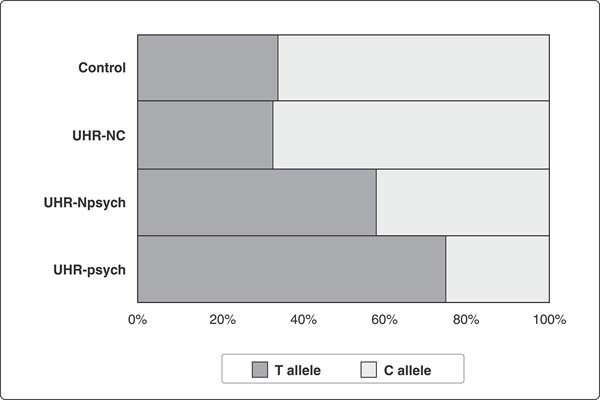
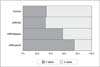
Further examining the DRD2-rs6277 SNP, TT and CT genotypes were related to higher psychiatric morbidity on follow-up, with the T allele showing a dose-response relationship (Figure 1). UHR subjects with a psychotic disorder (UHR-psych) and those with other psychiatric disorders (UHR-Npsych) had the highest T allele frequency (75 and 58%, respectively). UHR-NC and controls had the lowest T allele frequency (32 and 36%, respectively) (p = 0.003).
DISCUSSION
Our study showed that DRD2 rs6277 was significantly related to transition to psychiatric disorders and to psychosis in a general-population sample of UHR individuals. Moreover, the T allele of this SNP was associated with psychiatric morbidity in a dose-response fashion.
Few studies analyzed genetic polymorphisms in UHR samples to assess their influence in transition. Jagannath et al.12 analyzed six DAO, DAOA, and NRG1 SNPs in UHR individuals and found none to be associated with conversion to psychosis. In Australian help-seeking UHR subjects, two NRG1 SNPs and one DAOA SNP were associated with transition.13 Bousman et al.27 assessed Korean UHR subjects in a prospective cohort, and a SNP related to the cytokine interleukin (IL)-1B was associated with transition. Unlike the present work, these studies enrolled help-seeking individuals.
Concerning the SNP found, rs6277 is in DRD2, one of the several genes encoding dopamine receptors. This specific neurotransmitter pathway is implicated in aberrant salience - a hypothesis whereby dopaminergic dysregulation would lead to misattribution of significance to irrelevant stimuli - and in the production of psychotic symptoms,28 and many studies demonstrated an association between rs6277 and schizophrenia. In meta-analyses,29-31 C was the risk allele in Caucasian populations; when stratified by race, results are not the same for Asians. Accordingly, a study of 421 Chinese subjects with schizophrenia found the T allele to be associated with schizophrenia.32 This inconsistency for risk alleles is not unexpected and may be accounted for by a phenomenon known as flip-flop. Described by Lin et al.33 in 2007, it refers to a situation in which opposite alleles of the same biallelic SNP are associated with the same trait. Flip-flop can occur, for instance, when a variant is in linkage disequilibrium (LD) with an actual causal variant - in this case, the LD architecture may vary among different ethnic populations.33 Our results are thus aligned with previous reports on the association between rs6277 and psychosis, while the genotype's influence on neurobiology has yet to be investigated.
Our study has several limitations. First, our design led to a small sample size, with relatively few individuals converting to psychosis. This was an expected disadvantage of our decision to use population-based sampling to lessen the selection bias of help-seeking samples. Second, the number of SNPs studied led to the non-survival of several initially significant p-values due to correction for multiple comparisons. Third, there is no GWAS assessing the risk of schizophrenia in the Brazilian population. We tried to lessen this limitation by basing part of our research on a European GWAS,34 as Brazilians have an important European genetic background.35
To conclude, in our UHR cohort DRD2 rs6277 was significantly associated with transition to psychosis and to non-psychotic psychiatric diagnoses. Our results encourage further investigation of rs6277 in larger samples to assess its potential as a genetic biomarker of UHR mental state.
ACKNOWLEDGEMENTS
The Laboratory of Neuroscience (LIM27) receives financial support from Associação Beneficente Alzira Denise Hertzog da Silva. This work was supported by Fundação de Amparo à Pesquisa do Estado de São Paulo (FAPESP), Brazil (grant 2016/09069-1).
 PDF
 Print
 Send this article by email
 How to cite this article
 Submit a comment
 Mendeley
 Pocket
 Share on Facebook
 Share on Twitter



