



FIGURES
| Received: September 20 2022; Accepted: February 03 2023 |
It is of great importance that we do not let 2022 pass without remembering the 30th anniversary of the discovery of the mirror neuron. It was in 1992 that Giacomo Rizolatti1 and his team discovered this special type of cell while studying neuronal activation in certain tasks, more specifically, while observing that some kind of neurons were activated when monkeys observed movement. Unfortunately, the study, rejected by Nature but published by Experimental Brain Research, did not provoke the excitement it warranted in the scientific community.
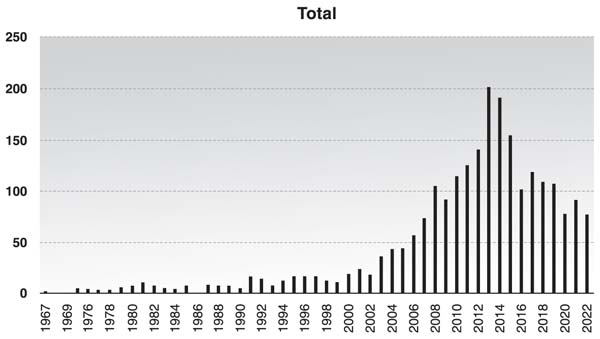
Fast forwarding 18 years, Mukamel et al.2 published a study on electrophysiology in deep-brain epilepsy patients, the only one to successfully identify similar properties in those same neurons in human brains. Until then, other studies had focused only on behavioral associations, such as movement imitation, as had been done with animals.3 A survey of PubMed (Figure 1) shows that until Mukamel et al.,2 few studies had been published on the same theme.
However, these specific neurons remained relatively unknown to the public. It was only Rizzolatti and Ramachandran (whose work praised the discovery in an Edge.org editorial years after Rizzolati's publication4) who defended the crucial importance of mirror neurons in many human social skills. Certain theories were proposed, such as the "broken mirror" hypothesis, that ascribed the difficulty autistic patients have in understanding the thoughts of others to mirror neuron deficiency.4 Nevertheless, other studies only described behavioral associations, such as the imitation or observation of movement, or used indirect brain visualization techniques, which cannot conclusively demonstrate that mirror neurons exist in humans, which is why so many scientists contest these theories.4
However, recent technology has allowed for better visualization of the brain,5 leading to a shift in opinion among skeptics. Although older studies used electroencephalography to the identify activation of these neurons, with the advent of neuroimaging, specifically transcranial magnetic stimulation and functional magnetic resonance imaging,3,6 it is now possible to explore other means of visualizing mirror neurons in action. However, the new evidence is still insufficient to resolve dispute about the "broken mirror" hypothesis.4
Thus, although the importance of mirror neurons has been considered less than what was initially assumed, and despite recent criticism, they do play an important role in many behaviors. Due to their discovery, the day-to-day lives of many neurological and psychiatric patients have been affected, e.g., the use of virtual reality to activate the mirror neuron system, their use in post-stroke6 and aphasia treatment,7 as well as in hand laterality recognition.8
 PDF
 Print
 Send this article by email
 How to cite this article
 Submit a comment
 Mendeley
 Pocket
 Share on Facebook
 Share on Twitter