



ABSTRACT:
OBJECTIVE: The process of detecting faces can be considered one of the initial steps in face
recognition, which is essential for human interaction. We sought to investigate whether
a face perception task reliably detects subtle perceptual disturbances between patients
with bipolar disorder (BD) and healthy controls.
METHODS: In this multisite study, we examined differences between BD patients and matched healthy
controls. Participants were instructed to detect the orientation (either left or right)
of a face when it was presented as a face/non-face pair on a computer screen using
Bayesian entropy estimation. Data analyses compared performance between the groups.
RESULTS: Overall, BD patients exhibited more perceptual disturbances compared with controls.
BD patients who took olanzapine had better performance and faster reaction times (RTs)
than patients who took lithium or were medication-naive. BD patients who took lithium
had better performance and faster RTs than medication-naive patients. The medication-naive
BD group exhibited greater disturbances than all other groups.
CONCLUSION: These findings highlight the reliability of the face perception task used herein and
may be important for public health initiatives and follow-up studies that seek to
understand the diverse effects of other variables that can affect sensory processing
in this population.
Keywords: Bipolar disorder; medication; olanzapine; serum levels; face perception; face detection.
FIGURES
| Received: January 23 2022; Accepted: April 04 2022 |
INTRODUCTION
The ability to detect faces is essential for human interaction. The process of detecting faces is considered an initial step of facial recognition, a high-order process that is related to both sensory and cognitive aspects. Detecting faces can be difficult because of the many attributes of the human face, such as skin tone, hair, and specific facial features.1 Impairments in facial processing can be associated with activation or disturbances of several cortical areas involved in face processing (e.g., the superior temporal sulcus, occipital lobe face area, right mid-fusiform gyrus, and fusiform area),2 both in the case of low-level stimuli (line drawings of faces) and high-level stimuli (hair and texture).2 Some studies have reported impairments in these areas in patients with bipolar disorder (BD).3,4
Although a recent study showed that facial detection can be improved by nicotine gum administration,5 some findings indicated that facial processing, in terms of facial detection, can be impaired by some mental health conditions, including schizophrenia6 and tobacco use disorder.7 The ways in which other diseases or conditions are related to impairments in facial detection remain unclear.
Bipolar disorder (BD) is a complex and chronic condition. Its clinical course is characterized by recurrent episodes of mania and depression, with periods of euthymia.8 BD can be classified according to manic, hypomanic, and depressive episodes. Perceptual disturbances in BD have been reported to involve disturbances in low-level contrast processing9 and motion perception10 at both cortical and subcortical levels.11 Whether these perceptual disturbances are impacted by medications, mood states, and other variables is unknown.
With regard to medications, studies have reported a negative relationship between benzodiazepine use and the recognition of facial expressions (i.e., higher the dose, worse the performance).12-14 Zangara et al.7 compared the effects of benzodiazepines and placebo on the ability to recognize facial expressions. Their results showed that the use of psychotropic drugs impaired the ability to recognize expressions such as anger and fear, but not other emotional expressions.14
Perceptual disturbances are increasingly seen as a therapeutic target in the treatment of BD.11,15,16 However, drawing definitive conclusions from these studies is difficult because of data heterogeneity, which is attributable to small sample sizes, undifferentiated analyses of data from patients with different BD-related conditions (e.g., BD-I, BD-II, and euthymia), and the variability of research designs and techniques that are used. Perceptual heterogeneity in BD can also influence research results and produce inconsistencies across cognitive findings.16-20 The severity of cognitive deficits that are related to perceptual disturbances (e.g., face perception) may depend on individual responses, family risk factors, age at onset,21 disease severity and clinical course,22,23 pharmacological treatment, number of manic patients in the sample and number of manic episodes, hospitalizations, and illness duration.24
Studies of patients with a long and chronic course of BD25 and first-episode BD26 found significant effects on both symptoms and cognitive function. However, some studies did not find significant associations between manic episodes and neuropsychological measurements.27 In a meta-analysis, Miskowiak et al.28 underscored the need to overcome the main limitations of several studies that associated pharmacological treatments and perceptual and cognitive function in BD. For example, drug exposure (i.e., medication exposure) slows brain reactions in patients with BD, and this slowing may be reflected as disturbances in perceptual processing, such as contrast, motion, and face processing.
One unanswered question is whether perceptual disturbances are different according to treatment strategy in BD (i.e., medicated with lithium, medicated with an antipsychotic, or unmedicated). Face perception is at the core of facial recognition processing. It is also essential for understanding the ways in which simple face processing works in patients with BD. Based on several studies of schizophrenia,6,29 a decrease in facial processing would be expected in BD. However, some cases of first-episode BD patients having better performance on perceptual measures have been reported.26,29 For example, studies have indicated that BD patients exhibit impairments in detecting contrast stimuli, regardless of medication status.9,30,31 However, symptom severity has not been thoroughly investigated in some of these studies.
There are no data on face perception in BD, and studies investigating possible perceptual disturbances in these patients are needed. The inclusion of unmedicated first-episode BD patients in studies that use a facial detection task is also needed to broaden the knowledge in this field. In the present study, we expected that face perception performance of patients with BD would differ from that of healthy controls (HCs), and that the performance of patients with BD would be related to their medication status and symptom severity. We also expected that unmedicated patients with BD would perform significantly differently from those on an antipsychotic or lithium.
METHOD
Participants
Forty-seven HCs (mean age = 31.15 years; SD = 5.97 years), 25 unmedicated, drug-naive patients with BD (mean age = 32.52 years; SD = 6.48 years), 34 patients with BD taking only olanzapine (mean age = 32.71 years; SD = 6.19 years), and 31 patients with BD taking only lithium (mean age = 29.87 years; SD = 7.22 years) were recruited from the general population or from private clinics. Participants were aged between 20 and 45 years and did not have retinal or other eye impairments on the basis of self-report and previous examinations.
BD patients met the DSM-532 criteria for type 1 BD. All were taking olanzapine or lithium for the first time. Patients were recruited from Australia, Finland, Brazil (HCs), and Russia.
Data from 14 participants were disregarded for analysis because they were met the following exclusion criteria: recent history of neurological disorder (n=1), cardiovascular disease (n=1), traumatic brain injury (n=1), chronic contact with substances such as solvents or substance use disorder (n=9), tobacco use disorder, or due to personal reasons (n=2). For the HCs, the use of medications that might affect cognitive processing (e.g., benzodiazepines) was also an exclusion criterion. The HCs had no neuropsychiatric disorders according to the Structured Clinical Interview for the DSM (SCID).32 An initial screening for eligibility was conducted, and after this assessment, the groups were classified and matched for gender, age, and education level. Eligibility criteria and the sample characterization format are available in greater detail elsewhere.29,33-36 All participants had a corrected or normal-to-corrected acuity of at least 20/20 (binocular viewing) as assessed using a Snellen chart.
Clinical assessments were conducted by professionals trained (reliability coefficient of 0.89) in the use of the SCID and symptom-rating scales. We assessed severity symptoms using the Young Mania Rating Scale (YMRS),36 the 21-item Hamilton Depression Scale (HAMD-21),37 the Brief Psychiatric Rating Scale (BPRS),38 and the Montgomery-Åsberg Depression Rating Scale (MADRS).39 Except for the unmedicated group, patients were only included in the sample if were within these score ranges for the scales: < 12 for the YMRS, < 15 for the HAM-D, < 22 for the BPRS and < 18 for the MADRS since this was the first time the patients were taking any of the medications after their first hospitalization. Unmedicated patients were recruited just after their first hospitalization. All patients on medication had been taking olanzapine or lithium for at least 6 weeks, which is long enough to reliably achieve a therapeutic effect.40
Ethical approval
The present study followed the ethical principles of the Declaration of Helsinki and was approved by the relevant ethics committee. Written informed consent was obtained from all participants.
Facial detection task
The facial detection task was validated in a previous study.7 Briefly, the stimuli were presented on an Apple iMac (1,920 × 1,080 px, 60 Hz) with luminance calibrated using a DisplayCAL photometer. The Fundação Educacional Inaciana (FEI) database was used. The image and screen background were set to a grayscale value of 127.
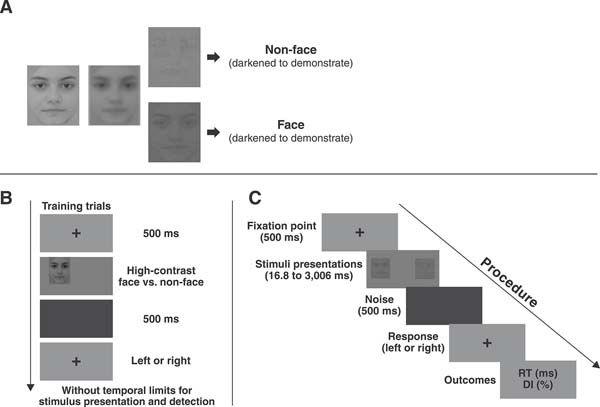
The participants were instructed to fix their gaze on a small black cross at the center of the monitor. A 2-AFC method was used. The participants' task was to indicate, using the keyboard, the direction (either left or right) of a face when present in a face/non-face pair (Figure 1C). The detection task only began after all participants understood the procedure.
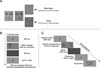
An oval mask was applied to remove visual cues (e.g., hair, texture). Gaussian smoothing was applied on each image and luminance was averaged to a grayscale value of 127 (Figure 1A). The image and screen background were set to this equivalent value. Faces were segmented (200 × 240 px) into 30 squares, each with a size of 33 × 40 px. To create the non-faces, each square was rotated, with equal probabilities, by one of the following angles: 45°, 90°, or 180°. The presentation time in each trial was selected to yield the maximum expected information for the prediction of the expected mean threshold (minimum of 75% correct responses to reach the criteria proposed by Kontsevich & Tyler41).
The presentation times ranged from 16.7 to 3,006 ms. This randomization prevented possible learning effects or response bias. The training phase consisted of some trials in which the faces or non-faces had suprathreshold contrast values (i.e., high contrast and absence of Gaussian smoothing) and were presented without time limits (Figure 1B).
Data analysis
For each condition, data distribution was assessed using measures of central tendency and measures of dispersion. Distributions for each group were compared using the Monte Carlo method for skewness and kurtosis, with a cutoff value of > 1.96.42 Statistical analysis was performed using SPSS 25.0 and MATLAB R2018b (mathworks.com).
To compare the nominal variable (gender), a nonparametric (chi-square, 4 × 2) test was conducted, and for comparisons between groups (biological and sociodemographic variables), analysis of variance (ANOVA) was used.
A multivariate analysis of variance (MANOVA) was conducted to analyze the results of the detection task for reaction time (RT) and discrimination index (DI) (two dependent variables). There was homogeneity of variance-covariance (Box's M test of covariance matrices). No multicollinearity was observed. Absence of multivariate outliers was checked assessing Cook's distance ( 4 n - k - 1 ). Canonical discriminant analysis was used as a post-hoc test. Sphericity was not violated. Cohen's f2 was used to assess effect sizes (MANOVA). Bonferroni's correction was applied to adjust the p-value and prevent type 1 errors.
Pearson's product-moment correlation (r) and the point-biserial correlation (r) were used to assess relationships between outcomes of the tests and biological and sociodemographic variables, such as age, gender, level of education, illness duration (months), medication, and scale scores.
RESULTS
Sample characteristics
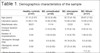
The characteristics of the participants are summarized in Table 1. The groups did not differ in age (F[3, 133] = 1.32, p = 0.270), level of education (F[3, 133] = 0.22, p = 0.884), or Mini Mental State Examination (MMSE) scores (F[3, 133] = 2.19, p = 0.064). A 4 × 2 chi-square test was conducted to compare the differences between males and females, and the results indicated no significant differences (?23 = 2.36, p = 0.501).
| Healthy controls (n=47) | BD, unmedicated (n=25) | BD, olanzapine (n=34) | BD, lithium (n=31) | |
|---|---|---|---|---|
| Age (years) | 31.15 (5.97) | 32.52 (6.48) | 32.72 (6.19) | 29.87 (7.22) |
| Education (years) | 13.09 (1.74) | 12.80 (2.90) | 12.68 (2.82) | 13.06 (2.97) |
| Male/female ratio | 26/21 | 11/14 | 12/22 | 12/19 |
| Disease duration (months) | 0.00 | 0.14 (0.04) | 0.70 (0.14) | 0.65 (0.15) |
| Number of hospitalizations | 0.00 | 1.04 (0.02) | 1.14 (0.76) | 1.08 (0.52) |
| Olanzapine dosage (mg) | 0.00 | 0.0 (0.00) | 16.18 (6.25) | 0.0 (0.00) |
| Olanzapine, serum (ng/mL) | 0.00 | 0.0 (0.00) | 27.23 (4.36) | 0.0 (0.00) |
| Lithium dosage (mg) | 0.00 | 0.0 (0.00) | 0.0 (0.00) | 712.35 (225.725) |
| Lithium, serum (mEq/L) | 0.00 | 0.0 (0.00) | 0.0 (0.00) | 0.70 (0.18) |
| YMRS | 0.00 | 16.40 (2.89) | 7.82 (1.85) | 6.96 (1.23) |
| MADRS | 0.00 | 16.04 (2.28) | 6.08 (1.89) | 3.74 (1.25) |
| HAM-D | 0.00 | 12.20 (3.52) | 5.18 (1.36) | 3.06 (1.09) |
| BPRS | 0.00 | 22.04 (3.25) | 8.04 (2.12) | 7.19 (4.16) |
| MMSE | 29.28 (0.40) | 28.24 (0.43) | 29.00 (0.59) | 29.19 (0.45) |
Data presented as mean (SD).
BD = bipolar disorder; BPRS = Brief Psychiatric Rating Scale HAM-D = Hamilton Depression Scale; MADRS = Montgomery-Åsberg Depression Rating Scale; MMSE = Mini Mental State Examination; YMRS = Young Mania Rating Scale.
Facial detection task
MANOVA indicated significant differences between groups for the facial detection task (F[6,266] = 34.32, p < 0.001, Pillai's trace = 0.87, ?2 = 0.85 [95%CI 0.74-0.97]).
Reaction time
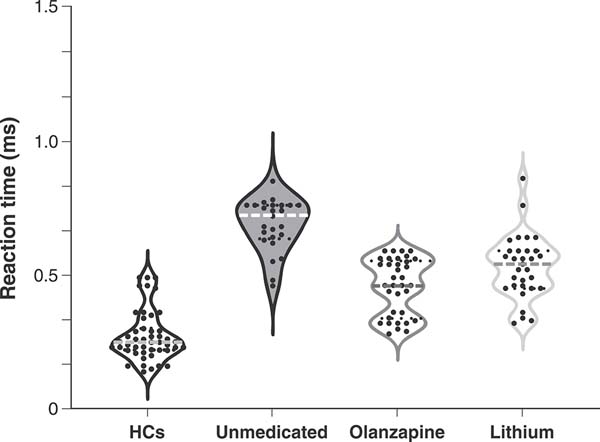
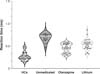
Discriminant analyses revealed that patients taking only olanzapine had faster RTs than patients taking lithium (mean difference = -0.08, SD = 0.02, p = 0.026; Hedges' g = 0.65 [95%CI 0.16-1.16]) and unmedicated patients (mean difference = -0.23, SD = 0.03, p < 0.001; Hedges' g = 2.24 [95%CI 1.60-2.93]). The results also revealed that patients taking lithium had faster RTs than unmedicated patients (mean difference = -0.16, SD = 0.03, p < 0.001; Hedges' g = 1.41 [95%CI 0.84-2.02]). HCs had faster times than all BD groups (all p-values < 0.05). The results for the RTs are summarized in Figure 2.
Discrimination index
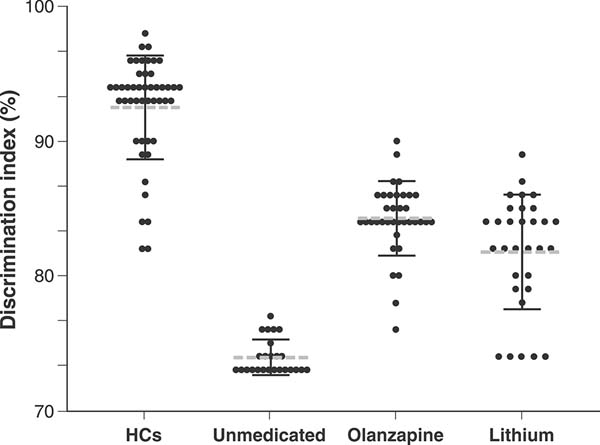
Discriminant analyses revealed that patients taking only olanzapine had higher DIs than patients taking lithium (mean difference = 2.46, SD = 0.84, p = 0.023; Hedges' g = 0.70 [95%CI 0.40-1.19]) and unmedicated patients (mean difference = 10.19, SD = 0.89, p < 0.001; Hedges' g = 4.46 [95%CI 3.54-5.59]). The results also revealed that patients taking lithium had higher DIs than unmedicated patients (mean difference = 7.74, SD = 0.90, p < 0.001; Hedges' g = 2.33 [95%CI 1.67-3.04]). HCs had higher DIs than all BD groups (all p-values < 0.05). The results for the DIs are summarized in Figure 3.
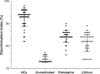
Correlation analysis
Separate analyses were performed. No significant relationships between any of the pairs of variables were found in the control group (all p-values > 0.05).
Reaction time
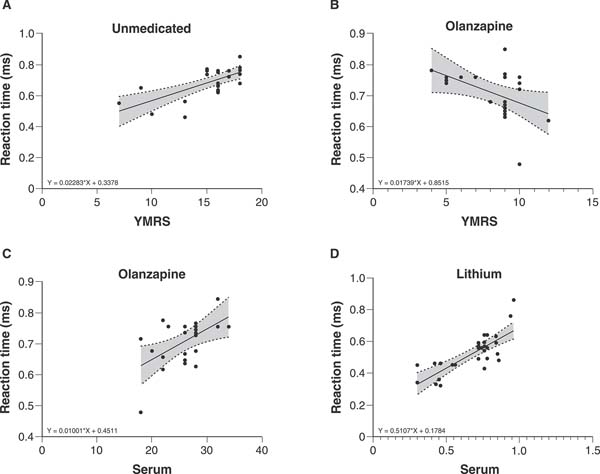
There was correlation between RT and the YMRS (r = 0.68, p < 0.001 [95%CI 0.39-0.84]) in the unmedicated group. There were correlations between RT and the YMRS (r = -0.44, p = 0.008 [95%CI -0.68 to -0.13]) and between RT and serum olanzapine level (ng/mL) (r = 0.80, p < 0.001 [95%CI 0.62-0.89]). Regarding the lithium group, there was correlation between the RT and serum lithium level (mEq/L) (r = 0.48, p < 0.001 [95%CI 0.27-0.65]). The results of the correlations for the RTs are summarized in Figure 4.
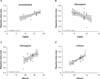
Discrimination index
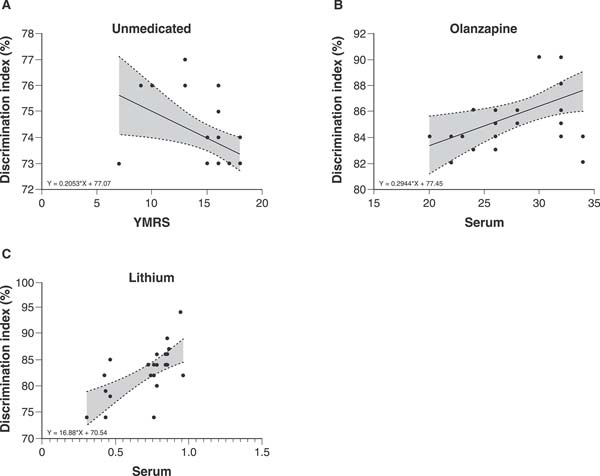
There was correlation between DI and the YMRS for the unmedicated group (r = -0.46, p = 0.020; 95%CI -0.72 to -0.09). There was correlation between DI and serum olanzapine level (ng/mL) (r = -0.48, p = 0.003; 95%CI -0.72 to -0.18). Regarding the lithium group, there was correlation between DI and serum lithium level (mEq/L) (r = -0.39, p = 0.028; 95%CI -0.65 to -0.45). The results of the correlations for the RTs are summarized in Figure 5.
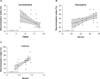
DISCUSSION
Our main findings showed the expected pattern of results. Controls exhibited higher discrimination and faster RTs than patients with BD. Those who took olanzapine had better performance than patients who took lithium and first-episode, medication-naive BD patients. Unmedicated BD patients had worse performance than all other participant groups. Serum levels of medications were associated with some scales, RT, and DI. Finally, the use of medications and the absence of medication use significantly influenced face perception.
Faces contain a wide range of spatial frequencies, with the thalamic parvocellular and ventral visual cortical streams tuned to high spatial frequencies (fine resolution, slow responses), and the magnocellular and dorsal visual streams tuned to low spatial frequencies (coarse resolution, fast responses).43,44 Face perception (or detection) and identity processing rely strongly on higher spatial frequencies.45 According to Dakin & Watt,46 mechanisms are tuned to the horizontal visual information in faces, which tends to co-align vertically forming clusters they refer to as facial "bar codes". Such one-dimensional bar codes are believed to facilitate face detection, but they are susceptible to shifts or changes in the sequence of bars in each facial code (e.g., spatial inversion, contrast-polarity reversal). At present, it is not possible to assert if BD medication affects the decoding of those facial bar codes; future studies are needed to address this suggestion.
With regard to medication, one study showed that olanzapine triggered changes in regional cerebral blood perfusion and a decrease in cerebral blood flow in the sensorimotor cortex.47 Furthermore, different reactions to medications that occur through yet-unknown mechanisms can be presumed because of the various effects of olanzapine on different brain structures.48 Treatment with olanzapine improved performance on tests of vigilance, selective attention, and delayed recall.49 Some studies reported that atypical antipsychotics led to better performance in perceptual tasks compared with other medications,50 but no such studies have been performed in patients with BD51 at the perceptual level. We suggest that the pharmacological properties of olanzapine, including its actions on dopamine D1 receptors and serotonin 5-HT2A receptors, can account for better performance in face processing. Data on the effects of lithium on perceptual processing are still scarce, thus underscoring the novelty of our study. The association between facial detection and neurotransmitters was reported in a previous study. Silva et al.7 reported that, although no neural mechanisms involved in this processes are yet known, an explanation can be inferred from some of the alterations induced by brain acetylcholine receptors. These relate to the synthesis, release, or uptake of neurotransmitters present in areas of the visual cortex or areas responsible for facial detection.
Lithium is the gold standard for mood stabilization in BD.8 However, little is known about its effect on perceptual processing, attention, information processing speed, intellectual ability, and verbal and visual memory in individuals with BD.23,52 A detrimental effect of lithium on memory and motor speed was reported by Shaw et al.53 in studies that did not subdivide patients according to BD status (e.g., manic, depressive, and euthymic). This may account for slowed sensory processing. These previous studies and their disparate findings demonstrate the scarcity of research on the effects of lithium on sensory processing. Lithium modulates neural circuits and clinically improves BD; therefore, it is essential to better understand its pharmacological actions. The heterogeneity and paucity of drug studies limit the generalizability and comparisons of results. Therefore, our data should be interpreted with caution. The deterioration in processing speed observed in BD is at least partially attributable to the diverse effects of medications and symptom severity. The mechanisms of changes in face processing that are caused by medications or result from the absence of medication use in BD patients need to be elucidated. In the present study, data were collected without association between circadian activity rhythm. Although the influence of biological rhythms on visual processing has been widely reported,54-56 there are no data regarding facial detection, which justifies future studies.
The present study has limitations. First, we investigated only one aspect of facial processing (i.e., face detection). Therefore, any inferences regarding neurophysiological or mechanisms are largely speculative. Second, the inclusion of additional measures (e.g., the use of other scales) would be helpful to understand state- or trait-like effects of the disease.57 Additional physiological approaches are needed before strong causal relationships can be defined. Although we used reliable scales, there is a need to extend the assessment of clinical variables. Finally, the absence of measurement of other physiological or biological markers (e.g., brain-derived neurotrophic factor) is also a limitation.29,58
Overall, we expect our findings will be useful to researchers, patients, and the scientific community, and may serve as indicators of sensory function in first-episode BD patients. The dosages and serum concentrations of medications and the mechanisms by which they influence face processing should be investigated in future studies.
ACKNOWLEDGEMENTS
We extend our thanks to all our volunteers for agreeing to participate. Studies on the Russian side were carried out with the support of the Russian Ministry of Education and Science on the provision of a grant in the form of subsidies from the federal budget for the implementation of state support for the creation and development of a world-class scientific center (Pavlovsk Center Integrative Physiology - Medicine), High-Tech Healthcare and Stress Resistance Technologies, and the Russian Academy of Sciences (theme no. 0134-2019-0006 [63.3.]). Conselho Nacional de Desenvolvimento Científico e Tecnológico (CNPq; grants 305258/2019-2, NAS, and 163780/2020-0, TPF) and Coordenação de Aperfeiçoamento de Pessoal de Nível Superior (CAPES) supported the Brazilian arm of this study.
DISCLOSURE
The authors report no conflicts of interest.
REFERENCES

 PDF
 Print
 Send this article by email
 How to cite this article
 Submit a comment
 Mendeley
 Pocket
 Share on Facebook
 Share on Twitter



