



ABSTRACT:
OBJECTIVES: To compare suicide rates observed in Brazil after the onset of the COVID-19 pandemic
with the estimated rate based on suicide deaths between 2010 and 2020, and identify
sociodemographic variables associated with this outcome.
METHODS: Ecological time-series study. Data were obtained from Brazilian Unified Health System
Department of Information Technology (DATASUS), with the structural break of the data
set in March 2020. The number of actual suicides observed and the number of expected
suicides if there were no COVID-19 pandemic were analyzed through bayesian structural
time series modeling.
RESULTS: The overall incidence of suicides in Brazil remained stable after the start of the
COVID-19 pandemic compared to what would be expected. However, there was a significant
increase in suicide deaths among women (6.9%) and older adult (9.1%). Analysis by
macro-regions of the country showed significant increases in suicide deaths in the
Center-West (7.4%), Northeast (5.7%), and Southeast (10%). Stratified analyses revealed
differences according to age, sex, education, and skin color.
CONCLUSIONS: Despite stability in the overall number of suicides, this phenomenon occurs heterogeneously
among different population groups and regions of Brazil. Rates have increased in populations
with a history of poor access to health, which may have been more severely impacted
by the pandemic.
Keywords: Suicide; COVID-19; Brazil; pandemics.
FIGURES
| Received: March 12 2022; Accepted: June 18 2022 |
INTRODUCTION
The COVID-19 pandemic crisis has led to serious consequences for the mental health of the population.1 In parallel to the biological threat, restrictive measures such as quarantine and isolation, as well as economic and social challenges, may have contributed to increasing psychological distress.2 Fear, anxiety, uncertainty, and grief - all known risk factors for psychiatric disorders - were exhaustively reported.3,4
Previous studies demonstrated that major crises, such as disasters or public health emergencies, have led to an increase in suicide rates.5-8 During the COVID-19 pandemic, numerous investigations explored this phenomenon; nonetheless, their findings are still ambiguous.9 A recent systematic review reported stability or modest reductions in suicide rates, especially in high and middle-income countries.9 On the other hand, middle and low-income countries are underrepresented in the literature, although they account for 77% of all suicide deaths worldwide.9 Furthermore, the effect of major crises on suicide rates may vary over time or be heterogeneous within the same country. In other words, the stability of the suicide rate could be the result of this rate increasing in some groups while decreasing in others.
Brazil was one of the main epicenters of the pandemic during the year 2020. Investigations conducted in the country demonstrated a high level of psychological distress10 and high rates of suicidal ideation in this period.11 Moreover, despite the reduction in the number of inpatient and outpatient appointments in mental health care during the pandemic, the number of hospitalizations due to suicide risk remained stable in Brazil in comparison to the previous year's.12 To date, there are no studies investigating whether there were changes in suicide rates in Brazil after the onset of the pandemic and potential regional and sociodemographic differences in these rates. Importantly, Brazil has an integrated unified public health system with the potential to collect accurate epidemiological data and provide targeted interventions to more vulnerable subpopulations. In this study, we aimed to compare the actual suicide rates observed in Brazil after the onset of the COVID-19 pandemic with the expected rate (based on suicide deaths between 2010 and 2020) and to identify sociodemographic variables associated with this outcome in the five Brazilian macro-regions.
METHODS
Study design and procedures
An ecological time-series study was carried out. Data on deaths by suicide that occurred from January 2010 to December 2020 were extracted from the National Mortality Information System (Sistema Nacional de Informações sobre Mortalidade [SIM]), maintained by the Brazilian Unified Health System Department of Information Technology (DATASUS), in May 2022. This database is managed by the Brazilian Ministry of Health and gathers information on all deaths that occur in the country. Deaths were identified in the system under the category of "intentional self-harm," according to the ICD-10. Then, information on sociodemographic characteristics (age, sex, skin color, educational attainment, and region of residence) was collected. Analyses were conducted to identify the total amount of suicides estimated in Brazil, and independent analyses were performed for each of the country's five regions. In both cases, secondary analyses of sociodemographic data were performed.
Statistical analysis
Data were analyzed in R software, version 4.1.3. The structural break was set in March 2020. To estimate the average number of suicide deaths and the predicted number if there was no COVID-19 pandemic, the causalimpact R package was used for causal inference using bayesian structural time-series models. This model was used to estimate the counterfactual, i.e., how suicide deaths would have progressed after the breakpoint (March 2020) if the pandemic had not occurred. A heat map of the percent change in suicide rates associated with the pandemic was created using the heatmap package.
Ethics statements
According to Brazilian legislation (National Health Council resolutions no. 466 of December 12, 2012 and no. 510 of April 7, 2016), research on public databases is exempted from ethical committee approval.
RESULTS
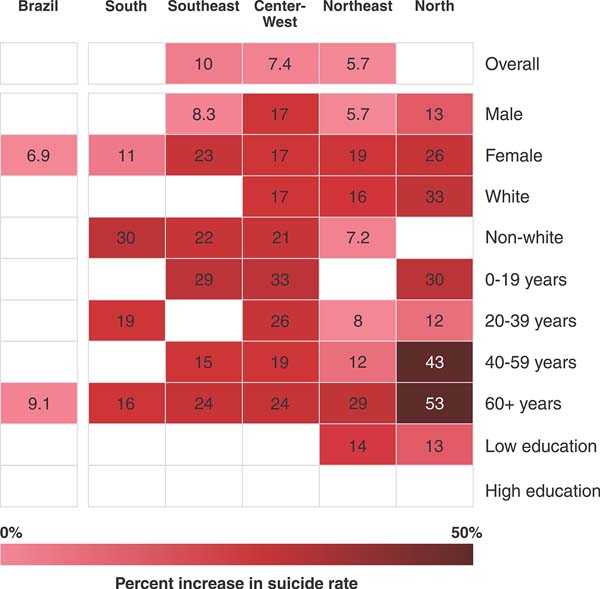
The overall incidence of suicides in Brazil remained stable in 2020, after the beginning of the COVID-19 pandemic, with no significant difference compared to the expected rate (p = 0.486). However, subgroup analyses revealed a significant increase in self-inflicted deaths in women (6.9%, p = 0.017) and in people aged 60 and older (9.1%, p = 0.004). Analysis according to the macro-region of residence showed a significant increase in suicides in the Center-West (7.4%, p = 0.032), Northeast (5.7%, p = 0.027), and Southeast (10%, p = 0.007). Stratified analyses revealed that the impact of the pandemic on suicides was heterogeneous, depending on the population group assessed (Table 1). In men, the most pronounced increase was observed in the Center-West (17%, p = 0.001); in women, a higher increase was observed in the North (26%, p = 0.002), in the Southeast (23%, p = 0.001), and in the Northeast (19%, p = 0.001). In white individuals, there was a significant increase in suicide rates in the North (33%, p = 0.011), in the Center-West (17%, p = 0.016), and in the Northeast (16%, p = 0.010). In non-whites, the most pronounced increases were observed in the South (30%, p = 0.001), in the Southeast (22%, p = 0.001), and in the Center-West (21%, p = 0.001). Regarding age, young people (up to 19 years old) presented significantly higher levels of suicide in the Center-West (34%, p = 0.004), in the North (30%, p = 0.004), and in the Southeast (29%, p = 0.004); young adults (20-39 years), in the Center-West (26%, p = 0.001); middle-aged adults (40-59 years) in the North (43%, p = 0.001), Center-West (19%, p = 0.005), Southeast (15%, p = 0.001), and Northeast (12%, p = 0.002). Older adults (over 60) presented a significant increase in suicide rates in all five macro-regions, with the most pronounced increase reported in the North (53%, p = 0.002). Individuals with low educational attainment (up to 7 years of schooling) had higher rates in the Northeast (14%, p = 0.001) and in the North (13%, p = 0.022). Among those with 8 years or more of schooling, no significant increase in suicide rates was observed in any region. Figure 1 summarizes the main findings of this study, highlighting the respective population groups and regions of residence where increases in suicide rates were observed.
| Prediction┼ (95%CI) | Average during the pandemic | Relative effect (95%CI)╬ | Bayesian p-value§ | |
|---|---|---|---|---|
| Brazil (overall) | 11,334 (10,737-11,900) | 11,353 | 0.17 (-4.8 to 5.4) | 0.486 |
| Region | ||||
| Center-West | 1,010 (930-1,088) | 1,085 | 7.4 (-0.28 to 15.0) | 0.032 |
| Northeast | 2,548 (2,394-2,695) | 2,694 | 5.7 (-0.3 to 12.0) | 0.027 |
| North | 855 (764-944) | 904 | 5.8 (-4.6 to 16.0) | 0.143 |
| Southeast | 3,753 (3,468-4,052) | 4,136 | 10.0 (-2.2 to 18.0) | 0.007 |
| South | 2,569 (2,394-2,750) | 2,534 | -1.4 (-8.4 to 5.4) | 0.355 |
| Sex | ||||
| Male (overall) | 8,913 (8,460-9,366) | 8,881 | -0.36 (-5.4 to 4.7) | 0.447 |
| Center-West | 729 (642-805) | 854 | 17.0 (6.7 to 29.0) | 0.001 |
| Northeast | 2,039 (1,913-2,162) | 2,155 | 5.7 (-0.34 to 12.0) | 0.041 |
| North | 629 (550-703) | 709 | 13.0 (0.91 to 25.0) | 0.016 |
| Southeast | 2903 (2665-3130) | 3,145 | 8.3 (0.52 to 17.0) | 0.022 |
| South | 2,021 (1,866-2,172) | 2,018 | - 0.17 (-7.6 to 7.5) | 0.489 |
| Female (overall) | 2,310 (2,133-2,456) | 2,470 | 6.9 (0.6 to 15.0) | 0.017 |
| Center-West | 196 (158-230) | 230 | 17.0 (-0.10 to 37.0) | 0.027 |
| Northeast | 453 (404-505) | 539 | 19.0 (7.5 to 30.0) | 0.001 |
| North | 154 (123-184) | 195 | 26.0 (7.0 to 47.0) | 0.002 |
| Southeast | 803 (723-887) | 990 | 23.0 (13.0 to 33.0) | 0.001 |
| South | 464(415-517) | 516 | 11.0 (-0.2 to 22.0) | 0.029 |
| Skin color | ||||
| White (overall) | 5,457 (5,185-5763) | 5,352 | -1.9 (-7.5 to 3.1) | 0.263 |
| Center-West | 328 (274-376) | 383 | 17.0 (2.0 to 33.0) | 0.016 |
| Northeast | 340 (297-384) | 393 | 16.0 (2.5 to 28.0) | 0.010 |
| North | 98 (75-124) | 130 | 33.0 (6.1 to 56.0) | 0.011 |
| Southeast | 2,173 (2,023-2,329) | 2,290 | 5.4 (-1.8 to 12.0) | 0.080 |
| South | 2,189 (2,042-2,342) | 2,156 | -1.5 (-8.5 to 5.2) | 0.352 |
| Non-white (overall) | 5,793 (5,482-6,085) | 6,001 | 3.6 (-1.5 to 9.0) | 0.090 |
| Center-West | 578 (513-639) | 702 | 21.0 (11.0 to 33.0) | 0.001 |
| Northeast | 2,147 (2,009-2,290) | 2,301 | 7.2 (0.49 to 14.0) | 0.018 |
| North | 709 (623-785) | 774 | 9.2 (-1.5 to 21.0) | 0.055 |
| Southeast | 1,512 (1,371-1,661) | 1,846 | 22.0 (12.0 to 31.0) | 0.001 |
| South | 291 (236-340) | 378 | 30.0 (13.0 to 49.0) | 0.001 |
| Age | ||||
| 0-19 years (overall) | 939 (846-1039) | 959 | 2.1 (-8.5 to 12.0) | 0.334 |
| Center-West | 97 (74-121) | 129 | 33.0 (8.2 to 57.0) | 0.004 |
| Northeast | 193 (160-227) | 212 | 9.9 (-7.6 to 27.0) | 0.136 |
| North | 131 (102-160) | 170 | 30.0 (7.7 to 52.0) | 0.004 |
| Southeast | 229 (187-275) | 295 | 29.0 (8.7 to 47.0) | 0.005 |
| South | 136 (105-166) | 153 | 12.0 (-9.4 to 35.0) | 0.145 |
| 20-39 years (overall) | 4,425 (4,136-4,715) | 4,444 | 0.44 (-6.1 to 7.0) | 0.454 |
| Center-West | 391 (343-443) | 491 | 26.0 (12.0 to 38.0) | 0.001 |
| Northeast | 968 (887-1049) | 1,045 | 8.0 (-0.42 to 16.0) | 0.034 |
| North | 368 (319-418) | 412 | 12.0 (-1.7 to 25.0) | 0.043 |
| Southeast | 1,574 (1,453-1,703) | 1,601 | 1.7 (-6.5 to 9.4) | 0.312 |
| South | 750 (665-838) | 895 | 19.0 (7.6 to 31.0) | 0.001 |
| 40-59 years (overall) | 3,626 (3,403-3,831) | 3,779 | 4.2 (-1.4 to 10.0) | 0.082 |
| Center-West | 257 (221-294) | 307 | 19.0 (5.0 to 34.0) | 0.005 |
| Northeast | 800 (736-872) | 900 | 12.0 (3.5 to 21.0) | 0.002 |
| North | 151 (120-183) | 217 | 43.0 (23.0 to 64.0) | 0.001 |
| Southeast | 1,287 (1,171-1,404) | 1,478 | 15.0 (5.7 to 24.0) | 0.001 |
| South | 833 (748-914) | 877 | 5.3 (-4.4 to 15.0) | 0.151 |
| 60 years or older (overall) | 1,971 (1,826-2,112) | 2,151 | 9.1 (2.0 to 16.0) | 0.004 |
| Center-West | 126 (99-151) | 156 | 24.0 (3.6 to 45.0) | 0.012 |
| Northeast | 414 (361-466) | 533 | 29.0 (16.0 to 42.0) | 0.001 |
| North | 67 (49-84) | 102 | 53.0 (27.0 to 79.0) | 0.002 |
| Southeast | 606 (525-675) | 753 | 24.0 (13.0 to 38.0) | 0.001 |
| South | 522 (449-598) | 607 | 16.0 (1.7 to 30.0) | 0.015 |
| Education | ||||
| 0-7 years (overall) | 4,154 (3,874-4,429) | 4,344 | 4.6 (-2.0 to 11.0) | 0.101 |
| Center-West | 364 (319-413) | 402 | 10.0 (-3.0 to 23.0) | 0.061 |
| Northeast | 1,197 (1,048-1,304) | 1,370 | 14.0 (5.5 to 24.0) | 0.001 |
| North | 367 (321-413) | 415 | 13.0 (0.43 to 25.0) | 0.022 |
| Southeast | 1,244 (1,131-1,347) | 1,248 | 0.32 (-8.0 to 9.4) | 0.439 |
| South | 944 (860-1032) | 909 | -3.7 (-13.0 to 5.2) | 0.192 |
| 8 years or more (overall) | 4,779 (4,492-5,102) | 4,529 | -5.2 (-8.0 to 9.4) | 0.050 |
| Center-West | 500 (447-553) | 526 | 5.1 (-5.4 to 16.0) | 0.181 |
| Northeast | 726 (653-795) | 705 | -2.9 (-12.0 to 7.2) | 0.288 |
| North | 400 (350-449) | 398 | -0.39 (-13.0 to 12.0) | 0.469 |
| Southeast | 1,835 (1,699-1,973) | 1,874 | 2.1 (-5.4 to 9.6) | 0.308 |
| South | 1,086 (983-1,180) | 1,026 | -5.5 (-14.0 to 3.9) | 0.132 |
DISCUSSION
To our knowledge, this study is the first to analyze official rates of suicide in Brazil in 2020, after the onset of the COVID-19 pandemic, and compare it to the previous 10 years' rates. Despite the stability in suicidal death rates after the onset of this crisis in the overall population, the incidence of suicide was heterogeneous in Brazil, with significant increases in some groups of individuals as defined by sociodemographic characteristics, such as region of residence, sex, skin color, age, and educational attainment. This is in line with studies conducted in other countries that showed an increase in suicides in some minority groups since the beginning of the pandemic.13-15
Suicide presented as a heterogeneous phenomenon worldwide during the COVID-19 pandemic. In Japan, for example, there was a 14% reduction in suicides between February and July 2020, followed by a 16% increase between July and October.16 In agreement with this, a study conducted in Canada projected increases in suicide rates in the years following the pandemic as a consequence of the economic crisis,17 which also corroborates an investigation that reported a rise in suicide rates among teenagers in England in the years after the economic crisis of 2008.18
Brazil already had large socioeconomic disparities, a high prevalence of mental health disorders,19 and rising suicide rates before the pandemic.20,21 There is a complex interaction between socioeconomic and other risk factors, including the emergence of mental health disorders and health and environmental crises. Altogether, these factors can ultimately lead to an increase in suicide rates in some groups.7 Accordingly, previous studies reported that, in Brazil, the spread of COVID-19 was widely affected by socioeconomic vulnerability settings.22 For instance, cities with less social inequality, better healthcare coverage, and higher social development were less affected by the pandemic.23 Conversely, social isolation was associated with the reduction of support mechanisms, especially among the poorest.16 Individuals with fewer financial resources suffer a synergistic negative effect of the pandemic, as it perpetuates poverty and is perpetuated by it.24 This vulnerable group also presents more job instability, which can trigger stress, depression, and less privacy at home, aggravating family conflicts.25 In addition, they have less access to mental health care.26 These pieces of information are important to understand why there was a rise in self-inflicted deaths during the COVID-19 pandemic only in some groups.
Suicide rates varied substantially across the Brazilian regions. The sharpest increase in suicide rates was observed in groups with the highest socioeconomic vulnerability, including housing vulnerability, and informal workers.22 The North and Northeast regions, for example, have the lowest Human Development Index (HDI) in Brazil, with substantial socioeconomic inequality, extreme poverty,27,28 and the greatest scarcity of public hospital resources.22 Economic instability and poor access to health care are common risk factors for suicidal behavior.29 These results are similar to those evidenced in Nepal and India, where the most dramatic increases in suicide rates have been observed in settings with high poverty rates and low HDI.30,31 Furthermore, in the North and Center-West, an indicator of mental health care coverage (lndice de Cobertura Assistencial da Rede de Atenção Psicossocial) is substantially lower than in the South and Southeast regions, which may impact psychosocial support and aggravate mental health conditions.32
The North region was one of the epicenters of crisis during the pandemic.33 This finding is in line with a large study conducted in China which observed that people living in regions where the pandemic was most severe had higher psychological distress levels.34 Despite being a region with higher HDI than the North and Northeast,27 the Center-West has had the highest suicide rates in Brazil in recent years.21 Some socio-cultural factors may potentially be associated with this finding. This region is at the forefront of the national agricultural economy. Agricultural workers have higher rates of death by suicide when compared to other occupations,35 and individuals living in rural areas present significantly higher suicide rates than those living in urban settings.36 Other social determinants such as masculinity, social isolation, difficult access to health services, and exposure to pesticides are explanatory hypotheses well described in the literature.35,37
On other hand, our findings suggested stable suicide rates in individuals with higher education levels. This finding is in line with previous studies that show that higher educational attainment may be a protective factor.38 Even though data on income are not available in DATASUS, schooling might be an indication of more favorable socioeconomic conditions, and a protective factor against suicide. It is possible that higher schooling mitigated the economic impact of the pandemic, as it may be associated with more formal jobs and the possibility of remote work.28 In this sense, a recent study with data from the Brazilian Longitudinal Study of Adult Health (ELSA-Brazil) cohort reported that psychiatric symptoms were slightly reduced throughout 2020 in public servants of a Southeastern university who were working remotely.39
Non-white individuals presented increased suicide rates in four Brazilian regions. This population has higher socioeconomic vulnerability and less access to health and education across Brazil.13,28 This finding is in accordance with a recent study which reported differences in mortality by suicide trends according to skin color in the U.S. state of Maryland during the pandemic.13 Interestingly, the greatest increase in suicide among non-white people was evidenced in the Southern region, where the population is predominantly white (78.3%) and where there is great economic and social disparity between whites and non-whites. In 2020, in the state of Rio Grande do Sul, the income of white individuals was significantly higher than that of non-whites.40 A recent report revealed that, in Brazil, extreme poverty and poverty rates among blacks and browns were more than double those observed for whites, and even more so among Black and Brown women.28
Our findings showed a paradoxical increase in suicide rates among women during the pandemic. A pronounced increase in suicide among women has also been reported in other countries, such as Japan.41 Historically, suicide rates are lower in women,42 but they are more vulnerable to depression and anxiety when compared to men.43-45 One possible explanation is that isolation has led to an overload of additional stress due to an increase in domestic tasks and domestic violence, affecting women's wellbeing.16
Another relevant finding is the increase in suicide rates among older adults, corroborating a recent study that assessed trends in suicide rates in Brazil before the pandemic (from 1997 to 2015).42 The elderly are known to be more vulnerable to suicide due to a complex interaction between neurological and social factors.46 The prevalence of depressive disorders, for example, is higher among older compared to younger adults.46 Recent studies highlighted that this population was particularly affected by the pandemic, possibly because measures to control the pandemic increased loneliness, triggering or worsening psychiatric conditions.47 Moreover, the pandemic may have created barriers to access to mental health care.48 The increase in suicide among young adults was also evidenced in three regions, all of them with rates in excess of 30% compared to the expected figure. A significant increase in the burden of mental illness in children and adolescents was reported during the first year of the pandemic.49 This may be associated with isolation, reduced contact with peers, and overexposure to news about COVID-19, among other factors.49,50
This investigation has limitations, most of which are intrinsic to ecological studies. The performance of pooled analyses without the identification of individual cases precludes variable adjustments, which may hide the existence of confounding factors. It was also impossible to evaluate income because this information is not available in DATASUS; hence, we included data on the HDI of each macro-region in the discussion. In the analyses considering data from different regions, the reduced sample size for some variables may also have led to possible biases. Finally, death by "undetermined causes," which may include suicides that were not reported as such, was not analyzed, which may have led to an underestimation of suicide rates. Therefore, future studies must continue to assess suicide rate trends in the coming years, stratified by subgroups known to be at risk in the Brazilian reality. In the realm of public health policy, the development of psychosocial strategies targeted at the most vulnerable groups may be able to reduce suicide attempts.
In sum, overall suicide rates in Brazil remained stable despite the COVID-19 pandemic, but some population groups seem to be more vulnerable than others. Specifically, older adults, non-white populations, and women, predominantly from regions with greater socioeconomic discrepancies, have higher suicide rates. Finally, it bears mentioning that changes in suicide patterns may not occur immediately after tragedies and public health emergencies.9
 PDF
 Print
 Send this article by email
 How to cite this article
 Submit a comment
 Mendeley
 Pocket
 Share on Facebook
 Share on Twitter



