



| Received: March 22 2020; Accepted: December 1 2020 |
This study translated and validated a Brazilian-Portuguese version of the Affective and Cognitive Measure of Empathy (ACME-BP). Whereas most empathy scales measure cognitive empathy and affective empathy, their affective subscale only reflects affective resonance - feeling the same emotion as others. The ACME expands the measurement of affective empathy with a third subscale that measures affective dissonance - feeling an opposing emotion, such as pleasure from others' pain, or pain from others' pleasure. Compared to previous measures of empathy, which predict 1-4% of the variance in aggression and externalizing disorders,1 the ACME predicts 15-30% of variance in these constructs.2
This study recruited 338 Brazilian community members, who completed the 28-item Interpersonal Reactivity Index (IRI), a traditional measure of empathy,3 and the 36-item ACME-BP. To construct the ACME-BP, the English ACME was first translated by a native Brazilian-Portuguese speaker and then back-translated by a native speaker of English, naive to the ACME. The back-translated version was compared to the original English ACME by one of its authors (Vachon) and two other collaborators who judged if the two versions were equivalent in meaning. A sample of 10 people then evaluated the readability of ACME-BP items, and three experts judged the semantic validity of each item.
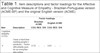
After collecting the data, structural equation modeling was used to validate the three-factor model of empathy. The data were suitable for factor extraction, based on a Kaiser-Meyer-Olkin index of 0.90 and Bartlett's test of sphericity (p < 0.001). The model had good fit: ?2 (591) = 697.46, p = 0.002; comparative fit index = 0.949; Tucker-Lewis index = 0.945; root mean square error of approximation = 0.023.4 Factor loadings are presented in Table 1; only items that loaded on a theory-congruent factor and had adequate factor loadings were retained, defined as a factor loading above 0.32.5 The factor loadings for ACME and ACME-BP were very similar, differing on average by 0.10. They also showed nearly identical factor correlations: across both measures, cognitive empathy was correlated with affective resonance at 0.32-0.34, cognitive empathy with affective dissonance at 0.16-0.20, and affective resonance with affective dissonance at 0.71-0.75. Taken together, these findings provide evidence of structural generalizability.
| Factor loadings | |||||||
|---|---|---|---|---|---|---|---|
| Brazilian ACME | English ACME | ||||||
| Item | Description | COG | RES | DIS | COG | RES | DIS |
| Cognitive empathy (COG) | |||||||
| 1r | I have a hard time reading people's emotions / Tenho dificuldade para ler as emoções dos outros | 0.72 | -- | -- | 0.81 | -- | -- |
| 3 | I can tell when someone is afraid / Eu consigo perceber quando alguém está com medo | 0.60 | -- | -- | 0.59 | -- | -- |
| 4 | It's obvious when people are pretending to be happy / É óbvio para mim quando as pessoas fingem que estão felizes | 0.39 | -- | -- | 0.60 | -- | -- |
| 9 | I usually understand why people feel the way they do / Normalmente, eu compreendo por que as pessoas se sentem de determinada maneira | 0.58 | -- | -- | 0.65 | -- | -- |
| 14r | I have a hard time figuring out what someone else is feeling / Tenho dificuldade para compreender o que outra pessoa está sentindo | 0.72 | -- | -- | 0.78 | -- | -- |
| 15 | I can tell when people are about to lose their temper / Eu consigo perceber quando as pessoas estão prestes a perder a calma | 0.59 | -- | -- | 0.58 | -- | -- |
| 16 | I can usually predict how someone will feel / Geralmente, eu consigo prever como alguém irá se sentir | 0.67 | -- | -- | 0.66 | -- | -- |
| 25 | I can usually tell how people are feeling / Normalmente, eu consigo perceber como as pessoas estão se sentindo | 0.80 | -- | -- | 0.82 | -- | -- |
| 31r | I am not good at understanding other people's emotions / Eu não sou bom em compreender as emoções dos outros | 0.75 | -- | -- | 0.71 | -- | -- |
| 33 | I can usually guess what's making someone angry / Normalmente, eu consigo adivinhar o que está deixando alguém com raiva | 0.67 | -- | -- | 0.69 | -- | -- |
| 34 | People don't have to tell me when they're sad, I can see it in their faces / As pessoas não precisam me dizer quando estão tristes, eu consigo ver em seus rostos | 0.73 | -- | -- | 0.87 | -- | -- |
| 35r | I find it hard to tell when someone is sad / É difícil para mim perceber quando alguém está triste | 0.62 | -- | -- | 0.81 | -- | -- |
| Affective resonance (RES) | |||||||
| 7 | It makes me feel good to help someone in need / Ajudar alguém que está passando necessidade faz com que eu me sinta bem | -- | 0.64 | -- | -- | 0.86 | -- |
| 8 | I get excited to give someone a gift that I think they will enjoy / Eu fico empolgado(a) ao dar para alguém um presente que penso que irá gostar | -- | 0.32 | -- | -- | 0.43 | -- |
| 12r | I don't worry much about hurting people's feelings / Eu não me preocupo muito em ferir os sentimentos dos outros | -- | 0.60 | -- | -- | 0.72 | -- |
| 13r | I don't really care if other people feel happy / Não me importo se outras pessoas estão felizes | -- | 0.39 | -- | -- | 0.54 | -- |
| 17r | I don't really care if people are feeling depressed / Não me importo se outras pessoas estão deprimidas | -- | 0.68 | -- | -- | 0.68 | -- |
| 22r | Other people's feelings don't bother me at all / Os sentimentos das outras pessoas não me incomodam nem um pouco | -- | 0.52 | -- | -- | 0.66 | -- |
| 23 | I feel awful when I hurt someone's feelings / Sinto-me péssimo(a) quando firo os sentimentos de alguém | -- | 0.55 | -- | -- | 0.60 | -- |
| 24r | Other people's misfortunes don't bother me much / As desgraças dos outros não me incomodam muito | -- | 0.75 | -- | -- | 0.75 | -- |
| 28 | If I see that I am doing something that hurts someone, I will quickly stop / Se eu percebo que estou fazendo algo que machuca alguém, eu paro na mesma hora | -- | 0.45 | -- | -- | 0.59 | -- |
| 29 | I often try to help people feel better when they are upset / Frequentemente, tento ajudar as pessoas a se sentirem melhor quando estão chateadas | -- | 0.49 | -- | -- | 0.60 | -- |
| 30 | I enjoy making others happy / Eu sinto prazer em fazer os outros felizes | -- | 0.58 | -- | -- | 0.84 | -- |
| 32r | People have told me that I'm insensitive / Já me disseram que sou insensível | -- | 0.59 | -- | -- | 0.57 | -- |
| Affective dissonance (DIS) | |||||||
| 2r | I think it's fun to push people around once and a while / Acho divertido intimidar as pessoas de vez em quando | -- | -- | 0.53 | -- | -- | 0.51 |
| 5r | I love watching people get angry / Adoro ver as pessoas ficarem com raiva | -- | -- | 0.72 | -- | -- | 0.56 |
| 6r | I enjoy seeing strangers get scared / Sinto prazer em ver pessoas que não conheço se assustarem | -- | -- | 0.45 | -- | -- | 0.55 |
| 10r | When my friends are having a good time I often get angry / Frequentemente me sinto irritado(a) quando meus amigos estão se divertindo | -- | -- | 0.30 | -- | -- | 0.41 |
| 11r | People who are cheery disgust me / Sinto desprezo por pessoas "alegrinhas" | -- | -- | 0.47 | -- | -- | 0.72 |
| 18r | I like making other people uncomfortable / Gosto de deixar os outros desconfortáveis | -- | -- | 0.52 | -- | -- | 0.50 |
| 19r | I get a kick out of making other people feel stupid / Sinto prazer em fazer com que os outros se sintam bobos | -- | -- | 0.66 | -- | -- | 0.57 |
| 20r | When my friends get angry I often feel like laughing / Quando meus amigos ficam com raiva, muitas vezes sinto vontade de rir | -- | -- | 0.54 | -- | -- | 0.55 |
| 21r | Sometimes I enjoy seeing people cry / Às vezes, sinto prazer em ver pessoas chorando | -- | -- | 0.53 | -- | -- | 0.69 |
| 26r | Sometimes it's funny to see people get humiliated / Às vezes, é engraçado ver pessoas sendo humilhadas | -- | -- | 0.52 | -- | -- | 0.45 |
| 27r | If I could get away with it, there are some people I would enjoy hurting / Se eu pudesse sair impune, há algumas pessoas que eu sentiria prazer em machucar | -- | -- | 0.64 | -- | -- | 0.45 |
| 36r | I admit that I enjoy irritating other people / Admito que sinto prazer em irritar outras pessoas | -- | -- | 0.73 | -- | -- | 0.49 |
Cognitive empathy (COG) = 1r, 3, 4, 9, 14r, 15, 16, 25, 31r, 33, 34, 35r.
Affective resonance (RES) = 7, 8, 12r, 13r, 17r, 22r, 23, 24r, 28, 29, 30, 32r.
Affective dissonance (DIS) = 2r, 5r, 6r, 10r, 11r, 18r, 19r, 20r, 21r, 26r, 27r, 36r.
r = reverse scored item: items are administered on 5-point Likert scale ranging from strongly disagree (1) to strongly agree (5). On all three scales (including DIS), high scores indicate greater empathy.
Finally, the ACME-BP scales were internally reliable (0.81 = a = 0.90) and had high 6-month test-retest reliability (0.81 = ? = 0.89). Theoretically similar constructs on the IRI correlated strongly with those of the ACME-BP (0.40 = r = 0.66), providing evidence of concurrent validity. It is worth noting that the sample was disproportionately young (20% of participants older than 38), limiting the generalizability of the results. Future work should evaluate the ACME in older Brazilian samples and in clinical samples. The ACME-BP is a short, useful measure of empathy that shows evidence of internal consistency, test-retest reliability, and structural generalizability in a Brazilian sample.
Disclosure
The authors report no conflicts of interest.
 PDF
 Print
 Send this article by email
 How to cite this article
 Submit a comment
 Mendeley
 Pocket
 Share on Facebook
 Share on Twitter