



FIGURES
| Received: November 9 2020; Accepted: November 19 2020 |
Data from around the world suggest that the coronavirus disease 2019 (COVID-19) pandemic and its associated social distancing policies are linked to a worrying rise in depression and anxiety, especially in young adults, women, and parents.1,2 However, most empirical studies are cross-sectional, and few have followed a longitudinal design that includes pre-pandemic measures.
Given the impact of COVID-19 on the Brazilian economy and support systems, the number of cases and deaths, combined with the lockdown and a context in which women frequently have a higher household and childcare workload, the impact of this pandemic on maternal mental health could be especially severe.3 However, empirical data is still scarce.
We nested two online surveys into the 2019 Rio Grande birth cohort - located in a medium-sized southern Brazilian city. All 2019 hospital deliveries were identified, and the mothers were invited to answer a baseline questionnaire (n=2,314) including the Edinburgh Postnatal Depression Scale (EPDS)4 and the Generalized Anxiety Disorder 7-item (GAD-7) scale.5 In 2020, two web-based follow-ups investigated aspects related to COVID-19 and mental health, also using the EPDS and GAD-7. The first wave of data collection occurred between May and July, and the second started in July and will end in December. Thus, the results presented here are still preliminary. We used a cut-off = 13 on the EPDS to define depression, and a cut-off = 10 on the GAD-7 to define anxiety.
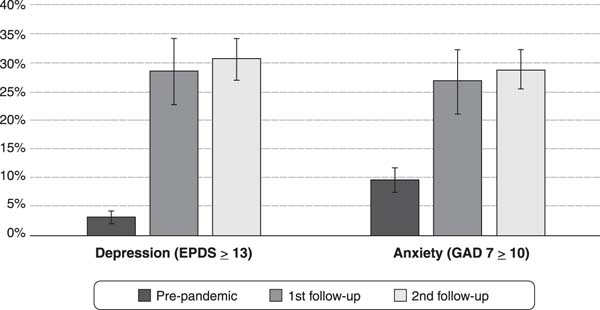
For the web-based follow-ups (first and second waves), mothers of liveborn singletons who lived in the urban area of Rio Grande, Brazil we considered eligible to participate (n=2,051). For our analysis we included only mothers with complete information for baseline and both follow-ups, representing 28.8% (n=591) of those eligible. The prevalence of depression rose from 3.1% (95% confidence interval [95%CI] 1.9%-4.8%) at the pre-pandemic assessment to 28.4% (95%CI 24.9%-32.2%) at the first wave of data collection, and then to 30.6% (95%CI 27.0%-34.5%) at the second wave. Anxiety increased from 9.6% (95%CI 7.5%-12.3%) to 26.7% (95%CI 23.3%-30.5%) and then to 28.8% (95%CI 25.3%-32.6%) (Figure 1). Comparing the pre-pandemic and the second wave of data collection, there was a 10-fold increase in the prevalence of depression (prevalence ratio [PR] = 10.1; 95%CI 6.3-16.1), and a 3-fold increase in anxiety (PR = 3.0; 95%CI 2.3-3.9).
The results demonstrate a clear increase in both depression and anxiety in mothers. This scenario is likely to be the same in other similar Brazilian locations, which suggests a mental health crisis. A change of this magnitude in maternal mental health is of huge concern since it will impact not only one, but two generations (mother-child dyad), beyond the COVID-19 pandemic. During this extremely stressful period, access to diagnosis and treatment is more challenging, as are planning treatment alternatives and avoiding future adverse outcomes. Monitoring the mental health of mothers and children is essential, but it is also fundamental that policy makers have a more active response.
Disclosure
The authors report no conflicts of interest.
 PDF
 Print
 Send this article by email
 How to cite this article
 Submit a comment
 Mendeley
 Pocket
 Share on Facebook
 Share on Twitter



