In post-Weimar Germany there was no point to an artist on being politically neutral. The Nazi Government (.) did not recognize neutrality at all, even less in art. A cubist or expressionist painting seems haughty to the totalitarian spirit of a bureaucrat. Instinctively, it draws a challenge to the new or to the old order.
Mário PedrosaIt is the 19
th of July, 1937. The German National Socialist Party opens in Munich a great Modern Art exhibition with approximately 650 pieces, including paintings, sculptures and engravings confiscated from the main German museums. The exhibition was entitled: entartete Kunst (Degenerate Art). Its purpose: to present to the German people examples of artistic manifestation condemned by the Nazi Regime.
Marc Chagall, Otto Dix, Max Ernst, George Grosz, Wassily Kandinsky, Ludwig Kirchner, Paul Klee, Jean Metzinger, Moholy- Nagy, Piet Mondrian, Karl Schmidt Rottluff, Kurt Schwitters and Lasar Segall were among the 112 artists that had pieces selected to the exhibition. The Degenerate Art was created to be easily assimilated by its layman public, presenting a tendentious and political interpretation about Modern Art as the absolute truth. Works were presented as a product of individuals mentally ill or ideologically disgraced. Because of that, these individuals should be banished from the new German society.
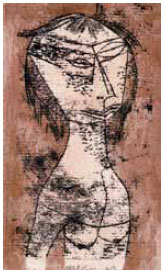
In this context, we would like to suggest a review on Paul Klee'
work Holy light from within, engraving in the collection of the Contemporary Art Museum of the Universidade de Sao Paulo. This piece was with other 16 works from the same artist in the Degenerate Art exhibition. Its catalogue compared Klee's engraving with the work of an individual with mental disorders that also reproduced a saint, and comments that the second author's piece was much more humanly comprehensible than Klee was. If nowadays the
Holy light from
within seems rather unpretending, it is because we are already far from its production context and the broad issues that it related with at that time.
Helouise Costa





 © 2026 All rights reserved


 Read in Portuguese
 Portuguese PDF
 Print
 Send this article by email
 How to cite this article
 Submit a comment
 Mendeley
 Pocket
 Share on Facebook
 Share on Twitter