



ABSTRACT:
OBJECTIVE: Cognitive changes in individuals who have experienced stress and trauma have gained
increasing prominence in the literature. In this study, we investigated the associations
between executive dysfunction, attention problems, and experiences of family violence
(both psychological and physical) and community violence throughout childhood, as
well as the relationship between these factors and epigenetic age acceleration in
youth.
METHODS: The sample included 86 individuals from a 500-student cohort in Rio de Janeiro, Brazil
who were followed for 17 years beginning in 2005. Data were collected through questionnaires
with mothers (or guardians) and children. The scales included the Barkley Deficits
in Executive Functioning Scale (executive dysfunction), the Achenbach System of Empirically
Based Assessment (attention problems), the Conflict Tactics Scale (family violence),
and the Coisas que Vi e Ouvi Scale (community violence). DNA methylation age and acceleration were estimated using
Zhang's epigenetic clock. Exposure-outcome relationships were assessed using Spearman
correlations and sex-controlled linear regressions.
RESULTS: Hierarchical linear regression identified psychological family violence (p = 0.03)
as a key factor in executive dysfunction, regardless of sex. Community violence was
also a factor in attention problems (p = 0.01), with psychological violence nearing
significance. Epigenetic age acceleration was correlated with attention problems and
executive dysfunction, but not with any form of violence. Individuals exposed to high
psychological and community violence were most vulnerable to age acceleration. High
community violence and low physical family violence during development were the most
notable factors in executive dysfunction. The small sample size and attrition warrant
cautious interpretation of the results.
CONCLUSION: Girls were more affected by psychological family violence, while boys had higher community
violence scores, reflecting structural inequalities and socialization. Violence across
developmental stages interacts with cognitive outcomes and epigenetic changes.
Keywords: Executive function; attention; violence; youth; DNA methylation.
FIGURES
| Note: How to cite this article: Ramos RQ, Silva CMFP, Serpeloni F, Lacerda NR, Evangelista AF, Avanci JQ, et al. Family and community violence: implications for executive dysfunction, attention problems, and epigenetic age acceleration in childhood and youth. Braz J Psychiatry. 2026;48:e20254500. Epub 2025 Nov 14. http://doi.org/10.47626/1516-4446-2025-4500 |
| Received: August 14 2025; Accepted: November 03 2025 |
INTRODUCTION
Family and community violence is a global public health concern, affecting up to a billion children.1 Estimates show that one in two children aged 2 to 17 years experiences some form of violence annually, often involving multiple simultaneous violent events.2 Brazilian data from 2024 indicate that 65.3 per 100,000 children and adolescents aged 0-17 years were exposed to maltreatment, 40.4 were exposed to physical domestic violence, and 24.4 were abandoned. Moreover, community violence led to the suspension of school activities in 3.6% of schools in 2023.3 In the state of Rio de Janeiro, the 2024 rates were lower for maltreatment (32.1 per 100,000) and abandonment (17.7 per 100,000), but were substantially higher for physical domestic violence (99.3 per 100,000) than the national average.3
Extensive research in clinical psychology, sociology, and medicine has demonstrated strong associations between early exposure to violence and increased symptoms of aggression, anxiety, depression, posttraumatic stress, and negative peer relationships.4,5 However, relatively little is known about the neurocognitive consequences, particularly executive function and attention problems (AP).
Executive function involves higher-order processes that govern goal-directed behavior, such as cognitive flexibility, inhibitory control, working memory, and planning.6 If these processes are affected, challenges could result with time management, impulse control, and adapting to new situations. The cumulative stress of family and community violence may alter how children process, interpret, and respond to social information, increasing the risk of attention and executive function difficulties.7,8 In contrast, children with AP are more likely to experience peer victimization, child maltreatment, and other forms of victimization in different contexts, such as school, home, and community9,10 due to difficulty sustaining focus, being easily distracted, and having trouble concentrating on tasks.
Although the two conditions may coexist, they are distinct. Executive function impairments affect higher-order cognitive control and are especially linked to the prefrontal cortex, which connects to limbic structures involved in emotional processing and affective decision-making.11 AP spans multiple domains and cerebral regions, encompassing hyperactivity (excessive movement), inattention (difficulty sustaining focus), and selective attention (the capacity to prioritize relevant stimuli amid competing inputs).12
Biomedical research has shown that direct exposure to environmental stressors - such as family and community violence - activates neuroendocrine, attentional, and neurocognitive systems, which enhance vigilance, focus on potential threats, and prompt rapid self-protective actions.13 Coupled with higher-order skills, such as cognitive reappraisal and problem-solving, these responses are thought to foster positive coping strategies for future stress.14 Repeated stress, particularly in vulnerable contexts, can produce allostatic load, characterized by reduced prefrontal-cortex activation (self-regulation and attention) and heightened limbic activation (emotional, threat-driven responses).15-18 Chronic stress has been consistently linked to poorer cognitive function.19,20
A number of genetic and environmental factors increase the risk of AP and executive function deficits, with most cases exhibiting multifactorial inheritance.21,22 However, the influence of psychosocial factors may be underestimated,23 even though context can shape symptom presentation and alter developmental trajectories, outcomes, and impairments.24 Several studies have connected early experiences to this phenotype.25
Violence and cognitive impairment are associated with epigenetic alterations that may influence biological aging. DNA-methylation biomarkers in blood, saliva, and other tissues can estimate biological age and its acceleration.26,27 Known as epigenetic clocks, these measurements correlate with reduced memory performance,28,29 reduced executive function capacity28,30 and attention-deficit/hyperactivity disorder (ADHD).31 Age acceleration has been linked to adverse life events, toxic stress, trauma, and violence.32-38 When biological age surpasses chronological age, the risk of chronic disease, inflammation, and premature mortality increases, which has significant implications for long-term health.36,37
The interplay between violence, cognitive processing, and epigenetics offers a promising avenue of investigation, as cognitive responses to threats shape children's coping mechanisms and subsequent mental and behavioral health.39,40 Examining different forms of victimization across the lifespan may clarify the variability in symptoms associated with childhood adversity in different contexts and exposure domains.41,42
This article investigates the association between family violence (psychological and physical) and community violence with executive dysfunction (ED) and AP during development in boys and girls. We hypothesized that exposure to family and community violence would be interrelated and associated with poorer executive function (affecting multiple executive function domains differently) and/or greater AP, with distinct sex-specific patterns. We also hypothesized that individuals who have experienced violence and/or present poorer executive function or attention would also have more accelerated epigenetic age.
METHODS
This longitudinal study, which was conducted in São Gonçalo, Rio de Janeiro, Brazil, investigated childhood development, encompassing socioeconomic factors, exposure to violence, cognitive functioning, emotional difficulties, and trauma.
Participants
The data were collected at five time points (2005, 2006, 2008, 2012/2013, and 2021/2022: a 17-year follow-up period) from a representative sample of 500 public school students who were in first grade in 2005 (baseline age: 6-13 years). By the 2021/2022 assessment, 129 participants remained.
Questionnaires were completed by mothers or guardians in 2005, 2006, 2008, and by the participants starting in 2008. Further sampling details are available in previously published articles.43-55
Saliva samples were obtained from 112 participants (2021/2022) for epigenetic analysis, of which 107 remained after quality control. For eligibility, participants had to complete all study scales in the five waves, resulting in a final sample of 86 individuals. Attrition data are shown in Supplementary Table S1.
Measures
Family violence
Variables were derived from two scales administered at every assessment. The Conflict Tactics Scale56,57 was used to measure physical and psychological violence within families, capturing events between parents and from parents toward children. The responses indicate frequency, but for this analysis they were dichotomized as yes (= 1 event) or no (0 events). The Conflict Tactics Scale has been cross-culturally validated, and its physical-aggression subscale has a Cronbach's a > 0.70.57 Witnessing parental verbal aggression in 2008, 2012, and 2022 was assessed with an item ("Have you heard your parents yelling at each other?") from the Things I Have Seen and Heard Scale,58,59 a validated measure of family and community violence. The Portuguese version has shown good reliability (Cronbach's a = 0.763). Responses were also dichotomized as yes (= 1 event) or no (0 events).
The Family Violence Construct (161 items)
The family violence construct was divided into physical (92 items) and psychological (69 items) dimensions spanning 2005-2022. Analyses were conducted for overall family violence, as well as physical and psychological subtypes. In all cases, the child was the focal point - either as victim or witness. Violence between siblings or between parents was not addressed.
Psychological family violence (69 items)
This dimension, which assesses insults, humiliation, threats, object throwing, and verbal aggression toward the child,56,57 was supplemented by the Things I Have Seen and Heard Scale item noted above. The caregivers answered 52 items (2005 to 2008), and the participants answered 17 items (2012 to 2022).
Physical family violence (92 items)
This dimension captures minor and severe acts of physical aggression by fathers and mothers (or guardians), assessed separately. These behaviors included pushing or grabbing, slapping or spanking, hitting or attempting to hit with objects, throwing objects, kicking, biting, punching, burning, and threatening or using a knife or gun.56,57 The caregivers answered 72 items (2005 to 2008), and the participants completed 20 items (2012 to 2022).
Community violence (51 items)
During the first 2 years, caregivers answered separate questions about witnessing serious injuries, living in dangerous circumstances, experiencing home invasions, or observing shootings and murders in the community. From 2008 onward, the Things I Have Seen and Heard Scale was administered, using the items proposed by Malik (2008)58 to assess community violence (e.g., seeing someone beaten or shot, experiencing a home invasion,, hearing gunfire, or witnessing arrests, stabbings, beatings, or killings). Responses ranged from never (0) to often (4). The caregivers responded to 15 items (2005, 2006), and adolescents/young adults responded to 36 items (2008 to 2022). The Cronbach's a was 0.763 in a comparable sample.47
The score for all violence variables was calculated by summing the item frequencies multiplied by the ratio of each year's total items to the number of items with valid responses. The results were then split into tertiles; the upper 33 % was considered the high category, and the remaining scores were considered the low category.
Executive dysfunction
The Barkley Deficits in Executive Functioning Scale (20-item short form) assessed future-oriented self-regulation across five domains: time management, organization/problem solving, self-restraint, self-motivation, and emotion regulation. The responses, which range from 0 (rarely/never) to 4 (very often), are summed for a total score. Age-based percentiles are used for interpretation (normal: < 44 for ages 21-24; < 42 for = 25), with no sex differences. The Brazilian version showed strong reliability (a = 0.911).60,61
Attention problems
Attention was assessed in 2022 using the Achenbach System of Empirically Based Assessment Adult Self Report.62 This 15-item AP scale covers concentration, impulsiveness, and inattention, with responses ranging from 0 (not true) to 2 (very true/often true). Raw scores were converted to T scores63; scores < 65 are considered normal. The instrument's internal consistency was good (Cronbach's a = 0.813).
Saliva
Saliva was collected using Oragene Discover kits (DNA Genotek, Ottawa, ON, Canada) on the same day the questionnaire was applied. Of 129 participants, 17 lacked samples due to refusal, kit shortages, or virtual participation, leaving 112 for epigenomic data preprocessing. The samples were randomized to control for sex, age, and lab conditions, with concurrent processing at Life & Brain (University of Bonn, Germany).
Epigenomic data preprocessing (n=112)
Epigenomic data were analyzed in R 4.2.2 using the ChAMP package (https://academic.oup.com/bioinformatics/article/33/24/3982/4082274). The pipeline assessed signal quality, bisulfite conversion, and negative controls. Batch effects were corrected, and the data were normalized via BMIQ to adjust for Type II probe bias, generating ß values (0-1). Datasets were stored as MAE objects in R/Bioconductor. Five samples failed quality control and were excluded, and missing violence data further reduced the analytic sample to 86 for the epigenetic clock analysis.
Epigenetic clock (n=86)
Zhang's epigenetic clock was used to compute the age acceleration residual (AAR) based on Elastic Net and BLUP, both trained on blood and saliva samples.26,27 Because Zhang developed the clock using raw ß values,26 we likewise used non-normalized ß values in our analyses conducted in R 4.1.1.
Analyses
Median violence exposure and non-normal ED/AP scores were analyzed by sex, age, and social stratum using Mann-Whitney U and Kruskal-Wallis tests. Spearman correlations were used to examine associations between violence and symptoms. Linear regressions were used to test violence and ED/AP scores unadjusted and adjusted for sex, as well as stratified by sex according to interactions. Hierarchical regression was based on distal to proximal exposures. Zhang's epigenetic clock was analyzed in two steps: association between violence, ED, AP, and AAR, followed by the association between AAR, ED, and AP with family violence, psychological violence, physical violence, and community violence, adjusting for sex. Participants with missing data in any of the violence scales were excluded from the analyses. No data imputation was performed. All statistical analyses were performed in R 4.1.1 through RStudio interface 2023.09.1. Sampling weights were applied to the data, and the threshold for statistical significance was set at an alpha of 0.05.
Ethics statement
This study, including its epigenetic analysis, was approved by the Fundação Oswaldo Cruz Ethics Committee (opinion no. 18723119.0.0000.5240). Parents or legal guardians provided written consent, and participant assent was obtained when appropriate.
RESULTS
Table 1 presents the violence (family, psychological, physical, and community forms), ED, and AP results according to sociodemographic variables. Family and psychological violence were higher among women and Black/Brown participants (p = 0.03). For physical violence, only skin color was significant (p = 0.02). Community violence was higher among Black and Brown participants (p = 0.01). Women had higher AP scores (p = 0.04). There were no differences in ED according to sociodemographic variables or social stratum.
| Family Violence (2005-2022)┼ | Psychological Family Violence (2005-2022)╬ | Physical Family Violence(2005-2022)§ | Community Violence(2005-2022)|| | Executive Dysfunction(2022)¶ | Attention Problems(2022)┼┼ | |||||||||||||
|---|---|---|---|---|---|---|---|---|---|---|---|---|---|---|---|---|---|---|
| Variable | Median score | IQR | p-value | Median score | IQR | p-value | Median score | IQR | p-value | Median Score | IQR | p-value | Median score | IQR | p-value | Median score | IQR | p-value |
| Sex (n=86) | ||||||||||||||||||
| Female (n=49) | 87.9 | 11.6 | 0.03|||| | 45.4 | 8.7 | 0.01|||| | 7.9 | 6.0 | 0.93|||| | 12.0 | 7.1 | 0.16|||| | 30.0 | 15.5 | 0.12|||| | 53.1 | 15.6 | 0.04|||| |
| Male (n=37) | 81.9 | 9.9 | 41.8 | 7.0 | 7.0 | 9.0 | 14.0 | 6.5 | 27.0 | 13.5 | 46.2 | 13.9 | ||||||
| Age (end of the study) (n=86) | ||||||||||||||||||
| 21-24 (n=77) | 83.9 | 12.3 | 1.0|||| | 43.9 | 9.3 | 0.97|||| | 8.0 | 6.3 | 0.53|||| | 13.0 | 8.0 | 0.60|||| | 30.0 | 14.5 | 0.79|||| | 49.7 | 13.9 | 0.41|||| |
| 25+ (n=9) | 84.3 | 10.8 | 43.6 | 7.1 | 6.0 | 4.1 | 12.0 | 5.9 | 29.0 | 11.0 | 47.9 | 13.9 | ||||||
| Skin color╬╬ (n=86) | ||||||||||||||||||
| White (n=23) | 80.9 | 8.4 | 0.002¶¶ | 40.9 | 6.5 | 0.002¶¶ | 4.0 | 5.0 | 0.02¶¶ | 8.0 | 6.9 | 0.01¶¶ | 30.0 | 10.2 | 0.48¶¶ | 49.7 | 14.8 | 0.31¶¶ |
| Black (n=28) | 90.0 | 11.4 | 47.4 | 8.0 | 8.6 | 6.4 | 13.6 | 5.0 | 30.0 | 17.5 | 53.1 | 12.6 | ||||||
| Brown (n=35) | 82.9 | 9.2 | 42.4 | 6.4 | 8.0 | 6.7 | 14.0 | 7.5 | 27.5 | 15.0 | 46.2 | 14.8 | ||||||
| Social stratum§§ (n=71) | ||||||||||||||||||
| Upper (n=12) | 81.6 | 13.0 | 0.46|||| | 44.0 | 7.9 | 0.71|||| | 7.9 | 7.2 | 0.47|||| | 10.1 | 6.5 | 0.45|||| | 38.0 | 19.0 | 0.09|||| | 54.0 | 14.8 | 0.60|||| |
| Middle/low (n=59) | 85.0 | 13.1 | 43.9 | 9.6 | 7.1 | 7.5 | 13.0 | 7.9 | 28.5 | 15.2 | 49.7 | 14.8 | ||||||
Bold type denotes statistical significance.
IQR = interquartile range.
┼ Range from 67.9-108.4.
╬ Range from 31.8-59.4.
§ Range from 0-34.
|| Range from 2-34.5.
¶ Range from 20-74.
┼┼ Range from 35.8-75.7.
╬╬ The sample included 1 Indigenous/Asian participant, who was included in the Brown category (similar to pardo, a Brazilian term used to describe people of mixed ethnic backgrounds, especially of Indigenous, African, and European ancestry).
§§ Calculated according to parental education level and household items, Economic Classification Criteria proposed by the Brazilian Market Research Association (Associação Brasileira de Empresas de Pesquisa).
|||| Mann-Whitney U test.
¶¶ Kruskal-Wallis test.
The association between family/community violence during development and executive dysfunction/attention problems in youth
Supplementary Figure S1 shows the Spearman correlations between family violence (overall, physical, psychological), community violence and ED (total and subscales) and AP in youth. Physical and psychological family violence were strongly correlated (rs = 0.621, p < 0.001). Overall, family violence was robustly associated with the physical (rs = 0.761, p < 0.001) and, especially, psychological component (rs = 0.946, p < 0.001). Family and community violence were not significantly related (rs = 0.197, p = 0.07).
ED was correlated with psychological family violence (rs = 0.31; p < 0.01) and community violence (rs = 0.23; p < 0.05), but not physical family violence. The ED self-regulation subscale was linked to family violence (rs = 0.30; p < 0.01), especially psychological violence (rs = 0.37; p < 0.001). Psychological family violence was associated with self-motivation (rs = 0.23; p < 0.05) and self-organization (rs = 0.24; p < 0.05), but physical violence was only associated with self-restraint (rs = 0.25; p < 0.05). Community violence was associated with total ED and three domains, excluding self-management, which showed no associations. AP were associated with family (rs = 0.219; p < 0.05) and community violence (rs = 0.256; p < 0.05), in addition to psychological family violence (rs = 0.273; p < 0.05). AP were strongly associated with ED and subscales (rs = 0.533 - 0.733; p < 0.001).
Modeling the associations between violence, executive dysfunction, and attention problems
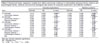
Prior to model definition (Figure 1), sex-mediated linear regression showed that family violence was associated with ED (p = 0.007) and AP (p = 0.01) only in girls (Supplementary Figure S2). Community violence was associated with female AP (p = 0.009) but not ED in either sex. The mediation of sex was intensified by interactions with family (ß = 0.003, p = 0.047) and community violence (ß = 0.025, p = 0.012), increasing female AP scores. No sex interaction was found for ED (Supplementary Table S2).
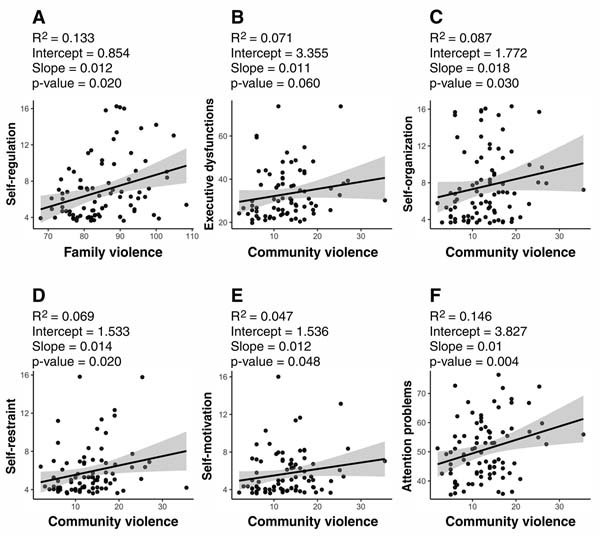
In sex-adjusted regressions (Figure 1), lifetime family violence was associated with poorer self-regulation (p = 0.02, Model A). Community violence had a near-significant association with ED (p = 0.06, Model B) and was associated with the ED subdomains: self-organization (p = 0.03), self-restraint (p = 0.02), and self-motivation (p = 0.048). AP increased with community violence exposure (p = 0.004, Model F).
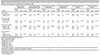
Hierarchical regression was used to determine the mediation of exposure variables in ED and AP (Table 2). Family violence was split into physical (distal) and psychological (proximal) types. Psychological violence was associated with ED, controlling for other exposure types (p = 0.01), and remained significant after adding sex (p = 0.03), which indicated that sex was a partial mediator. For AP, community violence was significantly reduced (p = 0.01) to 0.03 after adding psychological violence, and returned to 0.01 once sex was included, while psychological violence became non-significant.
| Executive dysfunctions | Attention problems | |||||
|---|---|---|---|---|---|---|
| Term | Estimate | SE | p-value | Estimate | SE | p-value |
| (1) Intercept | 3.313 | 0.083 | < 0.001*** | 3.794 | 0.048 | < 0.001*** |
| Community violence | 0.010 | 0.006 | 0.08 | 0.009 | 0.003 | 0.009** |
| (2) Intercept | 3.261 | 0.091 | < 0.001*** | 3.779 | 0.053 | < 0.001*** |
| Community violence + | 0.009 | 0.006 | 0.10 | 0.009 | 0.003 | 0.01* |
| Physical violence | 0.008 | 0.006 | 0.18 | 0.002 | 0.003 | 0.47 |
| (3) Intercept | 2.575 | 0.275 | < 0.001*** | 3.409 | 0.160 | < 0.001*** |
| Community violence + | 0.008 | 0.006 | 0.18 | 0.008 | 0.003 | 0.03* |
| Physical violence + | -0.004 | 0.007 | 0.56 | -0.004 | 0.004 | 0.34 |
| Psychological violence | 0.018 | 0.007 | 0.01** | 0.009 | 0.004 | 0.02* |
| (4) Intercept | 2.613 | 0.282 | < 0.001*** | 3.462 | 0.161 | < 0.001*** |
| Community violence + | 0.008 | 0.006 | 0.15 | 0.008 | 0.003 | 0.01* |
| Physical violence + | -0.003 | 0.007 | 0.62 | -0.002 | 0.004 | 0.59 |
| Psychological violence + | 0.017 | 0.008 | 0.03* | 0.007 | 0.004 | 0.10 |
| Sex | 0.051 | 0.074 | 0.52 | 0.077 | 0.042 | 0.07 |
Bold type denotes statistical significance.
SE = standard error.
* p < 0.05; ** p < 0.01; *** p < 0.001.
Modeling epigenetic clock results
Qian Zhang's epigenetic clock26,27 was used to estimate DNA methylation age, which was positively correlated with chronological age (r = 0.406; p < 0.001). Among the 86 participants, 71 had AARs between -3 and 3, with a stronger correlation between DNA methylation age and chronological age (r = 0.639; p < 0.001).
Linear regression (adjusted for sex) was used to assess associations between AAR, ED, AP, and violence exposure (Supplementary Figure S3). Only ED (ß = 1.42; 95%CI 0.33-2.50) and AP (ß = 1.39; 95%CI 0.17-2.59) were associated with higher AAR vs. controls. Girls had a higher AAR than boys, with increases of 1.68 (ED model) and 1.61 units (AP model) (Supplementary Table S3). There were no significant differences in AAR according to violence level.
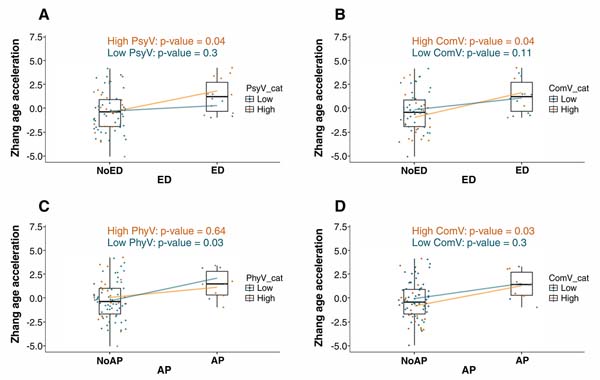
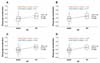
Linear models were used to assess AAR according to violence exposure (Figure 2). ED was linked to higher AAR in the high psychological family violence (ß = 1.60; p = 0.04, Model A) and high community violence groups (ß = 2.02; p = 0.04, Model B). AP was also associated with higher AAR in the high community violence (ß = 1.79; p = 0.03, Model D) and low physical violence groups (ß = 2.30; p = 0.03, Model C).
DISCUSSION
ED/AP scores were not associated with socioeconomic factors, except for higher AP in girls. The findings on sex and executive function in the literature are mixed. In the U.S. validation of the Barkley Deficits in Executive Functioning Scale, men had more symptoms related to self-restraint and self-motivation, while women had more symptoms related to emotional regulation.64 In the Brazilian validation of this scale, women reported more symptoms, with small effect size, in self-organization, emotional regulation, and overall executive dysfunction.61 Kamradt et al.65 reported findings consistent with ours: women had greater deficits in organization and emotional self-regulation, while men had greater deficits in self-control and self-motivation.
The association between violence and cognition may also be influenced by greater anxiety symptoms, which are often observed in girls.66 Individuals with high trait anxiety tend to experience elevated daily stress and heightened reactivity to stressors,67,68 often leading to maladaptive cognitive and behavioral responses, such as reduced cognitive capacity, avoidance, withdrawal, and impaired coping.40,69 Beyond sex, ED are more prominent in adolescence and early adulthood than later life, highlighting the need for continued developmental monitoring,61 particularly during youth. In combination with ADHD symptoms, ED has been identified as a longitudinal predictor of adult psychopathology.70
Psychological family violence (often accompanied by physical family violence) was the most common form of violence experienced by the participants, indicating violent family communication. However, no association was found between family and community violence. Moreover, boys and girls experience violence differently. Family violence, which is shaped by social norms, affects all individuals but often remains hidden. Boys face more physical and community violence, while girls more commonly experience psychological violence.71 Family violence is more common among Black children in Brazil, reflecting gender and racial inequalities.72 Girls face more abuse due to gender norms, while structural racism exposes Black youth to discrimination and mistreatment at home and school.
Violence was more strongly linked to ED and AP in girls. According to Hodes & Epperson,20 prenatal and early postnatal stress increases the risk of socialization disorders, such as ADHD in males. Females tend to show greater resilience in early life but become more vulnerable during hormonal transitions - puberty, pregnancy, and perimenopause - when the risk for depression, anxiety, and posttraumatic stress disorder increases. Clark et al.73 found that adverse family environments, e.g., those involving maternal aggression and violence, are associated with emotion regulation deficits, particularly in females. Green & McCormick74 demonstrated that stress affects antioxidant enzyme activity differently in males and females, suggesting sex-specific stress responses.
Family violence correlated only to ED self-regulation deficits (inhibition and emotion control), whereas community violence was correlated to poorer self-organization, self-restraint, self-motivation, and AP, reflecting issues with flexibility, impulse control, and inattention. Psychological family violence, correlated to ED, affects early development, even prenatally, when brain growth and plasticity peak. Community violence affects later stages, like myelination and signal transmission, and is more related to AP. Findings highlight the need to consider developmental timing in future research.75-78
The epigenetic acceleration observed in individuals with ED and AP (regardless of sex) aligns with findings from other studies. Similar associations have been reported in children, including accelerated aging and reduced cognitive performance,79 lower verbal comprehension and perceptual reasoning,80 and ADHD - particularly in older individuals.31 In women exposed to early life adversity, epigenetic age acceleration has been linked to lower cognitive abilities in early adulthood.81 These findings suggest that epigenetic alterations may serve as biomarkers for cognitive impairment and ADHD. However, longitudinal studies are needed to clarify causal directions.28,82 Trait-associated DNA methylation changes may reflect reverse causality or serve as markers of environmental exposures linked to the trait, such as lifestyle, medication use, infections, or maternal smoking.82
Previous studies have linked epigenetic acceleration to experiences of violence33,34,83,84 and early life adversities,37,85,86 and such associations reflect the impact of environmental factors on epigenetic modifications. In this study, the lack of significant associations between violence and epigenetic aging may reflect limited variability in violence exposure, as chronic exposure in this population reduces the contrast between groups. Biologically, ongoing activation of stress and inflammatory pathways could lead to adaptive or compensatory methylation changes,18,87 which may also reduce variability in epigenetic outcomes under high-stress conditions. This pattern may also be related to a decline in family violence alongside an increase in community violence during early adulthood, as different domains of violence and adversity can have distinct associations with epigenetic age acceleration.88 Overall, the results suggest that, under this analytical framework, exposures occurring more recently or during sensitive developmental periods may shape AAR more than the cumulative exposure measured across all five waves.
Individuals with ED symptoms in the highest tertile of psychological family violence had greater epigenetic age acceleration than those without ED. A similar effect was observed for high community violence in individuals with ED/AP symptoms. The low physical violence group with ED symptoms showed accelerated epigenetic aging, which we believe may be due to the generally lower physical family violence scores than other forms of violence, limiting our ability to detect small effects and group differences. This finding may also be influenced by information bias, especially in earlier years, since mothers/caregivers reported the physical violence they perpetuated. Psychological violence may have been more frequently reported due to its perception as less harmful. Previous studies have linked violence exposure to increased ADHD symptoms,89-91 with some reporting stronger effects in girls89 and others in boys.91 While no direct link between violence and epigenetic age acceleration was found, the observed correlation with ED and AP - particularly in those with greater exposure to violence - indicates increased vulnerability. Further research is needed to confirm this hypothesis.
This study has limitations. Key variables, including skin color, socioeconomic status, psychiatric conditions, and smoking, were uncontrolled. Parental mental illness or other psychiatric conditions in participants could act as common causes influencing both exposure to family violence and epigenetic or cognitive outcomes.92 Socioeconomic factors and skin color may influence violence exposure, whereas smoking is primarily associated with biological outcomes, including DNA methylation patterns. Skin color is often associated with structural inequalities, differential exposure to stressors, and disparities in access to resources, which could confound the observed associations. The absence of control or stratification for these aspects may have affected our results. Future studies should account for these variables to better elucidate the relationships between violence and epigenetic age acceleration.
Attrition during the 17-year follow-up period reduced the sample size. Although some loss to follow-up is expected in longitudinal studies, the long interval between the fourth and fifth waves may have had a particularly strong impact, as well as data collection during the COVID-19 pandemic. As the children grew older, changes in residence and other factors, including socioeconomic circumstances, increased exposure to community violence or additional health outcomes may have contributed to dropout, increasing selection bias and reducing statistical power. This affects the representativeness of the sample and the generalizability of the findings, potentially underestimating associations between violence exposure and epigenetic age acceleration, reducing variability in the measures, and making it more difficult to detect small effects.
Measuring ED and AP at a single time point restricts the ability to establish temporal relationships, limiting causal inference and raising the possibility of reverse causation. Childhood exposure to ED and/or AP may heighten susceptibility to later experiences of violence, possibly mediated by negative or dysregulated responses from caregivers.92 Self-report measures of violence and symptoms may also have introduced reporting bias, as responses can be influenced by recall, social desirability, or the respondent's emotional state at the time of assessment. Moreover, variations in informants across waves and potential underreporting of certain forms of violence - especially psychological or family-based violence - may have contributed measurement inaccuracies.
This study has shown the complex links between family and community violence and the development of ED and AP in Brazilian children. Sex differences were evident: girls were more frequently exposed to psychological family violence, whereas boys experienced higher levels of community violence, reflecting broader social inequalities. Children with ED or AP showed higher vulnerability to violence and signs of accelerated epigenetic aging. From a clinical and policy perspective, these results provide preliminary evidence to inform prevention and intervention efforts, although they should be interpreted with caution given the small sample size, limited representativeness of the population, and the small observed effect sizes.
Nevertheless, effect sizes help translate statistical findings into practical meaning, indicating where preventive actions may have the greatest potential impact and guiding future, larger-scale investigations.93 While broad strategies are needed to reduce violence exposure, sex or skin color differences suggest that benefits may vary across groups. This reinforces the need for more targeted interventions and longitudinal studies to identify early challenges, sensitive periods, and group-specific pathways. Policies should consider sex, skin color, and timing of exposure to ensure fair and effective protection for vulnerable children.
SUPPLEMENTARY MATERIALS
ACKNOWLEDGEMENTS
This study was supported by Conselho Nacional de Desenvolvimento Científico e Tecnológico (grant 407977/2021-0). RQR acknowledges support from Coordenação de Aperfeiçoamento de Pessoal de Nível Superior - Brasil (Finance Code 001).
We are deeply grateful to all the mothers, caregivers, and children whose trust and participation made this study possible.
 PDF
 Print
 Send this article by email
 How to cite this article
 Submit a comment
 Mendeley
 Pocket
 Share on Facebook
 Share on Twitter



