


FIGURES
| Note: How to cite this article: da Mota Gomes M, Nardi AE. Charcot's bicentennial legacy: bridging hysteria, neuroscience, and neurohumanities. Braz J Psychiatry. 2026;48:e20254389. Epub 2025 Sep 29. http://doi.org/10.47626/1516-4446-2025-4389. |
| Received: June 23 2025; Accepted: August 18 2025 |
Jean-Martin Charcot (1825-1893), though principally remembered as a neurologist, fundamentally reshaped our comprehension of mental disorders - particularly hysteria. Through his pioneering work at Pitié-Salpêtrière Hospital in Paris, he bridged neurology and psychiatry, demonstrating that hysteria - long dismissed as a mere psychological disturbance, manifested as a neurological condition involving "dynamic lesions."1-3 This revolutionary concept of functional rather than structural brain abnormalities laid critical groundwork for what we now call functional neurological disorders (FNDs). By systematically studying these phenomena, Charcot not only challenged entrenched medical dogmas but established a new paradigm for understanding the intricate interplay between mind and brain. His legacy endures in contemporary approaches to psychosomatic medicine, where neurological and psychological perspectives continually inform one another.4
The late 19th century marked a revolutionary period in neuropsychiatry, with La Salpêtrière Hospital emerging as the forge of our modern understanding of mental illness. At the center of this transformation stood Charcot, whose pioneering work on hysteria and neurological disorders challenged current medical paradigms while establishing new frameworks for investigation. This intellectual revolution unfolded amidst competing approaches - Charcot's neurophysiological model, the Nancy School's psychological perspective, and the Alienists' psychiatric tradition - each offering distinct yet interconnected visions of mental pathology that collectively shaped modern neuropsychiatry.
Charcot's revolutionary methodology transformed Pitié-Salpêtrière Hospital from a custodial institution into a pioneering center of scientific inquiry during the late 19th century, positioning it as the epicenter for redefining mental illness. By integrating hypnosis, anatomical studies, and clinical photography,5 he established unprecedented standards for neurological investigation while challenging medical orthodoxies. The most notable of these challenges was his conceptualization of hysteria as a FND despite the lack of visible lesions,1 thus maintaining a neuropathological framework, which diverged sharply from contemporary paradigms. This neurophysiological approach stood in deliberate contrast to both the Nancy School's psychological focus (embodied in the universal hypnosis model of Hyppolyte Bernheim [1837-1919] and Ambroise-Auguste Liébault [1823-1904]) and the Alienists' institutional psychiatry, creating a unique third way that reimagined the boundaries between neurology and mental health.
At La Salpêtrière Hospital, alienists including Jean-Pierre Falret (1794-1870) and Louis Delasiauve (1804-1893) made psychiatric diagnoses, such as hysterical psychosis, while meticulously documenting their patients' life histories, whereas Bourneville uniquely integrated neurological and psychological approaches, influencing Charcot's growing recognition of socioeconomic factors in hysteria.2 When France's inaugural mental diseases chair was established in 1875, Benjamin Ball (1833-1893), a collaborator of Charles Lasègue (1816-1883) and Charcot, was appointed rather than a traditional alienist.1 Charcot's pupils Joseph Jules François Félix Babinski (1857-1932) and Pierre-Marie-Félix Janet (1859-1947) subsequently advanced this integration, with Babinski's work on "pithiatism" during the First World War (emphasizing the role of suggestion in the development of symptoms) and his diagnostic reflex test fundamentally bridging neurology and psychology, transforming Charcot's theories into modern psychosomatic medicine.6
Charcot's groundbreaking focus on anatomical localization and visual documentation revolutionized neurology, despite creating significant limitations. His emphasis on observable physical signs often marginalized the patients' subjective experiences, particularly in hysteria cases, in which psychological and cultural factors proved equally crucial. This reflected both 19th-century medical priorities and his neurophysiological orientation, establishing a diagnostic paradigm that privileged visible symptoms over personal narratives. Complex psychosomatic phenomena were thus reduced to somatic terms, a limitation later addressed when Freud restored the critical dimensions of unconscious processes and individual subjectivity.
Charcot's true legacy lies in his clinical rigor, which bridged neurophysiology and psychology, forming the foundation of modern FND research. By challenging the organicist paradigm of traditional alienism, which attributed mental illness solely to brain lesions, he helped transition psychiatry from moral management in asylums to scientific study in hospitals. His innovative incorporation of hypnosis and psychological factors into hysteria research laid essential groundwork for psychodynamic theories, while his school's emphasis on meticulous clinical observation established enduring methodological standards that highlighted the epistemic value of visual documentation in medical practice.
Charcot revolutionized neurological study through his pioneering integration of visual media and performative pedagogy, establishing clinical photography as both a diagnostic tool and a means of standardizing medical documentation. His famed Tuesday Lectures at La Salpêtrière were a unique hybrid of scientific demonstration and theatrical spectacle that blended rigorous neurological explanation with carefully staged patient presentations, thereby creating an influential new model of medical education in which objective observation coexisted with dramatic narrative. The live performances were complemented with systematic recording of symptoms in photographic atlases.
Charcot's lectures were far more than academic exercises - they were masterful performances that fused scientific rigor with eloquence and theatricality. Drawing large, distinguished crowds - including figures like Babinski and the young Sigmund Freud - these sessions shaped the trajectory of modern thought. By seamlessly integrating empirical depth with compelling narrative, Charcot revealed clinical neurology as a discipline that could both enlighten and enthrall, blurring the line between science and spectacle.
Didi-Huberman5 critically explores how Charcot's staged photographs of hysterical women, many of whom were marginalized and actively performing their symptoms, blurred the lines between objective documentation and theatrical performance. Created within a hierarchical context, these images raise significant ethical questions regarding the representation and pathologization of vulnerable bodies. While they advanced scientific understanding, they also highlight the violence and moral dilemmas inherent in visualizing mental illness, issues that still resonate in debate about medical imaging and the ethics of representation.
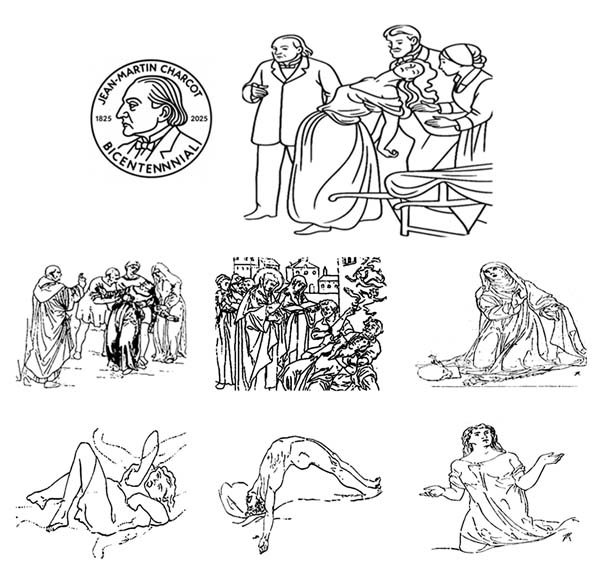
Figure 1 presents a striking three-part visualization of Charcot's enduring legacy. The top level contrasts a bicentennial commemorative medal bearing Charcot's dignified profile with a carefully selected detail from Brouillet's painting La leçon clinique à La Salpêtrière (1887), which captures the unique blend of scientific rigor and dramatic performance that characterized his famous demonstrations. Below this, the narrative shifts to sacred imagery, where Charcot's groundbreaking collaboration with Paul Richer in Les démoniaques dans l'art (1887)7 reveals how neurological insights transformed our understanding of religious ecstasy, creating an unexpected bridge between centuries of spiritual art and modern medical illustration. The bottom level brings us to the heart of Charcot's clinical work: the meticulous anatomical depictions of hysterical episodes that standardized the study of la grande attaque hystérique. Most remarkably, this visual journey highlights Charcot's deliberate inclusion of male hysteria cases3 displayed alongside more typical female presentations - a radical challenge to then-current prejudices that continues to inspire modern neuropsychiatry's engagement with cultural and gender perspectives.
Charcot's enduring legacy in neurological nosology is exemplified by his seminal contributions to disease classification and characterization, most notably his pioneering identification and naming of multiple sclerosis as a distinct pathological entity, his definitive clinical description of amyotrophic lateral sclerosis, and his crucial differentiation of Parkinson's disease from other tremor disorders, landmark achievements that not only established fundamental diagnostic categories still used in contemporary neurology but also demonstrated his unparalleled ability to synthesize clinical observation with pathological correlation, thereby laying the methodological foundations for modern neurological practice while simultaneously advancing the scientific understanding of these debilitating conditions.9,10 These diagnostic frameworks continue to underpin modern neurology. However, his emphasis on anatomical localization sometimes overlooked the subjective, experiential aspects of patients' conditions. In contrast, modern biopsychosocial models combine biological, psychological, and social factors to understand FNDs, disabling conditions at the neurology-psychiatry interface. Recent neuroscience has revealed the distinct neural mechanisms of FNDs, showing dysfunction in key brain networks involving emotion processing, agency, attention, interoception, and predictive processing. Each patient's symptoms reflect unique combinations of these network disruptions. While progress has been made in understanding the pathophysiology of FNDs, questions remain about how biopsychosocial factors produce them.4
Charcot's legacy transcended neurology, reaching into social realms, a connection poignantly embodied in his bond with Brazil's Emperor Dom Pedro II. What began as professional consultations evolved into a profound friendship that deepened during the Emperor's twilight years in exile. While Dom Pedro frequented Charcot's illustrious Tuesday salons, their most significant exchanges came as the Emperor battled not just diabetic decline but what Charcot identified as surmenage moral - emotional exhaustion from his political downfall. This prescient diagnosis, recognizing the mind-body connection, showcased Charcot's pioneering holistic approach, which foreshadowed contemporary psychosomatic medicine.11
In conclusion, Charcot's evolving grasp of hysteria, progressing from purely neurological explanations to embracing psychological dimensions, signaled a pivotal shift in medicine that resonated more powerfully when considering his patients' lived experiences, in which suffering extended far beyond clinical symptoms.2 Although his meticulous documentation of neurological signs, such as amaurosis, sometimes overlooked the human aspect of illness, his work nonetheless laid an enduring foundation for modern psychiatry, particularly regarding psychosomatic disorders and fibromyalgia. Ultimately, Charcot's greatest contribution was his interdisciplinary vision at La Salpêtrière, where he merged clinical neurology with cultural and psychological insights, framing hysteria as both a neurological condition and a profoundly human experience, a model that still informs our understanding of mind-body relationships today.
 PDF
 Print
 Send this article by email
 How to cite this article
 Submit a comment
 Mendeley
 Pocket
 Share on Facebook
 Share on Twitter