



ABSTRACT:
OBJECTIVE: Sleep quality is essential for health, and sleep deprivation is linked to physical
and mental issues. Homeless populations face additional sleep challenges, yet this
topic remains underexplored. This study assessed sleep quality among homeless individuals
in São Paulo, Brazil, considering demographics and substance use.
METHODS: A psychiatrist conducted interviews to collect demographic and substance use data
assessing sleep quality using the Pittsburgh Sleep Quality Index (PSQI). A generalized
linear model was used to analyze PSQI scores, considering sleeping location, sex,
substance use, and interactions as fixed factors, with homelessness duration as a
covariate. The sample comprised 177 participants (22% female, of whom seven were transgender;
mean age: 42.8 ± 11.4 years), with an average homelessness duration of 10.5 (SD, 8.4)
years (range: 1-40). Among them, 33% slept in shelters, 83% used depressants, 83%
used stimulants, and 59% used hallucinogens.
RESULTS: Approximately 67% reported good subjective sleep quality (mean PSQI: 4.9 ± 2.7). Depressant
and stimulant use correlated with poorer sleep. Women had poorer sleep, longer sleep
latency, and greater daytime dysfunction than men.
CONCLUSION: Positive sleep quality reports may reflect adaptive expectations from prolonged adversity
and substance use. The findings highlight the need for improved shelters and targeted
interventions to address sleep challenges in this vulnerable population.
Keywords: Homeless; ill-housed persons; sleep quality; substance use.
FIGURES
| Note: How to cite this article: Benavides-Gélvez RE, Hipolide DC, Vallim JRS, Cespedes JG, Rosa AS. Subjective sleep quality and its subcomponents among homeless individuals in São Paulo. Braz J Psychiatry. 2025;47:e20244078. http://doi.org/10.47626/1516-4446-2024-4078 |
| Received: November 07 2024; Accepted: February 20 2025 |
INTRODUCTION
Sleep is vital for maintaining overall health and bodily functions.1 Research has highlighted the social and economic repercussions of sleep loss,2,3 which can impair daytime functionality in both occupational and social contexts. However, vulnerable populations, such as homeless individuals, face significant barriers to achieving good sleep quality, which further exacerbates the health challenges they already face. In São Paulo, Brazil, homelessness has significantly increased in recent years, posing unique socioeconomic and environmental challenges that exacerbate health risks. A 2021 census recorded 31,884 homeless individuals in São Paulo and, compared to 2019, a 39.8% increase in shelter use.4-6 Despite these trends, research on sleep quality among homeless individuals often relies on studies from the United States or Europe, which may not adequately reflect local circumstances. Understanding the dimensions of sleep health needs among São Paulo's homeless population is crucial for tailoring effective interventions.
This study aims to fill this gap by evaluating the subjective sleep quality of homeless individuals in São Paulo using the Pittsburgh Sleep Quality Index (PSQI).7 It also seeks to examine the relationships between sleep quality, sex, sleeping location (street or shelter), and the use of psychoactive substances such as depressants, stimulants, and hallucinogens. This study provides important information about the sleep quality and needs of the homeless population in São Paulo and can be used to inform policies aimed at improving their quality of life.
METHODS
This study was conducted with the help of the Consultório na Rua, an organization providing medical, psychological, and social support to homeless individuals in São Paulo. They allowed researchers to accompany them when visiting individuals on the streets and in shelters and facilitated contact with potential participants.
Informed consent procedures were carefully adapted to address barriers related to literacy and cognitive impairment. Agreement to participate in the research and the ability to complete the evaluation questionnaire were the only inclusion criteria. All procedures adhered to Brazilian National Health Council Resolution No. 466/2012, ensuring the protection of participants' rights and ethical integrity. The interviews were conducted between May 12 and November 16, 2021.
The sample was recruited according to sample size calculation using a stratified sampling method based on the homeless population identified in the 2021 Census. The sample calculation was designed to achieve a margin of error of 10% and a confidence level of 95%, resulting in an initial estimate of 95 individuals. Ultimately, 177 individuals were included in the study, resulting in a sampling error of 7.3%.
Procedures
After recruitment, the participants underwent individual interviews with a qualified health care professional, who collected sociodemographic data and details about psychoactive substance use. Subjective sleep quality was assessed using the validated Brazilian Portuguese version of the PSQI.7,8 The PSQI consists of seven subcomponents: sleep quality, sleep latency, sleep duration, sleep efficiency, sleep disturbances, hypnotic drug use, and daytime dysfunction. We conducted a reliability analysis (Cronbach's alpha) to evaluate the internal consistency of the questionnaire within our sample, which showed a high level of reliability, 0.75.
A generalized linear model was used to analyze factors that influenced PSQI scores, and model fit was assessed using the Akaike information criterion (AIC). Independent variables included sleeping place, sex, psychoactive substance use, and their interactions as fixed factors, with the duration of homelessness relative to life span included as a covariate. The Bonferroni test was applied to investigate post-hoc interactions. A post-hoc power analysis was conducted using G*Power 3.1.9.7. For this analysis, the R2 of each model was considered the effect size, with an alpha value of 0.05, a total sample size of 177, and 13 predictors. All analyses were conducted in JAMOVI 2.4.6 (https://www.jamovi.org) and the significance level was set as 5% (p < 0.05). The graphs were created in GraphPad 10.1.0.
Ethics statement
This study adhered to National Health Council Resolution 466/2012, which delineates ethical standards for human research, and it received approval from the Universidade Federal de São Paulo research ethics committee for human subjects (protocol 4.569.268).
RESULTS
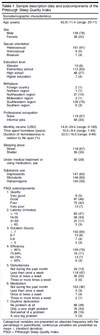
The study included 177 participants, with descriptive data shown in Table 1. Among the 39 female participants, seven identified as transgender (18%), while all male participants were cisgender.
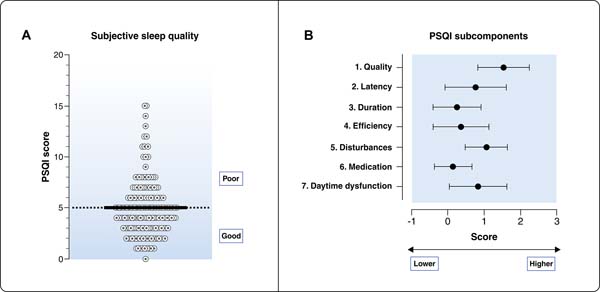
According to the global PSQI score, 67.2% had good subjective sleep quality (Figure 1A). The classification of the PSQI subcomponents is shown in Table 1.
| Sociodemographic characteristics | |
|---|---|
| Age (years) | 42.8±11.4 (range: 20-71) |
| Sex | |
| Male | 138 (78) |
| Female | 39 (22) |
| Sexual orientation | |
| Heterosexual | 161 (91) |
| Homosexual | 9 (5) |
| Bisexual | 7 (4) |
| Education level | |
| Illiterate | 10 (6) |
| Elementary school | 112 (63) |
| High school | 48 (27) |
| Higher education | 7 (4) |
| Birthplace | |
| Foreign country | 2 (1) |
| Northern region | 1 (1) |
| Northeastern region | 27 (15) |
| Midwestern region | 2 (1) |
| Southeastern region | 139 (79) |
| Southern region | 6 (3) |
| Professional occupation | |
| None | 119 (67) |
| Informal jobs | 58 (33) |
| Monthly income (USD) | 14.8±29.4 (range: 0-185) |
| Time spent homeless (years) | 10.5±8.4 (range: 1-40) |
| Duration of homelessness in relation to life span (%) | 22.5±16.0 (range: 0-64) |
| Sleeping place | |
| Street | 118 (67) |
| Shelter | 59 (33) |
| Under medical treatment or using medication, yes | 50 (28) |
| Substance use | |
| Depressants | 147 (83) |
| Stimulants | 146 (83) |
| Hallucinogens | 104 (59) |
| PSQI subcomponents | |
| 1. Quality | |
| Very good | 8 (5) |
| Good | 81 (46) |
| Poor | 75 (42) |
| Very poor | 13 (7) |
| 2. Latency (minutes) | |
| = 15 | 83 (47) |
| 16-30 | 58 (33) |
| 31-60 | 31 (17) |
| > 60 | 5 (3) |
| 3. Duration (hours) | |
| > 7 | 150 (85) |
| 6-7 | 15 (8) |
| 5-6 | 7 (4) |
| < 5 | 5 (3) |
| 4. Efficiency | |
| > 85% | 139 (79) |
| 75-84% | 19 (11) |
| 65-74% | 13 (7) |
| < 65% | 6 (3) |
| 5. Disturbances | |
| Not during the past month | 24 (13) |
| Less than once a week | 118 (67) |
| Once or twice a week | 35 (20) |
| Three or more times a week | 0 (0) |
| 6. Medication | |
| Not during the past month | 163 (92) |
| Less than once a week | 5 (3) |
| Once or twice a week | 7 (4) |
| Three or more times a week | 2 (1) |
| 7. Daytime dysfunction | |
| No problem at all | 68 (38) |
| Only a very slight problem | 76 (43) |
| Somewhat of a problem | 28 (16) |
| A very big problem | 5 (3) |
Categorical variables are presented as absolute frequency with the percentage in parenthesis; continuous variables are presented as mean ± standard deviation.
PSQI = Pittsburgh Sleep Quality Index.
Global Pittsburgh Sleep Quality Index score
We found significant effects for sex (?2 = 6.8, p = 0.009), stimulant use (?2 = 6.0, p = 0.014), depressant use (?2 = 4.6, p = 0.032), and the interaction between sex and sleeping place (?2 = 10.3, p = 0.001) on overall subjective sleep quality, as indicated by the global PSQI score (model fit: AIC = 837.1, R2 = 0.13, power = 0.88). Participants using depressants had higher PSQI scores (p = 0.019, mean difference = 1.2) than non-users, while stimulant users also scored higher (p = 0.007, mean difference = 1.5), suggesting these substances negatively impact sleep quality. Women had higher scores than men (p = 0.013, mean difference = 2.4), and women sleeping in shelters had higher scores than men in the same location (p = 0.024, mean difference = 5.0). Only four women reported sleeping in a shelter.
Pittsburgh Sleep Quality Index subcomponents
None of the independent variables had a significant effect on the sleep quality, efficiency, or medication use subcomponents.
In the sleep latency subcomponent, we found significant effects for sleeping place (?2 = 5.0, p = 0.025), sex (?2 = 9.4, p = 0.002), duration of homelessness (?2 = 5.1, p = 0.024), depressant use (?2 = 4.7, p = 0.030), and the sex-sleeping place interaction (?2 = 9.0, p = 0.003) (model fit: AIC = 429.8, R2 = 0.19, power = 0.98). Individuals who slept in shelters had higher sleep latency scores (p = 0.026, mean difference = 0.6) than those who slept on the street. Women had higher sleep latency than men (p = 0.003, mean difference = 0.9). Among shelter occupants, women scored higher than men (p = 0.005, mean difference = 1.7), while men who slept on the street had higher scores than women who slept in shelters (p = 0.021, mean difference = 1.5). Women who slept in shelters scored higher than women who slept on the street (p = 0.027, mean difference = 1.4). Depressant users had higher sleep latency (p = 0.031, mean difference = 0.4). Longer sleep duration was correlated with lower sleep latency scores (p = -0.01).
In the sleep duration subcomponent, we found significant effects for the interaction between the sleeping place and depressant use (?2 = 4.3 p = 0.037) and the interaction between sex and the sleeping place (?2 = 10.6 p = 0.001) (model fit: AIC = 362.5, R2 = 0.12, power = 0.85). Individuals who reported using depressants and slept in a shelter had higher scores than those that used these substances but slept on the street (p = 0.047 mean difference = 0.7). Women who slept in a shelter scored higher than women who slept on the street (p = 0.043 mean difference = 1.1), indicating that they slept more.
In the sleep disturbance subcomponent, stimulant use had a significant effect (?2 = 4.3 p = 0.038) (model fit: AIC = 310.9, R2 = 0.13, power = 0.88). Individuals who reported using stimulants had higher scores (p = 0.039 mean difference = 0.3), indicating that they had more sleep disturbances than individuals who did not use them.
In the daytime dysfunction subcomponent, sex had a significant effect (?2 = 6.3 p = 0.012) (model fit: AIC = 432.9, R2 = 0.08, power = 0.64): women had higher scores than men (p = 0.013 mean difference = 0.7).
DISCUSSION
Our findings revealed that about 67% of the participants reported good subjective sleep quality, a finding that contrasts with much of the existing literature. Previous studies have observed higher rates of poor sleep quality among homeless individuals. One explanation for this could be lower standards for "good sleep" after prolonged exposure to adverse conditions. Age-related differences may have also contributed to these findings, as sleep quality tends to decline with age.9 Our sample's mean age was 43 years, which is younger than that of other studies in the literature.9
Substance use emerged as a critical influence on sleep quality and duration. Because psychoactive substances, particularly central nervous system depressants, are frequently used as coping mechanisms, "sleep" on the streets often merges with sedation.
Although 67% of our participants reported good subjective sleep quality, women - who represented less than one-fifth of the homeless population - had more pronounced sleep impairment. This pattern is consistent with findings in the general population, in which women consistently report poorer sleep quality.10 Future studies should better explore these experiences to guide effective and inclusive interventions.
Life in shelters also plays a crucial role in shaping sleep outcomes. While shelters generally offer safer conditions,11 communal living presents challenges, including prolonged sleep latency due to noise, overcrowding, and lack of privacy. Implementing flexible schedules in shelters, improving infrastructure, and adjusting environmental factors, such as lighting and temperature, could help improve sleep quality.11
This study has some limitations that should be noted. Although we accounted for key variables such as sex, substance use, and sleep location, which have been identified as critical factors influencing sleep quality in homeless populations, we recognize that other potential confounders, such as comorbid mental health issues and daily activity levels, could also have significantly impacted the results but were not included in the analysis. Future research should aim to incorporate these additional variables to provide a more comprehensive understanding of factors that influence sleep quality.
Despite these limitations, our findings point to the urgent need for targeted interventions to address the multifaceted challenges faced by São Paulo's homeless population. Interventions should prioritize improving shelter infrastructure, implementing harm reduction strategies for substance use, and enhancing psychosocial support services. Gender-sensitive policies must address the unique needs of women, including childcare support, protection from violence, and improved health care access.
It is essential to recognize the diversity and heterogeneity of the homeless population when conducting studies to address their needs. This includes understanding the various stressors and barriers they face and developing assessment tools that reflect their specific circumstances. Moreover, concepts like "sleep quality" must be contextualized to reflect the unique local challenges of homelessness, such as shelter conditions and street environments. Developing context-specific sleep assessment tools tailored to this population will yield more accurate insights to guide targeted interventions.
ACKNOWLEDGEMENTS
This study was supported by Associação Fundo de Incentivo à Pesquisa, Conselho Nacional de Desenvolvimento Científico e Tecnológico, and Coordenação de Aperfeiçoamento de Pessoal de Nível Superior.
The authors would like to thank the Secretaria de Saúde de São Paulo for their support, with special thanks to the Consultório na Rua team for their indispensable role. We also extend our appreciation to the participants for their valuable input, and we acknowledge the support from the Programa Bolsas Brasil of the Programa de Alianças para a Educação e a Capacitação, Organization of American States - International Cooperation Group of Brazilian Universities.
 PDF
 Print
 Send this article by email
 How to cite this article
 Submit a comment
 Mendeley
 Pocket
 Share on Facebook
 Share on Twitter



