



FIGURES
| Note: How to cite this article: Junkes L, Piccinini WJ, Nardi AE. Leme Lopes: pioneering multiaxial diagnosis and the dilemma of subjectivity. Braz J Psychiatry. 2025;47:e20243990. http://doi.org/10.47626/1516-4446-2024-3990 |
| Received: October 25 2024; Accepted: November 11 2024 |
On the 120th anniversary of his birth, José Leme Lopes (1904-1990), the first president of the Brazilian Psychiatric Association, is remembered for his historical contributions on various fronts. The psychiatrist, a full professor at the Universidade Federal do Rio de Janeiro's Instituto de Psiquiatria (IPUB), served as president of the Brazilian National Academy of Medicine from 1971 to 1973 and from 1979 to 1981. He authored scientific and literary works and is regarded by many researchers as the "father of modern Brazilian psychiatry."1,2 Seventy years ago, in 1954, he discussed diagnostic validity by proposing a multidimensional theory that gained international recognition.3
Leme Lopes earned his MD from the Universidade Federal do Rio de Janeiro. He worked as a psychiatrist at the Casa de Saúde Doutor Eiras, a large psychiatric hospital in Rio de Janeiro and at the Instituto de Puericultura e Pediatria Martagão Gesteira and the Instituto de Neurologia Deolindo Couto.2 In 1943, he became a lecturer in clinical psychiatry at his alma mater.
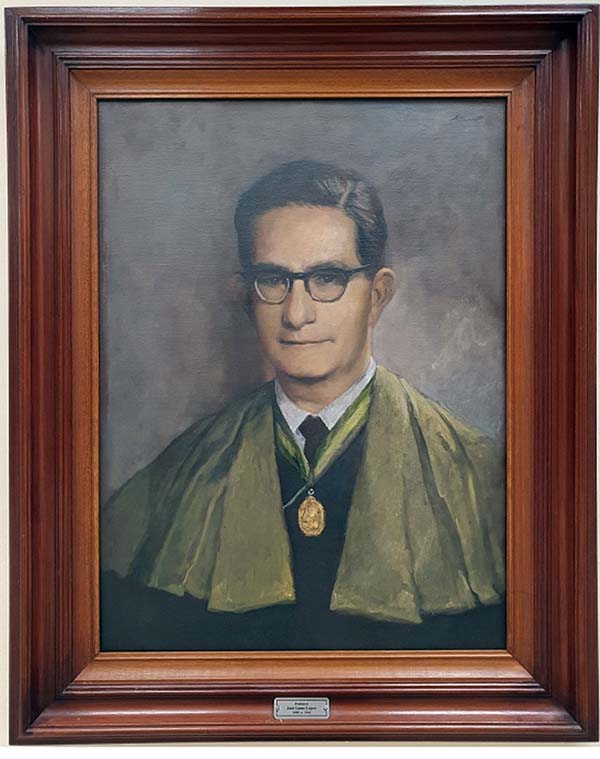
In addition to being a professor at the IPUB, he was also its director from 1958 to 1966 and from 1970 to 1974 (Figure 1). Both periods were marked by intense social tension, but he was able to maintain relative autonomy for the university and successfully transformed the institute into an important center for national psychiatry, establishing the psychological service, the occupational therapy sector, and the center for childhood and adolescence. He also expanded lato sensu graduate courses and established the first stricto sensu psychiatry courses in Brazil. He improved the Jornal Brasileiro de Psiquiatria's editorial process, which is one of the oldest specialty journals in the country.2 Leme Lopes fostered the exchange of ideas among different schools, furthering the Instituto de Psiquiatria's expansion to various lines of research by establishing the first Sector of Psychotherapy and Psychoanalytic Research in Brazil in 1959. He proposed that different approaches should be considered complementary and that treatments should be non-exclusive, advocating for a scientific psychiatry open to collaboration with other sources.4

In this spirit of partnership, he worked with psychiatrists from different states in the 1960s to establish a national professional organization. This effort led to the creation of the Brazilian Psychiatric Association in 1966, and he served as its first president (1966-67).2 Before establishing the Brazilian Psychiatric Association, the specialty received limited representation by the Brazilian Society of Neurology, Psychiatry, and Legal Medicine, which was founded by Juliano Moreira and others in 1904.4
Leme Lopes' international reputation was boosted by the inclusion of his innovative thesis in the 1995 edition of Kaplan and Sadock's Comprehensive Textbook of Psychiatry. This thesis, entitled "The dimensions of psychiatric diagnosis (contribution to its systematization)," proposed multiaxial diagnosis and discussed the challenges of diagnostic accuracy as a crucial issue in clinical practice and research. This novel multidimensional conception of psychiatric diagnosis influenced the classifications used in the World Health Organization's ICD-10 (1992) and the American Psychiatric Association's DSM III (1980). These classifications address the syndrome, its etiology, and the patient's previous personality5 without reducing diagnosis to a quantitative standard that excludes subjectivity.
Psychiatric diagnosis is phenomenological, based on psychopathology and narrative, which allows for clinical practice based on scientific evidence. However, psychopathology involves more than determining symptoms to arrive at a diagnosis, it also aims to describe the patient's personal experience in relation to both the patient and the world.6 Accurate diagnosis is crucial for treatment recommendations, determining prevalence rates - for mental health service planning - and documenting public health information. One aim of Leme Lopes' multidimensional diagnostic proposal seems to have been to engage the patient as an active participant in the discussion with the doctor "in the shared space of polyphony." This interaction serves as a meeting place between the patient's subjective experience and the doctor's perspective, with the doctor gathering important information to "translate" the patient's story. This exemplifies the integrated perspective of biomedical and psychodynamic models in Leme Lopes' thought and his advocacy for comprehensive humanistic education for psychiatrists.4
The U.S. National Institute of Mental Health has developed Research Domain Criteria (RDoC) for personalized medicine in psychiatry, whose objective is to assess patients using a combination of observable complex behaviors, neuropsychological tests, and assessment scales, rather than relying solely on psychopathological examinations.7 RDoC is based on the principle that neurobiological and biobehavioral mechanisms underlie mental illnesses, and that discovering these mechanisms will lead to definitive biological treatments, which, using a pathophysiology-based approach, lead to a cure rather than symptom relief.8 The aim of Research Domain Criteria is to improve the diagnostic process by using information from genetics, neuroimaging, cognitive science, and other sources, creating a new classification system based on observable behaviors and biological measurements.9 But how can we further our understanding of biological factors without disregarding the patient's complex subjective experiences, which cannot be solely explained by biology, especially when human interactions occur within the realm of subjectivity? A more inclusive approach could lead to more personalized and precise medicine.
José Leme Lopes is a distinguished figure in research on psychiatric diagnosis, alongside Emil Kraepelin, Kurt Schneider, Adolf Meyer, and Henry Ey.1 He was a lifetime member of the Society for Personality Assessment (New York), a member of the International Society of the Rorschach and Projective Methods (Bern), a founding member and president of Sociedade Católica Internacional para os Estudos Médico-Psicológicos, a Corresponding Member of the American Psychiatric Association, among other institutions. He received the Medals of the Order of Medical Merit, Clementino Fraga, Oswaldo Cruz, and the State of Guanabara. Leme Lopes is credited with developing a generation of clinical psychiatrists and psychoanalysts grounded in solid principles of phenomenological psychopathology and existential philosophy. Brazilian psychiatrists owe a great debt of gratitude and recognition to this outstanding professional, a legacy that should be honored by future generations. He passed away at the age of 86 on June 4, 1990, in Rio de Janeiro.
Disclosure
The authors report no conflicts of interest.
Author contributions
LJ: Conceptualization, Data curation, Formal analysis, Investigation, Methodology, Project administration, Software, Validation, Writing - original draft, Writing - review & editing.
WJP: Formal analysis, Project administration, Writing - review & editing.
AEN: Conceptualization, Data curation, Formal analysis, Methodology, Project administration, Supervision, Writing - review & editing.
All authors have read and approved of the final version to be published.
Handling Editor: Andre Brunoni
 PDF
 Print
 Send this article by email
 How to cite this article
 Submit a comment
 Mendeley
 Pocket
 Share on Facebook
 Share on Twitter