



FIGURES
| Received: ; Accepted: |
The authors have made us aware of some errors in the article titled ''Translating measurement into practice: Brazilian norms for depressive symptom assessment with the Patient Health Questionnaire (PHQ-9)'' (http://dx.doi.org/10.47626/1516-4446-2022-2945), by Damiano et al., published in the Brazilian Journal of Psychiatry in ahead of print format in March 2023, and in final form in September 2023, as part of our volume 45, issue 4.
The first error appears in the order of the values reported for each PHQ item in Table 1. The order of values as published across the four columns is incorrect and should read as presented below, in the fully revised, correct version of Table 1:
| ß (item difficulty) | ||||
|---|---|---|---|---|
| PHQ item (How often have you been bothered by the following in the past 2 weeks?) | Not at all = several days | Several days = more than half of the days | More than half of the days = nearly every day | a (item discrimination) |
| 1 - Little interest or pleasure in doing things? | 0.679 | 1.545 | 1.954 | 2.937 |
| 2 - Feeling down, depressed, or hopeless? | 0.729 | 1.532 | 1.962 | 2.935 |
| 3 - Trouble falling or staying asleep, or sleeping too much? | 0.553 | 1.371 | 1.781 | 1.557 |
| 4 - Feeling tired or having little energy? | 0.431 | 1.369 | 1.807 | 2.242 |
| 5 - Poor appetite or overeating? | 1.124 | 1.87 | 2.388 | 1.817 |
| 6 - Feeling bad about yourself - or that you are a failure or have let yourself or your family down? | 1.18 | 1.852 | 2.268 | 2.696 |
| 7 - Trouble concentrating on things, such as reading the newspaper or watching television? | 0.986 | 1.757 | 2.199 | 2.547 |
| 8 - Moving or speaking so slowly that other people could have noticed? Or so fidgety or restless that you have been moving a lot more than usual? | 1.176 | 1.891 | 2.356 | 2.191 |
| 9 - Thoughts that you would be better off dead, or thoughts of hurting yourself in some way? | 2.148 | 2.718 | 3.132 | 2.199 |
Parameters a and ß are described above in the text.
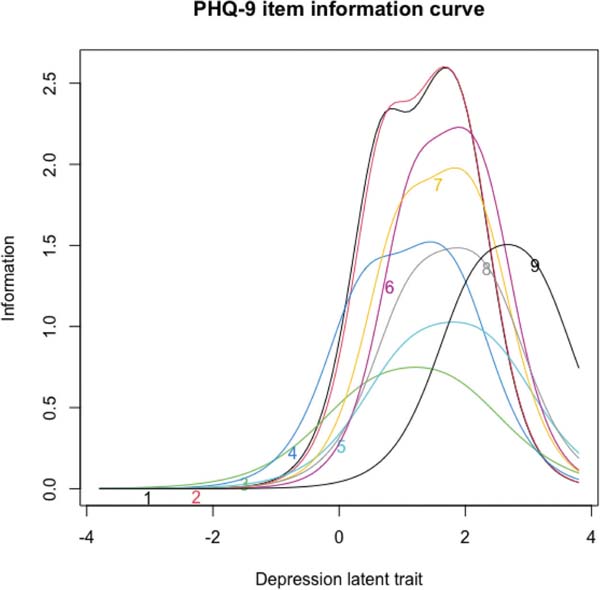
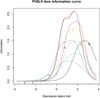
IRT analysis was used to characterize the distribution of depressive symptoms at the trait level. Full IRT results can be seen in the supplementary material (Figure S1 for IIC and Table 1 for item-level description of parameters a and ß). Overall, in this representative Brazilian sample, the PHQ-9 captured information about the most severe level of depression, with items 1 and 2 being the most informative (Table S2 and Table 1). In all items, the response ''more than half of the days'' had a low probability of capturing information (Table S3, Figure S2).
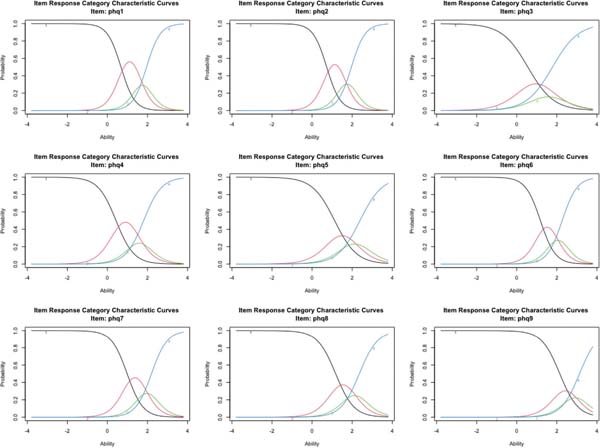
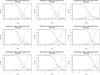
The online-only supplementary material published along with the article also shows errors in Figures S2 and S3. In both cases, the graphs were incorrectly assigned to the relevant PHQ item. Below we reproduce the revised, correct versions of Supplementary Figures S2 and S3:
Item 1: Little interest or pleasure in doing things?
Item 2: Feeling down, depressed, or hopeless?
Item 3: Trouble falling or staying asleep, or sleeping too much?
Item 4: Feeling tired or having little energy?
Item 5: Poor appetite or overeating?
Item 6: Feeling bad about yourself.
Item 7: Trouble concentrating on things.
Item 8: Moving or speaking so slowly that other people could have noticed?
Item 9: Thoughts that you would be better off dead, or thoughts of hurting yourself in some way?
Item 1: Little interest or pleasure in doing things?
Item 2: Feeling down, depressed, or hopeless?
Item 3: Trouble falling or staying asleep, or sleeping too much?
Item 4: Feeling tired or having little energy?
Item 5: Poor appetite or overeating?
Item 6: Feeling bad about yourself.
Item 7: Trouble concentrating on things.
Item 8: Moving or speaking so slowly that other people could have noticed?
Item 9: Thoughts that you would be better off dead, or thoughts of hurting yourself in some way?
The authors apologize for these errors and inform that the scientific conclusions of the article are not affected in any way by these corrections.
 PDF
 Print
 Send this article by email
 How to cite this article
 Submit a comment
 Mendeley
 Pocket
 Share on Facebook
 Share on Twitter