



ABSTRACT:
OBJECTIVE: This study investigated the relationship between impulsivity and early trauma through
a network analysis in individuals diagnosed with different substance use disorders.
METHODS: In a cross-sectional design, the sample included 556 men with substance use disorders
(195 with alcohol use, 157 with cocaine/crack use, and 214 with polysubstance use).
Early trauma and impulsive behavior were assessed using the Childhood Trauma Questionnaire
and the Barratt Impulsiveness Scale, respectively. The connection between trauma and
impulsivity was assessed using network analysis through a fused graphical lasso algorithm.
RESULTS: No connection was observed between impulsivity and trauma networks in individuals
with alcohol use disorder. In those with cocaine use disorder, networks were linked
through the motor domain and sexual abuse nodes. Inverse connections were observed
between the emotional neglect node and perseverance, but not the non-planning node.
In polysubstance use, the connection between impulsivity and trauma networks was weak,
with the cognitive complexity node connecting to the trauma network through physical
abuse. There connections were inversely proportional between the motor domain and
emotional neglect nodes, as well as between cognitive instability and physical neglect.
CONCLUSION: Our results suggest that the relationship between the type of early (childhood) trauma
and the expression of impulsivity could lead to different substance use profiles.
Keywords: Addiction; substance use disorder; childhood trauma; impulsiveness; network analysis.
FIGURES
| Received: June 29 2023; Accepted: February 5 2024 |
INTRODUCTION
Among individuals with substance use disorders (SUD), there is a high prevalence of psychoactive substance use. Although some users have a preferred substance, other drugs can also be used to increase pleasure and minimize the effects of withdrawal, mainly craving.1 Individuals with SUD have high rates of clinical and psychiatric comorbidities, trauma, and impulsivity,2-4 and there may be differences in these characteristics between individuals who use different substances.
Trauma can be characterized as a set of external, real, extreme, and/or chronic exposure events of intolerable emotional intensity.5 Over 60% of children (up to 16 years of age) are exposed to complex trauma worldwide6 and may exhibit lower reward sensitivity,7,8 which may explain the high prevalence of SUD in this population. This evidence, corroborated by meta-analyses9,10 and longitudinal4 and cohort studies,11 has drawn attention to the worse prognosis of mental disorders among these individuals.
Impulsivity, a multifaceted construct involving the decision-making process, impaired cognitive control, and behavioral disinhibition, usually leads to risky behaviors.12,13 Like trauma, impulsivity is another common characteristic observed among individuals with SUD. It is a risk factor for the abuse of alcohol and other types of psychoactive substances.12,14,15
Besides interacting with substance use, trauma and impulsivity can also interact among themselves. Exposure to traumatic events may be related to increased impulsivity.16,17 A recent study showed that patients with post-traumatic stress disorder scored higher in cognitive and behavioral impulsivity.18 A meta-analysis of 55 studies explored the relationship between these two outcomes,19 but only four of the included studies performed multivariate analysis of child maltreatment and impulsivity, and two others compared impulsivity with childhood trauma subtypes. Therefore, studies investigating multiple variables in impulsivity and early trauma are lacking.
The relationship between trauma and impulsivity could be associated with psychoactive substance use, considering that addicted individuals have impaired inhibitory control and emotion modulation.17 Although studies have shown a strong relationship between impulsivity, trauma, and substance use, it remains to be explained how childhood trauma interacts with impulsivity, and which component of each spectrum exerts the most influence on substance use. Network analysis allows simple visualization of each variable's role in different subgroups. In the mental health field, where multiple variables interfere with an outcome, network analysis allows central nodes of influence to be identified among the variables and reveals their relationship with the outcome.20 This type of approach offers a clearer perspective on the predominant ecosystem in a sample of individuals, such as characterizing expressive personality traits and the origin of some behavior disorders.21
Our primary hypothesis was that all dimensions of trauma and impulsivity are interrelated, combining two interconnected clusters.22 According to previous findings, we also hypothesized that emotional abuse is central among other nodes in the network analysis and involves greater influence.19 In this study, we aim to investigate the relationship between impulsivity and childhood trauma types using network analysis among individuals with alcohol, cocaine, and polysubstance use disorders.
METHODS
Design and sample
This cross-sectional study included 556 men with SUD (195 with alcohol use disorder, 157 with cocaine use disorder [including cocaine and crack use], and 214 with polysubstance use disorder [alcohol and cocaine/crack use]) who were hospitalized in a psychiatric addiction unit in southern Brazil. This inpatient facility for men specializes in SUD treatment (mainly, but not limited to, alcohol and cocaine use disorder). Inpatients can request discharge at any time, and cannot use any type of psychoactive substance, including tobacco, during hospitalization. Upon admittance, all patients are evaluated by a multidisciplinary team of professionals, including psychiatrists, nurses, and nutritionists. During hospitalization, patients undergo a period of detoxification with specific drug protocols (benzodiazepine, antipsychotics, and B-complex vitamins) to alleviate withdrawal symptoms. During this period, patients can participate in individual and group psychotherapy and exercise in the gym. Dietary requirements are provided according to the patient's needs (e.g., high-calorie, high-protein, or other restrictions). There are four mealtimes: 8:00 a.m., 11:50 a.m., 5:50 p.m., and 9:30 p.m.
Inclusion criteria were men 18 to 65 years of age without cognitive deficit who had been diagnosed with SUD according to the DSM-5.6
Evaluation/assessment
All clinical assessments were performed during the initial days of hospitalization, after withdrawal symptoms had stabilized. The research protocol was conducted by previously trained junior researchers who were supervised by psychologists or psychiatrists.
Childhood trauma was investigated using the Childhood Trauma Questionnaire,23 which investigates five components of trauma: physical and emotional neglect, physical and emotional abuse, and sexual abuse. The Barratt Impulsiveness Scale was used to assess impulsivity.24 This scale consists of 30 items scored to produce six first-order factors: attention, motor, cognitive complexity, non-planning, perseverance, and cognitive instability.25 Motor and cognitive instability are characterized by acting without thinking, while attention and cognitive instability involve a lack of focus on the task at hand. Non-planning and cognitive complexity encompass behaviors oriented on the present rather than the future.26,27 The Structured Clinical Interview for DSM Disorders28 was used to assess psychiatric disorders, and the Addiction Severity Index (sixth version)29 was used to assess dimensions of substance use.
Statistical analysis
Analyses were conducted in three separate groups according to primary substance: alcohol, cocaine/crack, or polysubstance (i.e., alcohol and cocaine/crack). The chi-square test was used to associate categorical variables, and standardized adjusted residuals were analyzed to detect categories with higher than expected frequencies. The Kruskal-Wallis test with Dunn post-hoc for multiple comparisons was performed to compare quantitative variables between groups. The data are presented as absolute and relative frequencies and median and interquartile range.
Network analysis30 was used to assess the interaction between early trauma and impulsivity in each patient group. To build a network, we identified the elements (nodes) and then determined the type of relationship (lines).30 Nodes are usually visualized as circles and can represent any conceivable variable. The lines connecting the nodes represent any kind of relationship, such as correlations (partial), probabilities, or neuronal connectivity. The relationship between impulsivity and trauma was estimated using the fused graphical lasso method. The connectivity of the networks between the three groups was compared using the Network-Comparison Test package. We calculated the node strength (main centrality measures), the expected influence (estimated by the centrality index), and the participation coefficient for each node. The correlation between centrality measures and expected influence were calculated to assess the similarity between groups.
The accuracy of lines and centrality estimates of the network factors was tested using the R "bootnet" package via a bootstrap sampling procedure with 1,000 iterations. We assessed the stability of the centrality metrics using the coefficient of stability by repeatedly correlating the centrality metrics from the original dataset with those calculated from subsamples including progressively fewer participants. The coefficient of stability represents the maximum proportion of participants that can be eliminated, with a 95% probability that the correlation between the centrality metrics from the full dataset and the subset data is at least 0.7 and should be above 0.5. As additional sensitivity analyses, we assessed the correlation of the centrality scores (1,000 samples) to estimate uncertainty in the three groups. All analyses were conducted in R 3.5.1 (R Core Team 2020).
Ethics statement
Written informed consent was provided by all included patients. The study was approved by research ethics committee at Hospital de Clínicas de Porto Alegre (decision 20140249).
RESULTS
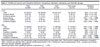
Mean age, hospitalization days, and occupational status differed among the substance groups (Table 1). The alcohol group was older, had a higher proportion of retirees, and remained hospitalized for longer periods than the cocaine and polysubstance groups. The alcohol group also had a higher prevalence of sexual abuse and emotional neglect (Table 2). The polysubstance group had higher scores for the attention, perseverance, and cognitive complexity domains than the other groups (Table 2).
| Total (n=556) | AUD (n=195) | CUD (n=157) | Poly-users (n=214) | Statistics, p-value | |
|---|---|---|---|---|---|
| Age (years) | 41.0 (31-51) | 53.0 (45-58)a,b | 32.0 (28-37)a,c | 38.0 (30-46)b,c | H(2) = 224.24, < 0.001 |
| Hospitalization days | 19.5 (8-35) | 32.0 (16-42)a,b | 13.0 (7-28)a | 13.0 (7-31)b | H(2) = 77.39, < 0.001 |
| Marital status | ?2(2) = 5.13, 0.07 | ||||
| Married | 138 (24.4) | 57 (10.1) | 39 (6.9) | 42 (7.4) | |
| Single/widower | 428 (75.6) | 138 (24.4) | 118 (20.8) | 172 (30.4) | |
| Race | |||||
| White | 504 (67.8) | 131 (23.1) | 117 (20.7) | 148 (26.1) | ?2(4) = 3.74, 0.44 |
| Black | 111 (14.9) | 27 (4.8) | 17 (3.0) | 34 (6.0) | |
| Other | 128 (17.2) | 37 (6.5) | 23 (4.1) | 32 (5.7) | |
| Education level | ?2(6) = 4.61, 0.56 | ||||
| Illiterate | 1 (0.2) | 1 (0.2) | - | - | |
| Complete primary school | 269 (47.5) | 94 (16.6) | 67 (11.8) | 108 (19.1) | |
| Complete high school | 153 (27.0) | 53 (9.4) | 48 (8.5) | 52 (9.2) | |
| Complete university | 143 (25.3) | 47 (8.3) | 42 (7.4) | 54 (9.5) | |
| Occupational status | ?2(6) = 41.1, 0.001 | ||||
| Student | 7 (1.2) | 66 (11.7)a | 67 (11.8)a | 112 (19.8)a | |
| Unemployed | 245 (43.3)a | 66 (11.7)b | 73 (12.9)b | 69 (12.2)b | |
| Employee | 208 (36.7)b | 61 (10.8)c,d | 14 (2.5)c,d,e | 31 (5.5)c,d,e | |
| Retired/disability benefits | 106 (18.7)c | 66 (11.7)a | 67 (11.8)a | 112 (19.8)a |
Data presented as median and interquartile range (Kruskal-Wallis test with Dunn post hoc for multiple comparisons) or as absolute and relative frequency (chi-square association test).
AUD = alcohol use disorder; CUD = cocaine use disorder.
Bold type denotes statistical significance.
Superscript letters show significant pairwise comparisons (p < 0.05).
| Total (n=556) | AUD (n=195) | CUD (n=157) | Poly-users (n=214) | Statistics, p-value | |
|---|---|---|---|---|---|
| CTQ | |||||
| Total | 43 (33-57) | 46 (35-59) | 42 (35.5-57) | 40 (32-57) | H(2) = 3.14, 0.20 |
| Physical abuse | 8 (6-13) | 8 (6-14) | 6 (7-7) | 8 (6-14) | H(2) = 0.14, 0.92 |
| Emotional abuse | 10 (7-15) | 11 (15-7) | 5 (5-5) | 10 (7-15) | H(2) = 1.41, 0.49 |
| Sexual abuse | 5 (5-6) | 5 (5-7)a | 5 (5-5)a | 5 (5-5.7) | H(2) = 7.78, < 0.05 |
| Physical neglect | 8 (5-11) | 8 (6-12) | 8 (5-11) | 8 (5-11) | H(2) = 2.75, 0.25 |
| Emotional neglect | 9 (6-13) | 10 (7-15)a | 9 (6-13) | 9 (6-13)a | H(2) = 8.64, < 0.01 |
| BIS | |||||
| Total | 74 (66-82) | 69 (62-77)a | 77 (68-83) | 77 (70-83) a | H(2) = 6.50, < 0.05 |
| Attention | 13 (11-15) | 13 (11-15)a | 13 (11-15)b | 14 (12-15)a,b | H(2) = 7.99, < 0.01 |
| Motor | 18 (16-20) | 18 (16-20) | 18 (16-20) | 18 (16-20) | H(2) = 3.31, 0.19 |
| Cognitive instability | 7 (6-9) | 7 (6-9) | 7 (6-9) | 7.5 (6-9) | H(2) = 3.28, 0.18 |
| Non-planning | 13 (12-15) | 13 (12-15) | 30 (26-33) | 13 (12-15) | H(2) = 4.65, 0.09 |
| Perseverance | 12 (9-10) | 10 (9-12)a,b | 10 (9-12)b | 11 (9-12)a,b | H(2) = 9.86, < 0.001 |
| Cognitive complexity | 13 (11-15) | 12 (10-15)a | 13 (11-15)b | 14 (11-16)a,b | H(2) = 15.58, < 0.001 |
Data presented as median and interquartile range (Kruskal-Wallis non-parametric test - Dunn test for multiple comparisons of groups).
AUD = alcohol use disorder; BIS = Barratt Impulsiveness Scale; CTQ = Childhood Trauma Questionnaire; CUD = cocaine use disorder.
Bold type denotes statistical significance.
Superscript letters show significant pairwise comparisons (p < 0.05).
Network analyses of early trauma and impulsivity
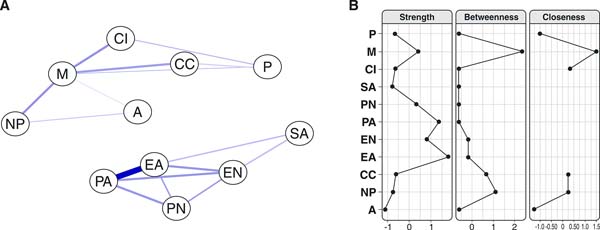
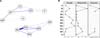
The impulsivity network was not connected to the trauma network in individuals with alcohol use disorder (Figure 1). The motor domain was the most important node among all centrality measures, having a close connection with the cognitive instability and non-planning nodes (Figure 1A). The strongest node of the trauma network was emotional abuse, which had a strong connection to physical abuse and a close connection to emotional and physical neglect. The results indicated that the networks remained stable over time (Figure S1, available as supplementary material).
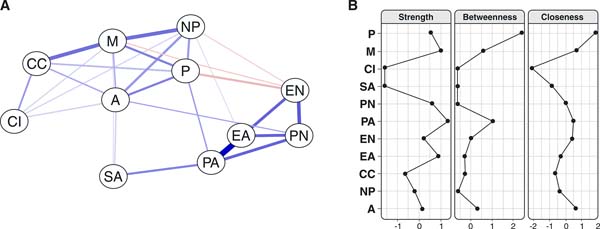
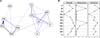
In individuals with cocaine use disorder, the impulsivity and trauma networks were connected through the attention and sexual abuse nodes (Figure 2). There were also inversely proportional connections between the emotional neglect node, perseverance, and non-planning nodes. In the impulsivity network, only cognitive instability showed no importance in the centrality index. All nodes in the trauma network were strongly interconnected. The emotional and physical abuse nodes showed greater strength and closeness. The network structure was also stable (Figure S2, available as supplementary material).

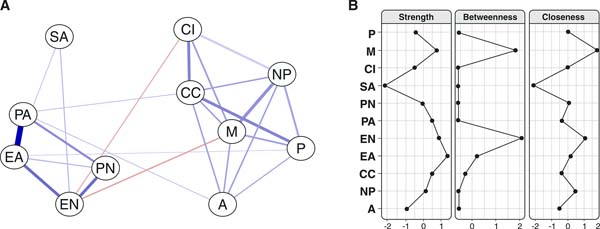
In the polysubstance use disorder group, the connection between the impulsivity and trauma networks was weak (Figure 3), with the cognitive complexity node connecting to the trauma network through physical abuse. There were also inversely proportional connections between emotional neglect, the motor domain, and cognitive instability. The centrality of the network was once again evidenced by the motor domain, whose closeness to the perseverance and non-planning nodes was high. In the trauma network, there were strong connections between the physical abuse and emotional abuse nodes, the physical and emotional neglect nodes, and the emotional abuse and emotional neglect nodes. Sexual abuse was weakly connected to the emotional neglect and physical abuse nodes. Our results indicated that the networks remained stable over time after the bootstrap analysis (Figure S3, available as supplementary material).
DISCUSSION
The present study, which investigated the relationship between early trauma types and impulsivity through a network analysis approach in psychoactive substance users, found connections between impulsivity and trauma networks in individuals with cocaine use disorder and polysubstance use disorder, albeit involving different nodes or domains. In individuals with alcohol use disorder, no connection was observed between the two networks.
In the trauma network, emotional abuse seemed to be the strongest and most consistent node in all groups, corroborating the findings of a meta-analysis by Liu,19 which also supports our secondary hypothesis, that this specific trauma dimension has a central role and greater influence in the network. This strong connection between nodes indicated that childhood traumatic events affect different spheres, both emotional and physical, having relevant implications in adulthood. Early trauma, especially physical and emotional abuse, is a well-known predictor for both SUD development and worse prognosis. A longitudinal study with adolescents demonstrated the co-occurrence of emotional abuse with other types of trauma,31 which could be due to the chronic aspect of emotional abuse, i.e. it can be perpetuated for years, possibly over a great part of an individual's life.32 According to a large meta-analysis of 244 studies, emotional abuse is the most prevalent type of childhood maltreatment.33 Trauma complexity can predict SUD severity,3,34 which could be expressed by impulsivity and polysubstance use.
In the impulsivity networks, the motor domain was the central link between the other dimensions, having a strong connection with the cognitive and non-planning nodes. Motor impulsivity involves acting precociously without considering the consequences of one's actions; it is directly related to negative outcomes, such as substance abuse. A previous study also found that a high frequency of motor and unplanned impulsivity may lead to a greater risk of alcohol abuse,35 corroborating our findings about the connection between impulsiveness domains in alcohol use disorder. In this context, deficits in response inhibition, attention, working memory, decision making, and delayed gratification, as well as a tendency to focus on the present moment without evaluating long-term consequences are consistently observed characteristics of individuals with SUD.12,36 Despite the strong relationship between impulsivity and SUD, a systematic review by Stevens et al.37 found that not all impulsivity domains are equally related to addiction. Motor impulsivity was not related to abstinence levels or treatment retention, whereas impulsive decision-making was associated with better addiction-related outcomes. This differs from our results, in which motor impulsivity was the main node among all centrality measures, having a relevant effect on these characteristics. One reason this contrasts with other findings in the literature could be that different tasks are used to estimate impulsivity. Furthermore, the small number of studies included in Stevens et al.'s37 systematic review and the spectrum of addiction severity adds further complexity to this scenario. Thus, further research is needed to determine the central dimensions of impulsivity in patients with SUD.
One limitation was that our study was being conducted at an inpatient facility for men only, i.e., it is possible that women interpret trauma differently. The fact that the sample was hospitalized might indicate selection bias; results from a sample of severe patients with little social support cannot be generalized to patients in other therapeutic modalities. Memory bias may have influenced the reliability of retrospective data, especially regarding early trauma. In addition, the research protocol was completed in the presence of an interviewer, which may have led to social desirability bias. Finally, studies with a control group, with individuals who use other substances, and longitudinal studies could more precisely explain the causal link between early trauma and impulsivity. Despite these limitations, no other study has assessed all dimensions of childhood trauma and impulsivity in a network analysis of substance users, determining the central nodes of interaction between the two phenomena.
In summary, we found that early trauma and impulsivity are directly related to SUD severity. Professionals should pay closer attention to the relationship between trauma type and impulsivity to improve patient assessment and develop more specific and effective interventions and treatments. Social skills training, trauma-focused therapies, and early childhood interventions could have a significant impact in this population. It is also important to develop and enforce public policies to prevent early trauma among children and adolescents.
ACKNOWLEDGEMENTS
This study was supported by Conselho Nacional de Desenvolvimento Científico e Tecnológico (CNPq; grant 478492/2013-8), Secretaria Nacional de Políticas sobre Drogas (SENAD)/Ministério da Justiça e Segurança Pública (grant 08129.015636/2017-78), Fundo de Incentivo à Pesquisa e Eventos - Hospital de Clínicas de Porto Alegre (FIPE-HCPA; grant 20140249), and Coordenação de Aperfeiçoamento de Pessoal de Nível Superior (CAPES; finance code 001). The funders had no role in study design, data collection and analysis, decision to publish, or preparation of the manuscript.
 PDF
 Print
 Send this article by email
 How to cite this article
 Submit a comment
 Mendeley
 Pocket
 Share on Facebook
 Share on Twitter



