



ABSTRACT:
OBJECTIVES: The kynurenine (KYN) pathway has been attracting attention as a relevant pathway in
schizophrenia (SZ), bipolar disorder (BD), and major depressive disorder (MDD). We
conducted a systematic review and meta-analysis of studies examining KYN pathway metabolites
from cerebrospinal fluid (CSF) samples in SZ, BD, and MDD.
METHODS: The PubMed and Scopus databases were systematically searched to identify peer-reviewed
case-control studies published until April 2022 that assessed KYN metabolites, namely,
tryptophan (TRP), KYN, kynurenic acid (KA), quinolinic acid (QA), and 3-hydroxykynurenine
(3-HK), in subjects with SZ, BD, or MDD compared with healthy controls (HC). The Preferred
Reporting Items for Systematic Reviews and Meta-Analyses (PRISMA) guidelines were
followed. The random effects model method was selected for comparison of standardized
mean differences (SMD) between two groups.
RESULTS: Twenty-three articles met the inclusion criteria (k = 8, k = 8, k = 11, for SZ, BD,
and MDD, respectively). In SZ, KA levels were increased (SMD = 2.64, confidence interval
[CI] = 1.16 to 4.13, p = 0.0005, I2 = 96%, k = 6, n=384). TRP (k = 5) and KYN (k = 4) did not differ significantly. In
BD, TRP levels (k = 7) did not differ significantly. The level of KA was increased
in MDD (k = 2), but the small number of studies precluded evaluation of statistical
significance. Finally, in MDD, although some studies tended to show an increased level
of KYN in those with remission vs. decreased levels in those with current depression,
no significant difference was found in any KYN metabolite levels. Similarly, an increased
level of QA was found, but the number of studies (k = 2) was small.
CONCLUSION: KA, which has possibly neuroprotective effects, is increased in SZ. QA, which has
neurotoxic effects, may be increased in MDD. There were no alterations in BD. Alterations
in the KYN pathway may occur based on population characteristics and mood states.
Future studies should explore the utility of these metabolites as biomarkers.
Keywords: Biomarker; kynurenic acid; quinolinic acid; tryptophan; mental disorders.
FIGURES
| Received: November 23 2022; Accepted: April 18 2023 |
INTRODUCTION
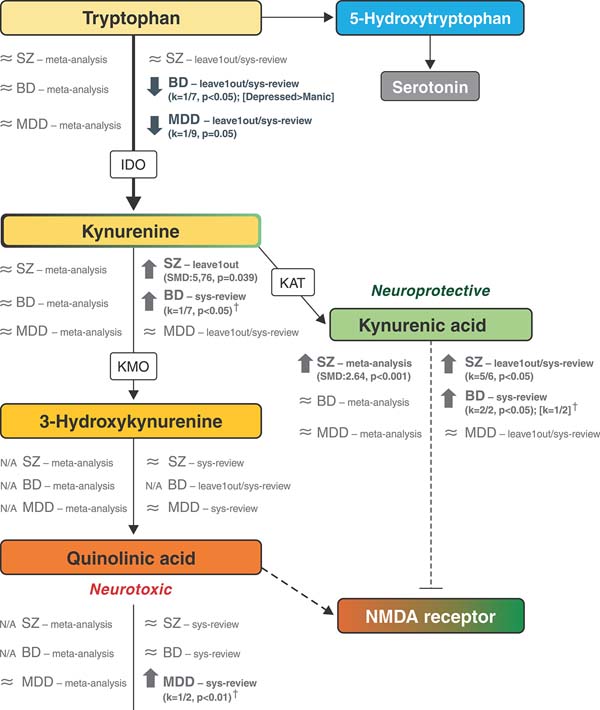
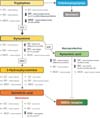
The kynurenine (KYN) pathway has been increasingly attracting attention as a relevant pathway in psychiatric disorders, including schizophrenia (SZ), bipolar disorder (BD), and major depressive disorder (MDD).1,2 Tryptophan (TRP) is a major precursor for neuroactive compounds and can be metabolized to either serotonin or N-formylkynurenine and enter the KYN pathway; in fact, more than 90% of TRP enters the KYN pathway.3 Following this, N-formylkynurenine is converted into KYN, which, in turn, is metabolized to either kynurenic acid (KA) in the astrocytes or to quinolinic acid (QA) in the microglia. Both KA and QA act on the N-methyl-D-aspartate (NMDA) receptor: KA as a glutamate receptor antagonist with hypothesized neuroprotective effects, and QA as an agonist with hypothesized neurotoxic effects.2,4
It has been postulated that MDD results from a dysregulation of monoaminergic transmission, therefore largely implicating the serotonergic and noradrenergic systems. Similarly, SZ has been considered a disorder of the dopaminergic system. These views have prevailed in the field for several decades. More recently, other factors have been implicated in MDD and SZ, including glutamatergic transmission and glial cell functions.5-9 Glutamate, an excitatory neurotransmitter that acts on the NMDA receptor, is now known to be involved in the pathophysiology of SZ, BD, and MDD.10,11 It has been hypothesized that there is a preponderance of QA in mood disorders (BD and MDD) and KA in SZ.1 An overstimulation of glutamate receptors by QA and consequent neurotoxicity with neuronal damage would occur in mood disorders12; conversely, blockade of NMDA receptors by KA, with consequent excitotoxicity, has been implicated in SZ.13 Accordingly, pharmacological antagonists of the NMDA receptor can indeed exacerbate positive symptoms in SZ.14
Due to the discrepancy among different studies regarding different metabolites of the KYN pathway in psychiatric disorders, we previously conducted a meta-analysis on the KYN pathway metabolites in peripheral blood in SZ, BD, and MDD, and verified a shift in the metabolism of TRP away from serotonin and toward KYN across all three disorders.1 Downstream, there appeared to be a shift from KA to QA in mood disorders, but not in SZ.1 However, the extent (if any) to which peripheral levels of those metabolites mirror central levels is unknown. Although a few other meta-analyses have been conducted, most pooled brain and peripheral levels of the metabolites together, without discrimination, or focused on only one disorder or on a few metabolites, thus failing to provide a full depiction of the patterns of the KYN pathway in these disorders.15-18 Thus, in this study, we aim to investigate TRP and the downstream metabolites of the KYN pathway in cerebrospinal fluid (CSF) samples cross-diagnostically, in SZ, BD, and MDD, to ascertain whether a discernible pattern exists across these disorders.
METHODS
Database search
The Preferred Reporting Items for Systematic Reviews and Meta-Analyses (PRISMA) guidelines were followed.19 Two investigators (BSF and ES) systematically searched the PubMed and Scopus databases from inception to April 2022 to identify peer-reviewed case-control studies that assessed KYN metabolites - specifically, TRP, KYN, KA, QA, and/or 3-hydroxykynurenine (3-HK) - in people with SZ, BD, and MDD. The search terms were (kynurenine OR kynurenic acid OR tryptophan OR IDO OR indoleamine 2,3-dioxygenase OR quinolinic acid OR 3-hydroxykynurenine) AND (depression OR depressed OR bipolar disorder OR schizophrenia OR schizoaffective) AND (cerebrospinal fluid).
Inclusion and exclusion criteria
Only studies published in the English language and conducted in SZ (including schizoaffective disorder), BD (including manic, depressed, and euthymic), or MDD (both depressed and those in remission) samples, measuring the metabolites of interest of the KYN pathway (as per the search criteria) only in CSF specimens, were selected. Studies that reported mixed data (i.e., not disaggregated) on multiple disorders were excluded. Studies were also excluded if they did not include a healthy control (HC) comparison group. If two or more manuscripts reported on the same or overlapping participant samples, data were only extracted from the manuscript that included the largest sample size. When inclusion or exclusion could not be determined based on the article title and abstract alone, full-text reviews were conducted independently by two authors (MEI and ES). Disagreements were managed by discussion to reach a consensus with a third author (BSF).
Data extraction
The following data were extracted: author and date of the study, demographic characteristics of participants (age, sex, body mass index [BMI], and other comorbidities when and if reported), metabolite levels (means, SD, and sample sizes), and medication and history of psychosis, if applicable. When results were described as median and interquartile ranges, these were converted to mean and SD using the formulae devised by Wan et al.20 and Luo et al.21
Data analysis
The meta-analysis was performed using the metafor package (version 3.0-2) in R version 4.1.2. The pre-processed Excel file was loaded to R using the readxl package (version 1.3.1). The data were fitted to the random effects model due to the heterogeneity of the studies after the standardized mean differences (SMD) were calculated. This is recommended for the comparison of heterogeneous ratios.22,23 Leave-one-out analysis was also performed to see if any outlier studies existed. All visualizations were generated in R. The primary results were visualized in forest plots. The secondary results were visualized and included in the online-only supplementary material as funnel plots, to show which studies showed significant results and in what direction, and as Baujat plots (with three or more studies), to show which studies influenced the results. Cochrane guidelines were followed when reporting the findings and adjusting for the covariates.24 We reported our meta-analysis findings only when at least two studies for a given metabolite were available.
RESULTS
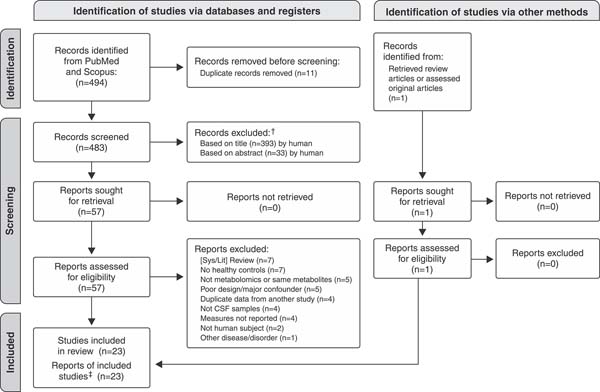
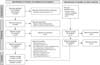
The search strategy resulted in 483 de-duplicated studies that were screened. Of these, 58 studies were considered in the full-text review, of which 23 studies, comprising 1,535 participants (701 with SZ, BD, or MDD; 834 HC) were included (Figure 1). KA was increased in SZ, but the results of the meta-analysis did not show any other significant differences in SZ, BD, or MDD compared to HC (Figure 2). Based on our systematic review of the literature, there is an overall shift toward the KYN pathway in SZ, BD, and MDD (Figure 2). We reported the results according to the different disorders investigated.
Schizophrenia
Meta-analysis
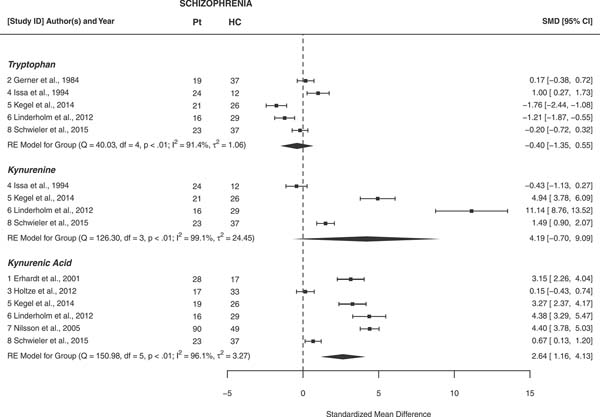
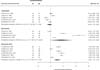
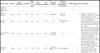
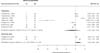
Eight studies were identified for SZ (Table 1).13,25-31 The mean sample size for SZ (n=238) and HC (n=240) per study was 29.8±24.7 and 30.0±11.8, and the mean age was 34.0±9.5 and 26.9±16.2 years, respectively. There were varying reports on TRP levels from each study, and no significant difference was identified between SZ and HC (SMD = -0.40, CI -1.35 to 0.55, p = 0.4077, I2 = 91%, k = 5, n=244) (Figure 3). The funnel plot showed significant findings toward both increased and decreased levels of TRP (Figure S1, available as online-only supplementary material). The Baujat plot showed that the two extreme studies, Issa et al.28 (study 4) showing increased and Kegel et al.29 (study 5) showing decreased levels, were the main influencers of the nonsignificant result (Figure S1). KYN levels were not significantly different between SZ and HC either (SMD = 4.19, CI -0.70 to 9.09, p = 0.0933, I2 = 99%, k = 4, n=188). However, three studies out of four suggested an increase in levels of KYN, in contrast to an outlier study suggesting a decrease.28 This trend was evident in the funnel plot, and the Baujat plot showed that Linderholm et al.13 (study 6) had the most influence on the results, followed by the outlier study28 (Figure S1). KA levels were significantly increased (SMD = 2.64, CI 1.16 to 4.13, p = 0.0005, I2 = 96%, k = 6, n=384). This trend was also evident on the funnel plot, and although the Baujat plot showed that the outlier, Holtze et al.27 (study 3), had the most influence, the findings remained significant (Figure S1). There was only one study reporting measures for 3-HK and another reporting for QA, which were not included in the meta-analysis (Table 1).
| Study, country | Subjects | Sample size(P/HC) | Gender(M/F) | Skin color, % white | BMI, mean(P/HC) | Age, mean(P/HC) | Diagnostic method | Current psychiatric medications(Y/N [%], details) | TRP | KYN | 3-HK | QA | KA | Key findings |
|---|---|---|---|---|---|---|---|---|---|---|---|---|---|---|
| SZ: total number of studies (max n=8) | 5 | 4 | 1 | 1 | 6 | |||||||||
| Erhardt,25 Sweden | Acute┼ | 28/17 | 45/0 | NA | NA | 27/27 | DSM-III-R | Y (11), not specified | ╬ | KA levels increased in SZ patients vs. controls (p = 0.038). | ||||
| Holtze,27 Sweden | Stable | 17/33 | 38/12 | NA | NA | 33/28 | NA | Y (82), multiple types | ╬ | No major difference in KA levels in SZ patients vs. controls; however, a KMO SNP is identified and linked to elevated levels of KA in both SZ patients and controls (SNP: rs1053230) (p = 0.023). | ||||
| Issa,28 United States | Acute | 24/12 | 23/13 | 25§ | NA | 30/31 | DSM-III, DSM-III-R | N | ╬ | ╬ | ╬ | This study controlled for freezer time. It is the only study in SZ to show increased levels of TRP in SZ patients (p < 0.01). This is also the only study with a large non-white population for SZ. There are no significant differences in KYN and 3-HK levels in SZ patients vs. controls. | ||
| Kegel,29 Sweden | Stable | 21/26 | 30/17 | 100 | 25/24 | 38/25 | DSM-IV, BPRS, GAF | Y (100), olanzapine | ╬ | ╬ | ╬ | ╬ | Nonsignificant trend for decreased levels of TRP in SZ patients, while KYN and KA levels are significantly increased (p < 0.01 and p = 0.012, respectively). Trend toward increased QA levels, but the QA/KA ratio is lower in SZ patients than in controls (p = 0.027). | |
| Linderholm,13 Sweden | Stable | 16/29 | 45/0 | NA | NA | 37/25 | DSM-IV, BPRS, GAF | Y (100), olanzapine | ╬ | ╬ | ╬ | Nonsignificant decrease in TRP levels in SZ patients, while KYN and KA levels are significantly increased (p < 0.01). | ||
| Nilsson,30 Sweden | Acute | 90/49 | 139/0 | NA | NA | 30/27 | DSM-III-R | Y (38), not specified | ╬ | KA levels in SZ patients are significantly increased (p = 0.031) in drug-naive (n=37), first-episode, or those on antipsychotics (n=34), but not in those with previous history of antipsychotic use who were drug-free at the time (n=19). | ||||
| Schwieler,31 Sweden | Stable | 23/37 | 38/22 | NA | 26/23 | 35/23 | DSM-IV, BPRS, GAF | Y (100), olanzapine, zopiclone, and lithium | ╬ | ╬ | ╬ | Nonsignificant trend toward decreased TRP levels and KYN:KA ratio. Significant decrease in TRP:KYN and TRP:KA ratios (p < 0.01), and significant increase in KYN and KA levels in SZ patients (p < 0.05). | ||
| Gerner,26 United States | Stable | 20/38|| | 34/24 | NA | NA | 25/31 | NA | N | ╬ | No significant difference in TRP levels in SZ patients vs. controls. | ||||
| BD: total number of studies (max n=8) | 7 | 1 | 0 | 1 | 2 | |||||||||
| Bech,33 Denmark | Depressed | 9/22 | 22/9 | NA | NA | 37/34(from MED) | Beck's Self-Rating Scale (1961) | N | ╬ | No difference in TRP levels between patients and controls. Positive correlation between TRP and age (p < 0.01). | ||||
| Bech,33 Denmark | Manic | 15/22 | 27/10 | NA | NA | 47/34(from MED) | Biegel's Manic-State Rating Scale (1971) | N | ╬ | No difference in TRP levels between patients and controls. Positive correlation between TRP and age (p < 0.01). | ||||
| Trepci,36 Sweden | Euthymic | 101/80 | 79/102 | NA | 25/23 (MED) | 43/33 (MED) | DSM-IV | Y (NA), multiple types | ╬ | ╬ | ╬ | ╬ | Antidepressants significantly increased CSF levels of KYN, KA, and KYN:TRP ratio (p = 0.02). Lamotrigine is also associated with increased levels of KYN (p = 0.03). Suicidal ideation is also associated with increased TRP levels and KYN:TRP ratio (p = 0.03 and p = 0.04, respectively). In general, KA levels are increased in bipolar patients compared to controls (p = 0.007). | |
| Ashcroft,32 Scotland | Depressed | 6/26 | NA | NA | NA | -/45 | PSE, Hargreaves Rating Scale | Y (NA), phenothiazine or butyrophenone groups | ╬ | No significant difference in TRP levels in BD patients vs. controls. | ||||
| Ashcroft,32 Scotland | Manic | 7/26 | NA | NA | NA | -/45 | PSE, Hargreaves Rating Scale | Y (NA), ECT or phenothiazine or butyrophenone groups | ╬ | No significant difference in TRP levels in BD patients vs. controls. | ||||
| Coppen,34 England | Manic | 3/14 | 8/9 | NA | NA | 46/52 | NA | NA; (100) lithium indicated, but not specified | ╬ | Plasma levels of TRP are normal, but CSF concentrations of TRP are decreased in BD patients. | ||||
| Sellgren,35 Sweden | Euthymic | 94/113 | 90/117 | NA | -/23 | 36/35 | DSM-IV, MADRS, YMRS, ADE, MINI, D-KEFS | Y (73) lithium, divalproex, olanzapine, quetiapine, lamotrigine | ╬ | Selective increase in CSF levels of KA in BD patients with history of psychotic symptoms (p = 0.029). No significant difference in KA levels for BD patients in general compared to controls. | ||||
| Gerner,26 United States | Manic | 15/38|| | 28/25 | NA | NA | 34/31 | RDC | N | ╬ | No significant difference in TRP levels in BD patients vs. controls. | ||||
| MDD: total number of studies (max n=11) | 9 | 4 | 1 | 2 | 2 | |||||||||
| Bech,33 Denmark | Depressed | 9/22 | 22/9 | NA | NA | 56/34(from MED) | Beck's Self-Rating Scale (1961) | N | ╬ | No difference in TRP levels between patients and controls. Positive correlation between TRP and age (p < 0.01). | ||||
| Paul,42 Sweden | Depressed | 36/33 | 22/47 | NA | 25/24 (MED) | 31/26 (MED) | MINI, ICD-10, DSM-V | Y (44), not specified | ╬ | ╬ | ╬ | ╬ | No significant differences in KYN, 3-HK, KA, or QA levels in depressed patients vs. controls. | |
| Curzon,38 England | Depressed | 14/10 | NA | NA | NA | 51/51 | Bridges & Bartlett (1977) | Y (NA), diazepam, nitrazepam | ╬ | No significant difference in TRP levels in depressed patients vs. controls. | ||||
| Kaddurah-Daouk,41 United States | Depressed | 15/18 | 16/17 | NA | 27/29 | 38/40 | MDRS, HAM-D, HAM-A | N | ╬ | ╬ | No significant difference in TRP levels in depressed patients vs. controls. | |||
| Kaddurah-Daouk,41 United States | Remission | 14/18 | 15/17 | NA | 29/29 | 45/40 | MDRS, HAM-D, HAM-A | N | ╬ | ╬ | No significant difference in TRP and KYN levels in MDD patients in remission vs. controls. There is likely a shift toward the KIM pathway in MDD patients in remission, based on decreased 5HIAA:TRP and 5HIAA:KYN ratios (p < 0.01). | |||
| Erhardt,39 Sweden | NA | 64/36 | 59/37 | NA | 24/24 | 37/30 | DSM-III-R, SCID I & II, MADRS, SIS | N | ╬ | ╬ | While there is no difference in KA levels of depressed patients with suicidal ideation vs. controls, QA levels are increased (p < 0.01). | |||
| Banki,37 Hungary | Depressed | 33/32 | NA | NA | NA | NA | Taylor-Feighner System | N | ╬ | No significant difference in TRP levels in depressed patients vs. controls. | ||||
| Ashcroft,32 Scotland | Depressed | 9/26 | NA | NA | NA | -/45 | PSE, Hargreaves Rating Scale | Y (NA), ECT or phenothiazine or butyrophenone groups | ╬ | No significant difference in TRP levels in depressed patients vs. controls. | ||||
| Hestad,40 Norway | Depressed | 44/31 | 30/45 | NA | NA | 45/44 | ICD-10, F32-34 Spectra, DSM-IV, MADRS, 0 | Y (51), not specified | ╬ | ╬ | No significant differences in TRP and KYN levels nor in KYN:TRP ratio in depressed patients vs. controls. | |||
| Coppen,34 England | Depressed | 10/14 | 9/15 | NA | NA | 52/52 | NA | NA | ╬ | Plasma levels of TRP were normal but CSF concentrations of TRP were decreased in depressed patients (p < 0.01). | ||||
| Coppen,34 England | Remission | 3/14 | 8/9 | NA | NA | 52/48 | NA | NA | ╬ | No significant difference in TRP levels in MDD patients in remission vs. controls. |
Acute refers to inpatient.
3-HK = 3-hydroxykynurenine; ADE = Affective Disorder Evaluation; BD = bipolar disorder; BDI-II = Beck Depression Inventory - Second Version; BMI = body mass index; D-KEFS = Delis-Kaplan Executive Function System; ECT = electroconvulsive therapy; F = female; HAM-A = Hamilton Anxiety Rating Scale; HAM-D = Hamilton Depression Rating Scale; HC = healthy controls; KA = kynurenic acid; KIM = kynurenine; KMO = kynurenine 3-monooxygenase; M = male; MINI = Mini International Neuropsychiatric Interview; MADRS = Montgomery-Asberg Depression Rating Scale; MDD = major depressive disorder; MDRS = Male Depression Risk Scale; MED = median (or "from MED", calculated from median); N = no; NA = not available; P = patients; PSE = Present State Examination; QA = quinolinic acid; RDC = Research Diagnostic Criteria; SCID I & II = Structured Clinical Interview for DSM; SIS = Suicide Intent Scale; SNP = single-nucleotide polymorphism; SZ = schizophrenia; TRP = tryptophan; Y = yes; YMRS = Young Mania Rating Scale.
┼ 89% first-episode.
╬ Measurements for the metabolite were reported.
§ 75% African Americans reported.
|| Measurements reported for only 19 SZ and 37 HC individuals.
Systematic review
Two of the most studied metabolites in the KYN pathway in SZ were TRP (k = 5) and KA (k = 6). Four studies reported measures for only a single metabolite, of which two were measured in acute states (total k = 3). Only two studies reported sex information (18.3% female); three studies did not have any female participants (Table 1). All studies that reported analytic methods assessed metabolite levels using high-performance liquid chromatography (HPLC), but only one study reported results adjusting for length of storage.28 The adjusted results were included in the meta-analysis, which did not have a significant effect on the results. Finally, not all studies reported details regarding antipsychotic use history, and only one of the studies discussed the significant effect of medications on TRP levels (r = -0.41, p < 0.05).26
There was no consistent discernible trend in any metabolite levels between acute vs. remitted and previously treated and/or medicated vs. drug-naive patients. TRP levels were decreased in remission,13,29,31 except in one study,26 and increased in acute states.28 One study reported a significant decrease in QA:KA ratio29 while another study reported significant decreases in TRP:KYN and TRP:KA ratios.31 Both studies were in remitted patients who were on antipsychotics at the time of the assessments. KA levels were increased in all studies13,25,29-31 but one, regardless of the clinical state of the patients at presentation or their antipsychotic use history.
Bipolar disorder
Meta-analysis
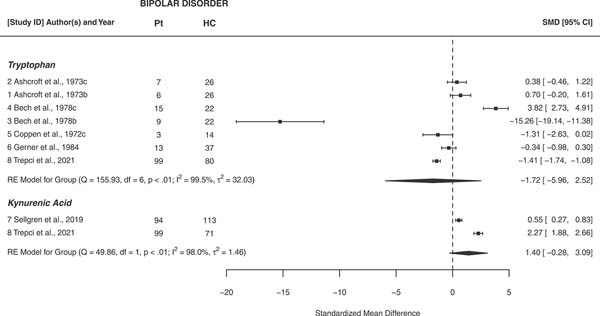
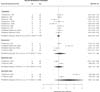
Six studies with eight comparisons were identified for BD (Table 1).26,32-36 The mean sample size for BD (total n=246) and HC (total n=340) per study was 30.8±40.8 and 42.5±35.1, and the mean age was 38.9±17.9 and 35.0±21.6 years, respectively. TRP levels did not differ significantly between BD and HC (SMD = -1.72, CI -5.96 to 2.52, p = 0.4265, I2 = 100%, k = 7, n=379) (Figure 4). Coinciding with this finding, the funnel plot showed scattered results from different studies, except for one outlier study (Bech et al.,33 study 3) (Figure S2, available as online-only supplementary material). Although individual studies showed an increase in KA in BD, the number of studies was too limited to draw a conclusion of increased levels of KA on meta-analysis (SMD = 1.40, CI -0.28 to 3.09, p = 0.1032, I2 = 98%, k = 2, n=377). This trend was also evident on the funnel plot, as both studies showed significantly increased levels (Figure S2). There was only one study reporting measures of KYN and QA levels, which were not included in the meta-analysis, and no study reported any measures for 3-HK (Table 1).
Systematic review
The most studied metabolite in the KYN pathway in BD was TRP (k = 7). Seven studies reported measures for only a single metabolite, and half were measured during a manic state (k = 4 out of eight). None of the studies reported race or ethnicity information, but they were mainly from Western Europe (England, Scotland, Denmark, and Sweden), except for one study from the United States (Table 1). The sex distribution was well balanced in BD (51.7% female), and none of the studies reported single-sex (i.e., males-only or females-only) results, although two studies did not report any sex information. Moreover, only three studies reported details on patients' medication history and type and adjusted results accordingly.26,35,36 Of these, two studies showed no significant effect of medication use,26,35 while one study showed significant increases in KYN (p = 0.02), KA (p = 0.001), and KYN:TRP ratio (p = 0.02).36
All studies, except for one,34 reported no differences in TRP levels in BD vs. HC. Only two studies reported measures for KA levels, and while both showed increased levels of KA,35,36 one showed increased levels only in those with a history of psychotic symptoms.35 Moreover, one study reported an association of suicidal ideation with increased levels of TRP (p = 0.03) and decreased KYN:TRP ratio (p = 0.04).36
Major depressive disorder
Meta-analysis
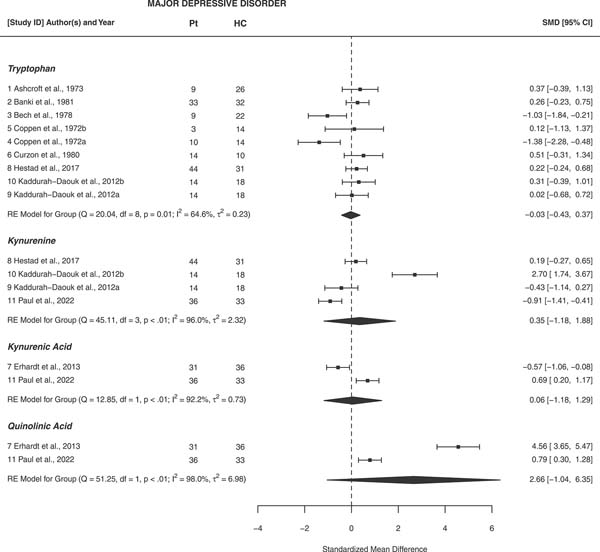
Nine studies with 11 comparisons were identified for MDD (Table 1).32-34,37-42 The mean sample size for MDD (total n=217) and HC (total n=254) per study was 19.7±13.6 and 23.1±9.0, and the mean age was 40.8±25.4 and 38.1±22.7 years, respectively. There were no significant differences in TRP (SMD = -0.03, CI -0.43 to 0.37, p = 0.8894, I2 = 65%, k = 9, n=335), KYN (SMD = -0.35, CI -1.18 to 1.88, p = 0.6524, I2 = 96%, k = 4, n=208), and KA levels (SMD = 0.06, CI -1.18 to 1.29, p = 0.9272, I2 = 92%, k = 2, n=136) in MDD compared to HC (Figure 5). The funnel plots for TRP and KYN showed nonsignificant, scattered results from different studies, while the Baujat plots showed no major study influencing the outcomes (Figure S3, available as online-only supplementary material). The funnel plot for KA showed a significant contradiction between the two studies (Figure S3). Since only two studies were available, no Baujat plots were constructed for KA and QA. The number of studies was too limited to conclude increased levels of QA (SMD = 2.66, CI -1.04-6.35, p = 0.1594, I2 = 98%, k = 2, n=136). This finding was also evident on the funnel plot, which showed a consistent trend toward increased levels in QA (Figure S3).
Systematic review
The most studied metabolite in the KYN pathway in MDD was TRP (k = 9). Six studies reported measures for only a single metabolite, and most were measured during a depressive state (k = 8 out of 11). None of the studies reported race or ethnicity information, but again they were mainly conducted in Western Europe (England, Scotland, Denmark, Sweden, and Norway), except for one study in Hungary and two in the United States (Table 1). The sex distribution was well balanced in MDD (52% female), and none of the studies reported single-sex results, although three studies did not report any sex information. Moreover, only two of the four studies reported details about medication history and type, of which three reported or discussed adjusted results.32,40,42 Of these, two studies showed no significant effect of medication use,32,40 while one study showed significantly decreased levels of 3-HK in untreated or medication-free MDD patients (p = 0.037).42
One study suggested that there may be decreased levels of TRP in currently depressed individuals vs. those in remission.34 The same study reported that the plasma levels of TRP did not correlate with CSF levels. Another study showed increased levels of KYN in patients in remission vs. relatively decreased levels of KYN in those with a current episode of depression.41 The same authors also showed a significant shift toward the KYN pathway away from the serotonergic pathway in those with remission.41 Finally, in the two studies which reported on KA and QA levels,39,42 no differences in KA levels were found, but one of the studies showed increased levels of QA in those with a history of suicide attempt (p < 0.001).39
DISCUSSION
There is increasing evidence from preclinical studies on the potential utility of the KYN pathway as a therapeutic target.43,44 Clinical studies have since emerged to explore this pathway. A recent meta-analysis and systematic review of KYN metabolites in SZ, BD, and MDD showed the potential of peripheral biomarkers from the KYN pathway to guide treatment decisions.1 Due to the variations in metabolite levels between different studies, metabolite-specific recommendations (such as the use of plasma samples for KYN vs. serum samples for TRP) have been made to reduce heterogeneity in findings.1 Moreover, Marx et al.,1 in contrast to our findings, has proposed that no change in KA levels occurs in SZ while suggesting a decrease in KA levels in BD and MDD, without controlling for mood states (current episodes vs. currently in remission).1 A recent systematic review did not find association between KA and manic and between KA and depressive episodes severity45 in CSF, although it reported a negative correlation between KA and severity of depressive episodes in the periphery. However, coinciding with our findings, Marx et al.1 also suggested a potential shift toward the KYN pathway, in TRP catabolism, away from the serotonergic pathway.1 Other studies have also reported conflicting findings between peripheral (blood and serum) and CSF samples, challenging the utility of peripheral biomarkers as representative in mental health.46,47 We believe that although the significant findings from peripheral biomarkers can be useful as a detection tool, CSF biomarkers may be more representative of pathophysiology in the brain. Hence, due to heterogeneity in sample selection, measurement, and analyses, as well as the expected dynamic physiological differences in the studied disorders,2 we focused this meta-analysis and systematic review on CSF samples.
Previous systematic reviews and meta-analyses reported increased levels of KA in SZ,15,17,18 but not all reported increased KA in BD.16 A previous systematic review reported increased levels of KA in the CSF but not in plasma45 in individuals with a history of psychotic episodes. In our findings, one study reported that only patients with psychotic symptoms showed increased levels of KA in BD,35 which would be consistent with increased levels of KA in SZ,13,25,27,29-31 while another study found a general increase in KA levels in BD.36 This discrepancy may suggest that, beyond symptomatology, a dynamic consequential activation by or causal activation of the KA pathway, by the KYN aminotransferase (KAT) enzyme, may be part of the underlying pathophysiology. Coinciding with this, antidepressants and suicidality were also associated with increased KA in BD,36 but - intriguingly - not in MDD. In contrast, suicidality selectively increased QA levels in MDD.39 This may indicate that the pathology in MDD is less likely a result of cellular toxicity, but an activation of the inhibitory pathways requiring activation of the excitatory QA pathway. On the other hand, the pathology in SZ and BD may be a result of elevated neurotoxicity due to underlying errors or inefficiencies in the cellular mechanisms requiring activation of the neuroprotective KA branch of the pathway. These findings are partially supported by previous studies, where a dynamic treatment approach was postulated that enlists neuroprotection for the initial state of therapy followed by upregulation of neuroplasticity and re-engagement of neural circuitry to recover connections lost from aggravated episodes, as the culprit of further deteriorations, in SZ and BD with psychosis.48-50
Recent studies have also uncovered the implications of prolonged oxidative stress involving the KYN pathway in exacerbating reductive stress.51-54 Currently depressed individuals in MDD showed increased levels of QA, which generates a reductive (or oxidized) form of nicotinamide adenine dinucleotide (NAD+), potentially leading to elevated reductive stress that may further exacerbate their disease state through disruptions in cellular mechanisms and activities, due in part to imbalances in mitochondrial homeostasis or redox equilibrium.55 On the other hand, inherent redox stress in SZ and BD may be the reason for the shift in the KYN pathway toward the generation of KA, a neuroprotective TRP catabolite. The KA pathway, however, has cognitive implications as an NMDA antagonist, which has been associated with reduced cognition.1,56-59 Exploration of these underlying mechanisms may help identify better treatment targets or disease-specific biomarkers.
In light of these findings, studies have started to explore different components of the KYN pathway as therapeutic options. While some studies provide details of different components and potential targets associated with them,2 others have delved into cell-specific properties and enzyme activities, paving the way for bioinformatics techniques such as single-cell analysis.60-63 The role of inflammatory pathways is also of great interest, once more emphasizing the role of microglia, to elucidate the dynamic role of inflammation in neuroplasticity and neurogenesis.64 There are many other opportunities to study this pathway in a multiplex and multi-omics approach, and in the context of data scarcity for psychiatric disorders, techniques can be established in other neurological diseases associated with the KYN pathway.
This systematic review and meta-analysis was limited by the number of eligible studies looking into the KYN pathway from CSF samples for the psychiatric disorders of interest (SZ, BD, and MDD). Since individuals with these conditions rarely need a lumbar puncture for clinical purposes, the difficulty and the risks associated with CSF sample acquisition may be among the reasons for the small number of studies published to date. Moreover, there were no demographic details in terms of race and ethnicity except for sex (which was also missing from some papers published before 2000). As such, due to the limited number of studies and details provided on patients, we could not perform covariate analyses (required k = 10).24 This would have been a valuable point, since heterogeneity was high in most of the analyses. Eggers' t-test also could not be conducted, and we could not reliably study variations in reported findings between the studies in our meta-analysis using additional statistical approaches (required k = 10).24 In addition, the magnitude of the effect sizes, the imprecision of the 95% CI, and the overall significance of the results are likely affected by the fact that most meta-analyses were underpowered. Another point is that further metabolites of the KYN pathway, such as picolinic acid, were not included, but might have a role in the pathophysiology of the disorders considered herein.61 Finally, we could not confirm if the reported findings are in any way incomplete such that certain metabolites may not have been reported, either due to unexpected results or to protocol deviations, potentially compromising internal validity (instrumentation, history, or maturation), external validity (based on laboratory conditions), and/or construct validity (due to inexplicit reporting, among others).46
KA, which has neuroprotective effects, was increased in SZ. The results of the meta-analysis did not show any other significant differences in SZ, BD, or MDD compared to HC. Despite an increase in KA levels observed in BD, there were not enough studies to show significance. Findings from the systematic review suggest that being in a current depressive episode vs. in remission may influence the KYN pathway in MDD. QA, which has neurotoxic effects, may be increased in MDD. Past or current psychotic symptoms in BD may also have an impact on, or be influenced by, the KYN pathway. Finally, there may be disparities in the KYN pathway based on population characteristics. More studies are needed to draw firmer conclusions. Future research should validate and explore the utility of these biomarkers as a diagnostic tool or treatment target.
ACKNOWLEDGEMENTS
ZZ was partially supported by the National Institutes of Health (grant R01LM012806).
We thank the Cancer Genomics Core and Data Science and Informatics Core, funded by the Cancer Prevention and Research Institute of Texas (CPRIT RP180734 and RP170668), for technical support.
 PDF
 Print
 Send this article by email
 How to cite this article
 Submit a comment
 Mendeley
 Pocket
 Share on Facebook
 Share on Twitter



