



ABSTRACT:
OBJECTIVE: Multimorbidity, or the occurrence of two or more chronic conditions, is a global challenge,
with implications for mortality, morbidity, disability, and life quality. Psychiatric
disorders are common among the chronic diseases that affect patients with multimorbidity.
It is still not well understood whether psychiatric symptoms, especially depressive
symptoms, moderate the effect of multimorbidity on cognition.
METHODS: We used a large (n=2,681) dataset to assess whether depressive symptomatology moderates
the effect of multimorbidity on cognition using structural equation modelling.
RESULTS: It was found that the more depressive symptoms and chronic conditions, the worse the
cognitive performance, and the higher the educational level, the better the cognitive
performance. We found a significant but weak (0.009; p = 0.04) moderating effect.
CONCLUSION: We have provided the first estimate of the moderating effect of depression on the
relation between multimorbidity and cognition, which was small. Although this moderation
has been implied by many previous studies, it was never previously estimated.
Keywords: Multimorbidity; epidemiology; aging; structural equation modeling.
FIGURES
| Received: March 22 2022; Accepted: May 23 2022 |
INTRODUCTION
With the increasing aging of the world's population,1 chronic diseases, such as heart disease, diabetes, cancer, and chronic respiratory diseases, have become the main health care challenge.2 The co-occurrence of two or more chronic diseases is defined as multimorbidity.3 The rising prevalence of multimorbidity, currently estimated at 35 to 80% of the population,4 is increasing the complexity and costs of treatment.4 Multimorbidity is associated with worse health outcomes, such as increased medication use,4 a decline in physical function,5 higher suicide risk,6 worse quality of life, and higher mortality.7 These findings have been found in both high- and low-income countries.7
There is evidence that having a mental disorder raises the chance of having one or more chronic physical disorders and vice-versa.8 Depression,9 psychosis,10 and substance use11 are related to a higher risk of multimorbidity. Mental disorders are themselves chronic conditions that have a large impact on quality of life6 and cognition,5 especially in younger individuals.4 Furthermore, there is evidence that treatment adherence is lower and mortality and disability are higher among people who have chronic diseases and mental disorders (including depression) than among those who have multimorbidity without mental disorders.12 In 2018, Wei et al.13 measured cognitive function using a modified version of the Telephone Interview for Cognitive Status and concluded that cognitive performance was associated with multimorbidity. Vassilaki et al.14 reported a significant association between multimorbidity and mild cognitive impairment (hazard ratio [HR]: 1.38; 95%CI 1.05-1.82). People with mental-physical multimorbidity have worse quality of life, greater socioeconomic hardship, and worse outcomes than those with only mental or physical morbidity.8 These studies often imply that mental disorders interact with multimorbidity in some outcomes, including cognition.5
Depression is the most prevalent mental disorder, affecting at least 350 million people worldwide.15 It is responsible for more disability-adjusted life years lost than any other condition.16 It is underdiagnosed and undertreated, with half the world's population living in countries that have<2 psychiatrists per 100,000 habitants.16 Maladaptive health risk behaviors and the physiological imbalance inherent to depression often lead sufferers to develop chronic disorders at an earlier age.17 A recent meta-analysis by Read et al.9 showed that patients with multimorbidity had twice the risk of depressive disorder of those without it. Depressive disorders have been found across age groups, settings, and cultures, regardless of whether they were measured according to formal diagnosis or questionnaire cut-off scores.9 Studies have found patients with major depression to be impaired in executive function, attention, memory, and psychomotor speed in both acute and remitted states.18
Although the relation between depression, multimorbidity, and cognition is well documented, to our knowledge no estimate of the moderating effect of depressive symptomatology and multimorbidity on cognitive performance has been reported. We set out to provide the first estimate of this effect, hypothesizing that depression would have a moderating effect on cognition. We used a large dataset of British subjects (2,681), excluding those with dementia and severe neurological diseases.
METHODS
Data source
The data set included 2,681 baseline observations from the Cambridge Centre for Aging and Neuroscience (Cam-CAN) dataset (available at https://www.cam-can.org/). Cam-CAN, a large-scale collaborative project begun in 2010, collected neuroimaging, demographic, and cognitive information on participants to evaluate cognitive abilities in aging.19 The exclusion criteria for Cam-CAN were a Mini-Mental State Examination (MMSE) score = 24, missing MMSE scores, severe memory defect, consent difficulties for the next stage, hearing problems, insufficient English language, vision difficulties, dementia diagnosis/Alzheimer's disease, Parkinson's disease, motor neuron disease, multiple sclerosis, cancer, stroke, encephalitis, meningitis, epilepsy, head injury with serious results, recently diagnosed or uncontrolled high blood pressure, pregnancy or trying to become pregnant, current serious psychiatric conditions, restricted mobility that would prevent further participation, inability to walk 10 meters, past or current treatment for drug abuse, current drug usage, and refusal to answer substance abuse questions. We did not have access to information about participant treatment or medication use. Since this analysis was performed using full information maximum likelihood, all observations were included in the analysis.
Data analysis
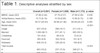
Descriptive statistics for all variables are shown in Table 1. Continuous variables were analyzed with the mean of the descriptive measures, median, minimum, maximum, and SD, while categorical variables were described with the total number of observations and their corresponding percentages stratified by sex. All analyses were performed using R version 4.1.1 (https://cran.r-project.org/). To test the hypothesis that depressive symptomatology moderated the effect of multimorbidity on cognitive performance, we performed a structural equation model. The umx package (version 4.9.5)20 was used for the structural equation model analysis, which estimated standardized coefficients and confidence intervals using full information maximum likelihood with the CSOLNP optimizer. We checked identification using an OpenMX (version 2.19.6) utility (mxCheckIdentification).
| Overall (n=2,681) | Female (n=1,508) | Male (n=1,172) | p-value | |
|---|---|---|---|---|
| MMSE, mean (SD) | 27.88 (2.44) | 27.79 (2.57) | 27.99 (2.26) | 0.036 |
| Verbal fluency, mean (SD) | 15.73 (6.10) | 15.59 (6.06) | 15.90 (6.15) | 0.196 |
| Age, mean (SD) | 60.57 (20.93) | 60.96 (21.46) | 60.09 (20.23) | 0.285 |
| Marital status | <0.001 | |||
| Single | 507 (19.0) | 296 (19.7) | 211 (18.1) | |
| Married | 1,300 (48.7) | 617 (41.1) | 683 (58.5) | |
| Cohabiting | 161 (6.0) | 89 (5.9) | 72 (6.2) | |
| Divorced | 265 (9.9) | 164 (10.9) | 101 (8.7) | |
| Widowed | 436 (16.3) | 336 (22.4) | 100 (8.6) | |
| Total income | <0.001 | |||
| A | 483 (18.2) | 237 (15.9) | 246 (21.1) | |
| B | 596 (22.5) | 349 (23.5) | 247 (21.2) | |
| C | 513 (19.4) | 253 (17.0) | 260 (22.3) | |
| D | 657 (24.8) | 389 (26.2) | 268 (23.0) | |
| E | 247 (9.3) | 183 (12.3) | 64 (5.5) | |
| F | 155 (5.8) | 75 (5.0) | 80 (6.9) | |
| Age last education, mean (SD) | 19.57 (4.39) | 19.24 (4.17) | 20.01 (4.62) | <0.001 |
| HADS-A, mean (SD) | 5.16 (3.40) | 5.51 (3.48) | 4.71 (3.23) | <0.001 |
| HADS-D, mean (SD) | 3.32 (2.91) | 3.32 (2.91) | 3.32 (2.91) | 0.955 |
| NCC, mean (SD) | 2.36 (2.00) | 2.43 (2.09) | 2.25 (1.88) | 0.028 |
| Asthma | 433 (16.9) | 252 (17.5) | 181 (16.2) | 0.417 |
| Illicit drug use | 165 (6.3) | 65 (4.4) | 100 (8.7) | <0.001 |
| Current smoker | 264 (10.1) | 123 (8.4) | 141 (12.3) | 0.001 |
| Daily drinkers | 554 (21.2) | 243 (16.5) | 311 (27.2) | <0.001 |
| Migraine | 351 (13.7) | 258 (17.9) | 93 (8.3) | <0.001 |
| Parkinson | 9 (0.4) | 5 (0.3) | 4 (0.4) | 1.000 |
| Epilepsy | 57 (2.2) | 31 (2.1) | 26 (2.3) | 0.867 |
| Insomnia requiring treatment | 154 (6.0) | 105 (7.3) | 49 (4.4) | 0.003 |
| Multiple sclerosis | 4 (0.2) | 3 (0.2) | 1 (0.1) | 0.802 |
| Chronic bronchitis | 38 (1.5) | 23 (1.6) | 15 (1.3) | 0.713 |
| Tuberculosis | 50 (1.9) | 29 (2.0) | 21 (1.9) | 0.910 |
| High blood cholesterol | 482 (18.9) | 247 (17.3) | 235 (21.0) | 0.019 |
| High blood pressure | 759 (29.6) | 417 (28.9) | 342 (30.4) | 0.448 |
| Angina | 131 (5.1) | 54 (3.8) | 77 (6.9) | 0.001 |
| Arrhythmia | 297 (11.6) | 158 (11.0) | 139 (12.4) | 0.298 |
| Diabetes | 148 (5.8) | 63 (4.4) | 85 (7.6) | 0.001 |
| Thrombosis | 71 (2.8) | 42 (2.9) | 29 (2.6) | 0.697 |
| Osteoporosis | 147 (5.8) | 123 (8.6) | 24 (2.1) | <0.001 |
| Thyroid | 208 (8.1) | 170 (11.8) | 38 (3.4) | <0.001 |
| Ulcer | 62 (2.4) | 29 (2.0) | 33 (2.9) | 0.158 |
| GI polyps | 97 (3.8) | 44 (3.1) | 53 (4.7) | 0.037 |
| Gallstones | 157 (6.1) | 105 (7.3) | 52 (4.6) | 0.007 |
| Varicose vein | 294 (11.4) | 199 (13.8) | 95 (8.4) | <0.001 |
| Arthritis | 567 (22.2) | 376 (26.2) | 191 (17.1) | <0.001 |
| Cancer | 279 (10.8) | 156 (10.8) | 123 (10.9) | 0.942 |
| Depression requiring treatment | 410 (16.0) | 274 (18.9) | 136 (12.1) | <0.001 |
| Other psychiatric illness | 65 (2.5) | 41 (2.8) | 24 (2.1) | 0.325 |
Data presented as n (%), unless otherwise specified. There was no sex information for one record.
MMSE = Mini-Mental State Examination; NCC = number of chronic conditions.
Group comparison was performed using chi-square tests for the categorical variables.
Model specification and variables included in the model
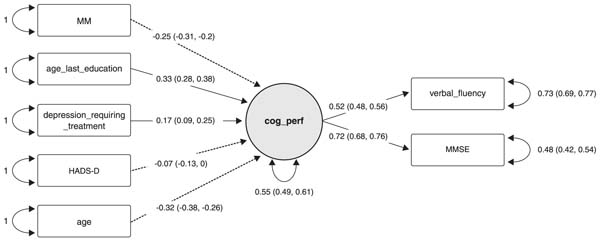
A latent reflexive variable representing cognitive performance was specified, loading from the MMSE and verbal fluency scores of each participant. A variable representing multimorbidity (the number of chronic conditions each patient presented, starting with the second condition) was regressed on the latent variable, together with Hospital Anxiety and Depression Scale-Depression Subscale scores (cutoff = 8 of 21 points), age, education level, and history of previous depression requiring treatment. Because age and education are known to interfere with MMSE and verbal fluency results, they were added as covariates in the model. The formal specification can be seen in Figure 1. The multimorbidity variable was defined as numerical, starting with two chronic conditions (those with 1 chronic condition were counted as 0). The conditions were history of illicit drug use, current smoking, daily drinking, and diagnoses of asthma, migraine, Parkinson's disease, epilepsy, insomnia that prompted treatment, multiple sclerosis, chronic bronchitis, tuberculosis, high blood cholesterol, high blood pressure, angina, arrhythmia, diabetes, deep vein thrombosis, osteoporosis, thyroid disease, peptic ulcer, gastrointestinal polyps, gallstones, varicose veins, arthritis, cancer, depression, and other psychiatric diagnoses. Finally, algebra for the moderation between the multimorbidity variable and Hospital Anxiety and Depression Scale-Depression Subscale scores was included in the model (Table S1 and Supplementary Material S1, available online only).

The MMSE is a simple cognitive test used in clinical settings that correlates with a standard cognition test (Wechsler Adult Intelligence Scale).21 This variable was used together with categorical verbal fluency (the number of words starting with the letter s recollected in 1 minute) in the latent variable cognitive performance.
RESULTS
A total of 2,681 individuals (1,508 women) participated in the study (Table 1). There were significant differences in anxiety symptom and MMSE scores between the sexes. The mean anxiety symptom scores were 5.51 for women (SD, 3.48, p<0.001) and 4.71 for men (SD, 3.23, p<0.001). The mean MMSE scores were 27.79 for women (SD, 2.57, p<0.05) and 27.99 for men (SD 2.26, p<0.05). There were also significant differences between the sexes regarding marital status (since most participants were married [women: 41.1% and men: 58.5%, p<0.001]), income (lower income levels, e.g., income level B was 23.5% among women and 21.2% among men, p<0.001); illicit drug use (women 4.4% and men 8.7%, p<0.001), current smoking (women 8.4% and men 12.3%, p<0.001), daily drinking (women 16.5% and men 27.2%, p<0.001), migraine (women 17.9% and men 8.3%, p<0.001), insomnia requiring treatment (women 7.3% and men 4.4%, p<0.05), high blood cholesterol (women 17.3% and men 21.0%, p<0.05), angina (women 3.8% and men 6.9%, p<0.05), diabetes (women 4.4% and men 7.6%, p<0.001), osteoporosis (women 8.6% and men 2.1%, p<0.001), thyroid (women 11.8% and men 3.4%, p<0.001), GI polyps (women 3.1% and men 4.7%, p<0.05), gallstones (women 7.3% and men 4.6%, p<0.05), varicose veins (women 13.8% and men 8.4%, p<0.001), arthritis (women 26.2% and men 17.1%, p<0.001), depression requiring treatment (women 18.9%, men 12.1%, p<0.001), mean age during the last year of education (women 19.24 [SD, 4.17] and men 20.01 [SD, 4.62], p<0.001), and the mean number of chronic conditions (women 2.43 [SD, 2.09] and mean 2.25 [SD, 1.88], p<0.05) (Table 1).
The structural equation model presented a good fit (?2[2] = 20.12, p<0.001; comparative fit index = 0.993; Tucker-Lewis index = 0.926; root mean squared error of approximation = 0.058) with a locally identified model. Results were standardized. It was found that for each unit increase in the multimorbidity variable there was a variance reduction of 0.25 SD for the latent cognitive performance variable. In addition, for each unit increase in depressive symptoms there was a 0.07 SD decrease in cognitive performance. Therefore, the more depressive symptoms and chronic conditions, the worse cognitive performance.23 The variables included as covariates were significantly correlated with cognitive performance. For each unit change in age, there was a 0.32 SD reduction in cognitive performance. Likewise, for each unit change in mean age during the last year of education, there was a 0.33 SD increase in cognitive performance. In other words, the higher the educational level, the better the cognitive performance (Figure 1). The moderation term was estimated at 0.009 (p = 0.04). Thus, there was a very small moderation effect between multimorbidity and depressive symptomatology on cognitive performance.
DISCUSSION
A large data set of 2,681 British individuals with mean age of 60.57 was used to investigate whether depressive symptomatology at baseline moderated the effect of multimorbidity on cognitive performance. We used all of the information in the set, controlling for age, education, and previous history of depression. Women had lower MMSE scores than men and more depression requiring treatment. It was found that depressive symptomatology indeed moderated the effects of multimorbidity on cognition.
There is evidence that the relationships between mental disorders and other chronic diseases are complex and bidirectional. Having mental disorders worsens several chronic disease risk factors, including worse lifestyle choices, poor health literacy, poor access to health care, and symptoms such as lack of motivation and energy.12 Additionally, a number of medications given to patients with mental disorders (notably antipsychotics), can enhance the risk of dyslipidemia, obesity and cardiovascular diseases.22 Furthermore, chronic diseases and mental disorders share similar risk factors, such as susceptibility to cytokine-mediated inflammatory responses, common genetic factors, and social-economic vulnerability (poverty and violence).12
Depression is associated with worse cognitive performance.23 According to the DSM-5, impaired concentration and indecisiveness are core symptoms of acute depression. In 2014, Lam et al.24 found that psychosocial functioning in depressive patients is moderated by cognitive performance. Deficits in processing speed, attention, executive function, learning, and memory have been demonstrated among depressed individuals in earlier studies,25,26 with some evidence that cognitive deficits persist even during remission of depressive symptoms.26 On the other hand, multimorbidity is associated with increased risk of mild cognitive impairment and dementia.14 In a more recent study, Vassilaki et al.27 found a stronger association between multimorbidity and neurodegeneration (volume change), than with amyloid deposition. These types of neurodegeneration are more related to cognition symptoms.27 There is evidence that the rate of chronic disease accumulation in multimorbid patients over time is associated with a faster rate of decline in verbal fluency, independent of baseline morbidity.28 We examined the possible moderating effect of depressive symptoms on the relation between multimorbidity and cognition, and we confirm that there is a small, albeit significant, moderation in this relationship.
This study has limitations that should be acknowledged. The analysis is cross-sectional and thus not causal. The number of observations is relatively small. We did not include information from the whole set of available neuropsychological tests. There was no information on biomarkers for Alzheimer's disease or vascular diseases in the data set. We did not include neuroimaging findings such as magnetic resonance imaging. Likewise, we did not have access to information about participant treatment or medication use. The multimorbidity variable did not allow examination of patterns of chronic conditions, instead capturing variance in the number of conditions for each individual. Since the chronic conditions were limited to those the original team included in the baseline interview, this cannot be considered a thorough investigation of chronic diseases.
Although a number of previous studies have implied that psychiatric symptomatology has a moderating effect on the relationship between multimorbidity and cognition, this has not been tested directly. Here, we present an estimation of such moderation using depressive symptoms, and we show that the main effects are larger than the moderation. The relation of depressive symptoms and other chronic diseases with cognition over time is still not known. It is plausible that this effect may differ from the cross-sectional effect of depression on cognition and multimorbidity on cognition. Future studies in this field should try to incorporate panel data in the analysis to determine whether the moderating effect changes over time.
ACKNOWLEDGEMENTS
Funding for the Cambridge Centre for Aging and Neuroscience (Cam-CAN) was provided by the UK Biotechnology and Biological Sciences Research Council (grant no. BB/H008217/1), together with support from the UK Medical Research Council and the University of Cambridge. JAPA, EFMX, ESR, DBM, and LFSCA were funded by the U.S. National Institute of Mental Health (grant no. R01MH128911). ESR, DBM, MLB, and LFSCA were funded by the UK Medical Research Council (grant no. MR/T03355X/1) during the study.
Disclosure
The authors report no conflicts of interest.
 PDF
 Print
 Send this article by email
 How to cite this article
 Submit a comment
 Mendeley
 Pocket
 Share on Facebook
 Share on Twitter



