



FIGURES
| Received: February 14 2021; Accepted: April 5 2021 |
Pregnancy is a time of important physiological, aesthetic and psychosocial changes.1 The fear of childbirth is a common condition, involving 5 to 20% of women.2 Clinically, the pregnancy and puerperal period can be affected, increasing the preference for cesarean section on request. Brazil ranks as the second country in the world with the highest rate of cesarean sections (57%),3 and the fear of childbirth is probably associated with many of these procedures. Using the recent published Tokophobia Assessment Questionnaire, objective identification of pregnant women with phobic fear of childbirth is possible in the Brazilian context.4 In addition, identifying factors which lead to this fear is important to guide and educate pregnant women and their families. However, in Brazil, there is no instrument that objectively evaluates this parameter, which makes it impossible to carry out assertive actions aimed at the Brazilian population. Thus, the Fear of Childbirth Motivators Questionnaire (Questionário de Motivadores do Medo do Parto, QMMP) was developed and validated specifically for the Brazilian sociocultural and clinical-obstetric context.
A cross-sectional study was conducted to estimate the reliability and validity of the proposed instrument. Pregnant women who attended prenatal consultations at a medical school clinic were included, and those with psychiatric conditions that made it difficult to understand the instrument or with absolute indications for cesarean section were excluded. A total sample of 266 patients was obtained. The guidelines for development and validation of the QMMP were supported by international recommendations.5 The psychometric properties were assessed using exploratory factor analysis (EFA).
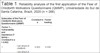
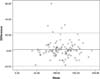
Validity was assessed by applying an external instrument (the Penn State Worry Questionnaire) and the QMMP (Table 1) to 266 pregnant women. The QMMP was subsequently re-administered to 107 participants. The reliability of the instrument was given by the high Pearson correlation coefficient (0.940) and the intraclass correlation coefficient (0.969), both with p < 0.001. The central dispersion verified in the differences and averages of almost all responses during the first and the second application of QMMP, which was observed in the Bland & Altman graph, demonstrates its stability (Figure 1). This observation highlights the instrument as a good parameter to identify motivators of the fear of childbirth, reducing the possibility of random and dispersed responses. A general Cronbach's alpha of 0.937 (Table 1) was obtained as a measure of the performance of the items, which corresponds to a high and satisfactory alpha, as well as favoring the overall reliability of the instrument and the retention of the 38 initial items. EFA identified items grouped into five components: fear of vulnerability and impotence, fear of physical and psychological consequences, fear of complications with the baby, fear of interference in the family relationship, and fear of obstetric procedures. Validation of these components makes it possible to ensure the provision of more assertive antenatal care with the QMMP.
| Subscales of the Fear of Childbirth Motivators Questionnaire (QMMP) | Cronbach's a | Factor loading | |
|---|---|---|---|
| Factor 1 - Vulnerability and impotence (7 items) - Cronbach's a = 0.903 | |||
| 1. | I am afraid of childbirth. | 0.422 | 0.556 |
| 2. | I am afraid of the pain of childbirth. | 0.405 | 0.508 |
| 12. | I am afraid of getting an infection due to poor maternity hygiene. | 0.558 | 0.304 |
| 13. | I am afraid of not being treated with respect at the time of delivery. | 0.614 | 0.513 |
| 14. | I am afraid of being alone at the time of delivery. | 0.496 | 0.397 |
| 15. | I am afraid of being exposed (naked) at the time of delivery. | 0.584 | 0.605 |
| 16. | I am afraid of not having privacy during childbirth. | 0.633 | 0.676 |
| 17. | I am afraid of losing emotional control during childbirth. | 0.639 | 0.672 |
| 18. | I am afraid of being traumatized by childbirth. | 0.629 | 0.638 |
| 19. | I am afraid of not having the necessary information for childbirth. | 0.616 | 0.617 |
| 23. | I am afraid of not acting correctly during childbirth. | 0.599 | 0.560 |
| 28. | I am afraid of not being medicated for pain if I need it during delivery. | 0.562 | 0.480 |
| 29. | I am afraid of vaginal touch exams during childbirth. | 0.496 | 0.616 |
| 30. | I am afraid that the doctor who delivers my child will not be the doctor of my choosing. | 0.588 | 0.609 |
| 31. | I am afraid that the doctor of my choosing will not be available to deliver my baby. | 0.574 | 0.543 |
| 32. | I am afraid I won't be able to schedule the date of birth. | 0.474 | 0.575 |
| Factor 2 - Physical and emotional sequelae (7 items) - Cronbach's a = 0.855 | |||
| 3. | I am afraid of pain after giving birth. | 0.513 | 0.477 |
| 5. | I am afraid of dying in childbirth. | 0.382 | 0.466 |
| 6. | I am afraid my body will not be as it was after delivery. | 0.493 | 0.642 |
| 7. | I am afraid of having physical consequences after delivery. | 0.604 | 0.718 |
| 8. | I am afraid of the consequences on my genitalia (vulva and vagina). | 0.600 | 0.776 |
| 9. | I am afraid that childbirth will interfere with my sex life. | 0.513 | 0.785 |
| 10. | I am afraid of developing urinary or fecal incontinence after delivery. | 0.626 | 0.634 |
| 11. | I am afraid of the scar that I will have if a C-section is performed. | 0.441 | 0.584 |
| Factor 3 - Complications for the baby (4 items) - Cronbach's a = 0.797 | |||
| 4. | I am afraid that the pain after delivery will interfere with childcare. | 0.556 | 0.421 |
| 33. | I am afraid I won't be able to get to the hospital on time. | 0.526 | 0.350 |
| 34. | I am afraid my baby will die in childbirth. | 0.413 | 0.781 |
| 35. | I am afraid that my baby will have physical problems due to the delivery. | 0.543 | 0.761 |
| 36. | I am afraid of not being able to breastfeed after giving birth. | 0.513 | 0.624 |
| 37. | I am afraid of not being able to take care of my baby after delivery. | 0.542 | 0.614 |
| Factor 4 - Relationship interference (4 items) - Cronbach's a = 0.764 | |||
| 20. | I am afraid of not receiving support from my partner during childbirth. | 0.395 | 0.756 |
| 21. | I am afraid of not receiving support from my family at the time of delivery. | 0.428 | 0.793 |
| 22. | I am afraid that childbirth will interfere with my relationship. | 0.398 | 0.604 |
| 38. | I am afraid of having to spend more than I would like on childbirth. | 0.477 | 0.476 |
| Factor 5 - Obstetric procedures (4 items) - Cronbach's a = 0.675 | |||
| 24. | I am afraid of needing a C-section. | 0.298 | 0.762 |
| 25. | I am afraid of having to use forceps during delivery. | 0.396 | 0.528 |
| 26. | I am afraid that I will not be able to participate in decisions during delivery. | 0.514 | 0.396 |
| 27. | I am afraid of having to undergo anesthesia. | 0.409 | 0.630 |
Therefore, the 38-item QMMP is a reliable and valid instrument for the Brazilian population, and allows consolidation of the identification of factors possibly catalyzing the development of fear of childbirth.
ACKNOWLEDGEMENTS
This study was partially funded by Coordenação de Aperfeiçoamento de Pessoal de Nível Superior (CAPES; financing code 001).
Disclosure
The authors report no conflicts of interest.
 PDF
 Print
 Send this article by email
 How to cite this article
 Submit a comment
 Mendeley
 Pocket
 Share on Facebook
 Share on Twitter